
Blog
The Second World War resulted in the deaths of around 85 million people. Additionally, tens of millions more people were displaced. However, amid all the carnage, people demonstrated remarkable courage, fortitude, compassion, mercy and sacrifice. We want to honour and celebrate all of those people. In the War Years Blog, we examine the extraordinary experiences of individual service personnel. We also review military history books, events, and museums. We also look at the history of unique World War II artefacts, medals, and anything else of interest.

War Stories and Myths: Revisiting the Falklands, the Denison Smock, and Arnhem’s Legacy
In this blog article, I bring together reviews of books and documentaries that revisit the Falklands War, unravel the myths of the Denison smock, and challenge long-held beliefs about Arnhem and Operation Market Garden. Join me as I explore how personal accounts and new evidence reshape our understanding of these pivotal moments in military history.
In recent months, I’ve been reading a range of books and viewing a series of documentaries exploring the realities of twentieth-century conflicts. From the windswept battlefields of the Falklands to the airborne drops of Operation Market Garden, these works both in print and on YouTube challenge accepted narratives, expose enduring myths, and offer fresh perspectives on events that continue to shape our understanding of war. In this article, I combine reflections on various military history books and videos to create a narrative about how easily historical facts can become obscured over time.
The Falklands War: Personal Accounts and Broader Perspectives
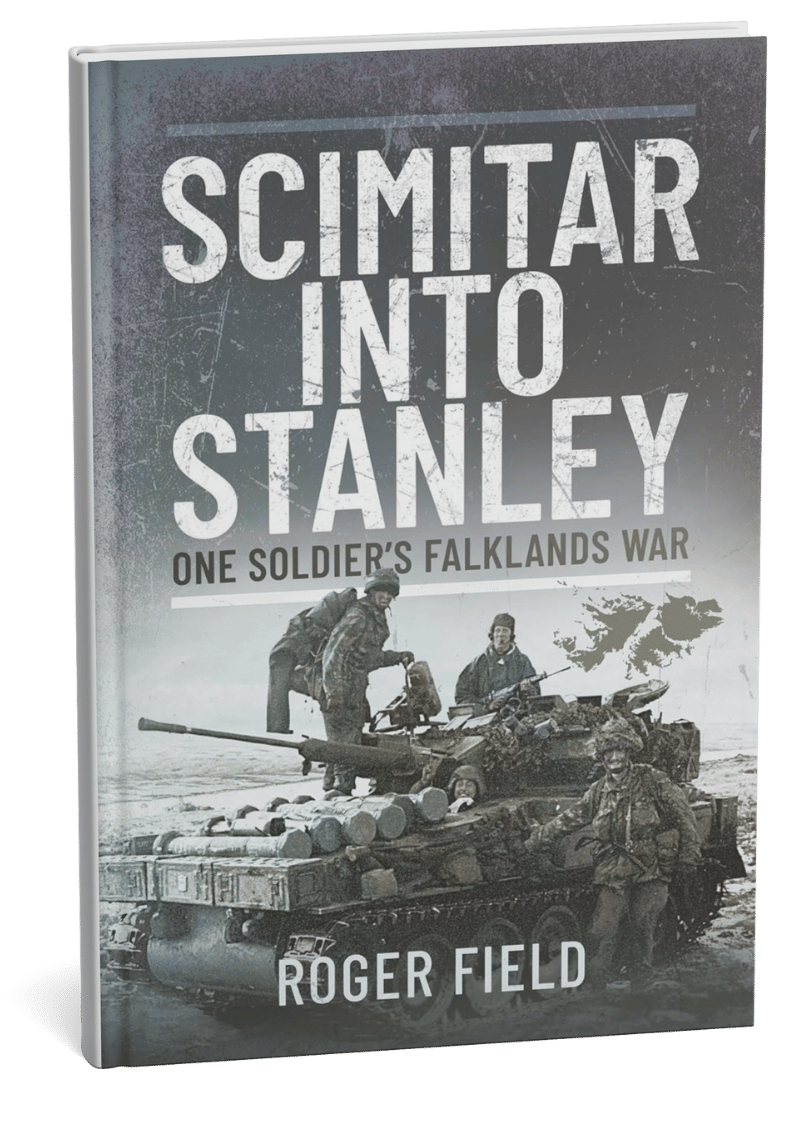
Roger Field’s Scimitar into Stanley (2022) offers a first-hand account of his experiences with the Blues and Royals during the 1982 Falklands War. Initially a staff officer, Field found himself commanding a Scimitar armoured car in battle, famously leading the charge into Port Stanley with journalist Max Hastings clinging to the back of his vehicle. The book is laced with humour, sometimes laugh-out-loud funny, though in today’s climate of political correctness, some may find parts of the text a little too candid. Field doesn’t shy away from naming names or calling out poor leadership, particularly criticising Brigadier Sir Tony Wilson. Yet, he’s equally honest about his own post-war struggles. The result is an open and honest personal account of modern conflict.
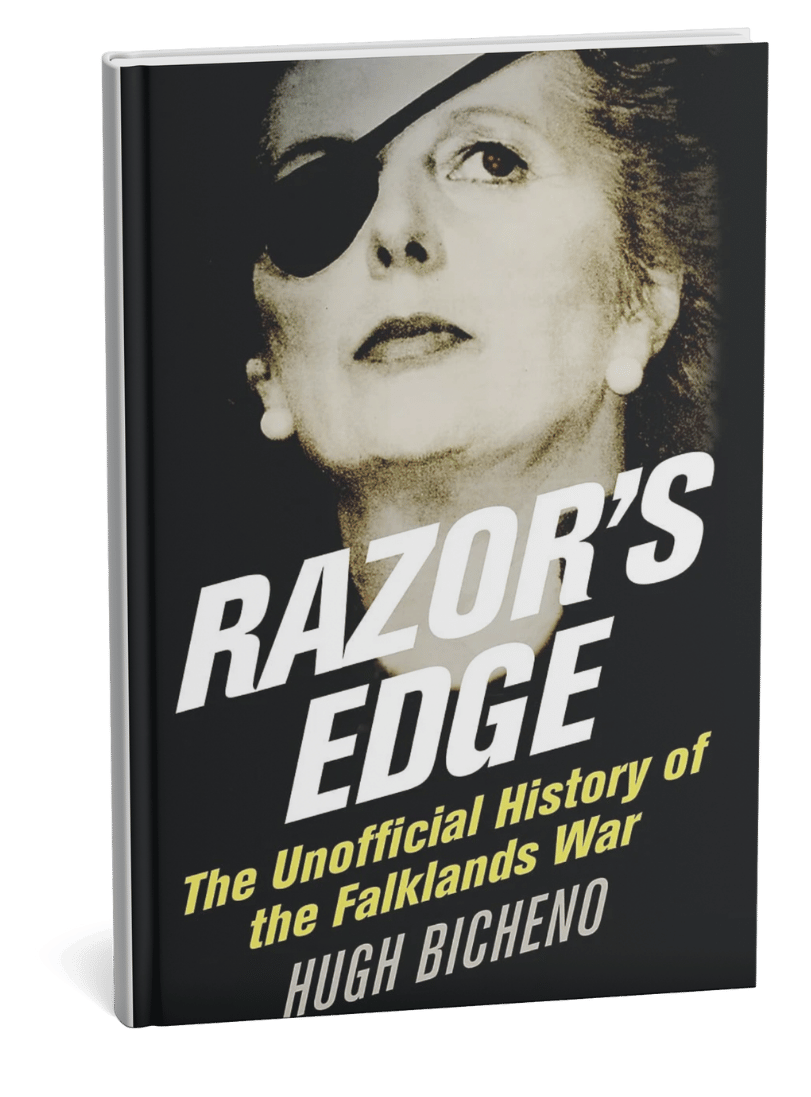
For those seeking a broader view, Hugh Bicheno’s Razor’s Edge (2007) steps back to examine the origins of the conflict. Bicheno, a former British spy in Argentina, foresaw the coming war, but his warnings fell on deaf ears in Whitehall. He spares no one in his critique, lambasting the Foreign Office, Civil Service, and politicians. The book is notable for its inclusion of the Argentine perspective, often overlooked elsewhere, and for its detailed descriptions of the campaign’s battles from both Argentine and Allied viewpoints. Bicheno highlights the role of chance in victory and defeat, and his unsparing criticism is directed at all parties in what he sees as an avoidable conflict. Interestingly, his book is used as a text at Argentina’s war college, a testament, perhaps, to its thoroughness.
If you want the soldier’s view, read Field. For the bigger picture, turn to Bicheno. Both are well worth your time.
Justice Denied: The Welsh Guards and the Sir Galahad Cover-Up
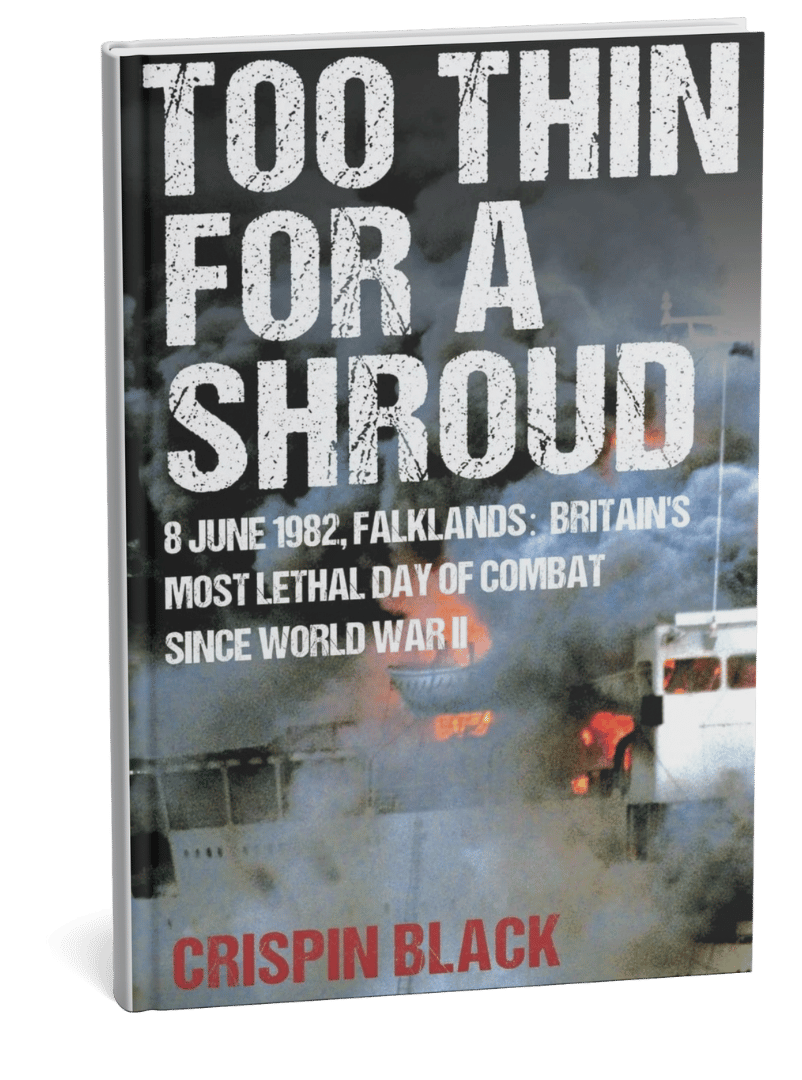
Another recent read, Too Thin for a Shroud by Lieutenant-Colonel Crispin Black (2023), delves into the bombing of the Royal Fleet Auxiliary’s Sir Galahad by the Argentine Air Force on 8 June 1982, the British Army’s deadliest day since 1945.
The Book's Claims
Black documents how 48 men died when Argentine A4 Skyhawks bombed Sir Galahad at Port Pleasant, Fitzroy. The ship was in the wrong location and lacked proper air defence. Packed with Welsh Guardsmen, Sir Galahad sat exposed in broad daylight for over six hours.
Using newly declassified Board of Inquiry documents from The National Archives, Black demonstrates that no direct orders to disembark were given to Major (later Colonel) Guy Sayle and the Welsh Guards. For 40 years, he was wrongly blamed for failing to disembark the troops. The inquiry proves this false. Black argues that senior Royal Navy and Royal Marines commanders made cascading failures: wrong location, defective landing craft, no air defence, and poor communications. The inquiry’s findings were classified until 2065, 83 years after the event.
The declassified files state, “At no time was a direct order to disembark given to Major Sayle by a superior officer.” Colonel Guy Sayle’s daughter has spoken to the media about how her father was made a “scapegoat” for the disaster, and now the Ministry of Defence (MoD) has said it “in no way blames” the Welsh Guards for the losses that day. Colonel Sayle died in 2022. According to Emma Sayle, her father died “haunted and penniless”.
Critical Reception
Unsurprisingly, reviews of Black’s book split sharply along service lines. Welsh Guards veterans and families praised the book as vindication. Royal Navy and Royal Marines personnel frequently criticise it as biased. The conservative Daily Telegraph called it “a repository of damning facts.” The Spectator acknowledged it “shows the Welsh Guards in a new light”, but questioned broader claims. In the court of public opinion, Amazon reviews range from five-star praise for the book's formidable detective work to one-star criticism for an inaccurate rewriting of history.
Senior commanders mounted coordinated rebuttals. RUSI Journal published responses from Major General Julian Thompson, Rear Admiral Jeremy Larken, and other Falklands officers. They challenged Black's interpretations whilst acknowledging errors in the original inquiry. Rear Admiral Larken contacted Black's publisher before reading the book, claiming the Welsh Guards were “unprofessional.” The Mirror reported that Larken claimed the Welsh Guards were an unprofessional and poorly led unit responsible for “pilfering” on his ship. Personally, if true, I think this statement says all we need to know about Larken.
On the flipside, General Sir Michael Rose supported Black's findings, suggesting a “cover-up” on national television.
Political Fallout
The book triggered parliamentary debates. On 25 March 2024, MPs pressed for the release of the documents. Sir Iain Duncan Smith stated: “There is now no question but that some kind of cover-up took place.” Defence Minister Andrew Murrison formally exonerated the Welsh Guards: “The board of inquiry is quite clear...the Welsh Guards were absolutely exonerated.” You can read the full transcript of the House of Commons debate on the Hansard website.
In May 2024, the MoD released 62 pages of previously classified documents. These largely confirmed Black's central claims: no orders were given to the Welsh Guards to disembark, the ship was sent to the wrong location, inadequate landing craft were available to offload the vessel, and no air defence was established.
Luckily for the families of those lost, the wounded and veterans, Black's credentials proved difficult to ignore by the Government, MoD and Navy. After all, he was on board Sir Galahad that fateful day, worked for the Cabinet Office as an intelligence adviser, and received an MBE for his work with the Defence Intelligence Staff during the crisis in the Former Yugoslavia. He is also a frequent contributor to the BBC and major British newspapers on terrorism and intelligence matters.
Crispin Black's book focuses on the bombing of RFA Sir Galahad, the subsequent cover-up, and the release of documents that prove the Welsh Guards were not to blame. He successfully campaigned for the declassification of these documents, which led to the official exoneration of the Welsh Guards after 42 years. While some critics question his interpretation of the events during the Falklands War, they present little counter-evidence. Many fundamental questions remain, and numerous documents will stay classified until 2065. Furthermore, no public inquiry has been announced. Black's work has challenged the previously accepted “official” narrative that unfairly scapegoated the Welsh Guards, turning it into an ongoing controversy.
Unravelling the Myths: The Denison Smock
On a lighter note, my recent purchase of a reproduction 1972-pattern Denison smock led me to a fascinating YouTube video by David Willey, formerly of The Tank Museum: “So you thought you knew about Denison Smocks…” The Denison smock, with its distinctive “brushstroke” camouflage, became iconic among British airborne forces, the SAS, and commandos. Yet, as Willey and Jon Baker (Curator at the Airborne Assault Museum) reveal, much of what we think we know is myth. There’s no evidence the smock was named after Major Denison—indeed, there’s no proof such a person existed. The famous “beaver tail” wasn’t designed to stop the garment riding up during jumps, as is often claimed. Willey’s video is a reminder of how easily repeated stories can become accepted fact.
Market Garden Revisited: Myths and Realities at Arnhem
Turning to Operation Market Garden, I recently watched two videos that challenge established narratives about the battle for Arnhem. The first was Niall Cherry’s Some Arnhem Myths... and a dose of reality! Part 2 on WW2TV, hosted by Paul Woodadge. Cherry, a former Royal Army Medical Corps senior NCO, has written eleven military history books. He is secretary of the Arnhem 1944 Veterans Club, a member of the 23 Parachute Field Ambulance OCA and Secretary of the Arnhem 1944 Fellowship. In the video, Cherry addresses specific myths and misconceptions with documentary evidence. Perhaps one of the most commonly held misconceptions about Market Garden is that because the radio equipment failed, the operation failed. On radios, Cherry explains that the 68 sets had known range limitations in wooded terrain. Tests in North Africa, Sicily, Italy and Normandy confirmed this. Commanders knew the Arnhem operational area exceeded set capabilities. In John Frost’s book, A Drop Too Many, he states that the failure of radio equipment was a perennial problem for Britain’s airborne forces.
Regarding the arming of British medics during the operation, establishment tables indicate that each parachute field ambulance was equipped with 123 pistols, 12 rifles, and 31 Sten guns. Of the 630 medics, only six were conscientious objectors. Photographic evidence confirms that most medics carried sidearms. As for the 21st Independent Parachute Company, the nominal rolls reveal that there were eleven foreign personnel among a total of 886 men, disproving the claim that there was a significant number of German Jews, which has become something of a myth.
In terms of planning failures, Cherry argues the 1st Air Landing Brigade should have seized the bridges at Arnhem. Air landing battalions had 750 men versus 550 in parachute battalions, formed up in seconds rather than forty minutes, and possessed superior firepower with four rifle companies, additional mortars, machine guns and anti-tank weapons. He examines General Browning’s influence on Jim Gavin at Nijmegen, where securing the Groesbeek Heights took priority over the Waal road bridge. Browning subsequently blamed Polish General Stanisław Sosabowski in a damning letter before departing for the Far East. Sosabowski's military career never really recovered from Browning’s unfounded criticisms.
During the WW2TV video, Cherry mentioned a short documentary film produced by Anglia Television on the 25th anniversary of Operation Market Garden in 1969. A quick search of YouTube, I found the programme in question, The Battle of Arnhem, directed by Harry Aldous. The programme is largely a collection of documentary interviews with many of the key protagonists and some local witnesses to events during the fighting for Arnhem and Oosterbeek.
In the documentary, Major General Roy Urquhart explained his 36-hour absence from divisional headquarters. He claimed wireless failures prompted his forward movement on the first afternoon. German opposition then trapped him with Brigadier Lathbury near St Elisabeth's Hospital. Lieutenant Colonel John Frost described reaching the Arnhem bridge intact on Sunday evening with over 500 men. Fewer than 200 remained alive and unwounded when resistance ended on Thursday morning. Brigadier John Hackett recounted arriving on Monday afternoon into active combat. His disagreement with Brigadier Pip Hicks over troop deployment at the Hartenstein reflected command confusion during Urquhart's absence.
Major General Allan Adair, Guards Armoured Division, blamed the terrain for his formation’s slow progress up the central axis of advance. The single-road approach prevented flanking movements, and the marshy Dutch polder land between Nijmegen and Arnhem, an area known as the Island, prohibited armoured manoeuvre.
SS General Wilhelm Bittrich assessed British troops as an “absolute elite” and commented on his troops' respect for their enemies. Housewife and mother, Kate ter Horst, described caring for the many wounded who packed her Oosterbeek home. Casualties filled every room. In the final segment of the programme, General Urquhart read from his 1945 report stating all ranks would willingly undertake similar operations again. Frost believed that most men who served at Arnhem, if asked, would accept another “invitation to the party”.
The Anglia Television documentary is an interesting, if uncritical, oral history filmed before later narratives worked their magic on the public imagination. The inclusion of a German perspective remains unusual for a 1969 British production. Both videos offer valuable source material. Cherry challenges operational assumptions with documented evidence. The Anglia TV program features first-hand accounts from key figures who planned, executed, and fought in the Battle of Arnhem. However, time and concerns about preserving their own reputations likely influenced the accuracy of their memories.
From the windswept South Atlantic to the battlefields of Holland, these books and documentaries reveal the enduring power of personal testimony and the importance of challenging received wisdom. Whether exposing cover-ups, debunking myths, or simply telling it as it was, each work adds a vital thread to the tapestry of military history. In revisiting these stories, we honour the lived experience and also ensure that the lessons, whether bitter or inspiring, are not forgotten.
Amazon Affiliate
This blog contains Amazon affiliate links. If you purchase books through these links, I receive a small commission at no additional cost to you. This helps support the ongoing research and content on The War Years.
References, Justice Denied:
https://www.spectator.co.uk/article/could-the-bombing-of-sir-galahad-have-been-prevented/
https://www.tandfonline.com/doi/full/10.1080/03071847.2024.2444114

The Author's Trap: How Book Club Scams Really Work
In this article, we expose the tactics behind book club scams that prey on unsuspecting authors. Discover how these schemes operate, the warning signs to watch for, and why a zero-trust approach is your best defence against digital deception.
In recent months, I’ve started to receive emails claiming to be from book clubs. Typically, the sender begins the email with a paragraph of glowing praise about my book, A History of the Guards Armoured Formations 1941-1945. Next, they inform me that their particular club has thousands of loyal members just crying out to read a review of my book, or have me appear as a guest in an online “meet-up” (a bit like a Zoom call). The emails always seem to come from the USA or Canada. All very flattering. All very suspicious.
A couple of weeks after I received my first invitation to be reviewed by one of these so-called book clubs, the Society of Authors (SOA) issued a warning about various author-targeted scams currently circulating. I’m naturally suspicious of unsolicited emails, especially when they make unsubstantiated claims and promise the earth. I usually report them as spam, block them and forget about them. But I was a little curious about how the scams worked, why they targeted authors, and who got paid.
A Google search returned a very informative article by Victoria Strauss, co-founder of the Writer Beware® website. Based in the USA and sponsored by the Science Fiction and Fantasy Writers Association ( SFWA®), the stated mission of Writer Beware® is to “track, expose, and raise awareness of the prevalence of fraud and other bad practices in and around the publishing industry.” A very laudable endeavour. Published in September 2025, Victoria’s article is titled, Return of the Nigerian Prince Redux: Beware Book Club and Book Review Scams. It makes fascinating reading.
In one day, I received two suspicious emails offering to promote my book. Instead of simply deleting and blocking the senders, I thought I'd do a little digging of my own. What I found shows exactly why authors need to be careful about unsolicited outreach. (Note: I've changed the names and email addresses to protect privacy, but all other details are accurate.)
The first email claimed to be from “Andy Smith,” organiser of a book club in Washington, DC, with “4,000+ members.” The second purported to be from “Charlotte Doe,” claiming to be a bestselling author. Both were fake, and examining their email headers revealed why. Despite claiming to be from Washington, DC, and Sydney, Australia, respectively, both emails showed a +0100 time zone—indicating they originated in the UK or Western Europe. Someone in Washington would use US Eastern Time (-0400/-0500), not European time. And someone living in Sydney, certainly wouldn't be sending emails on UK time either.
The technical details provided more clues to the fraudulent origin of the emails. Both used free Gmail accounts with names like “bookclub.readers1@gmail.com” and “charlottedoe1@gmail.com” (note the “1” suffixes, suggesting someone already had those names). A legitimate book club with thousands of members is likely to have a professional, branded domain. I think the same is true for an established bestselling author. The “book club” email linked to a music journalism archive with no connection to book clubs. The author’s impersonation included Amazon links tagged with “utm_source=chatgpt.com,” suggesting that the content was generated by AI. Both emails contained tracking pixels to monitor whether I opened them, marking me as an active target for future scams.
The way the emails were written was suspicious. One email opened with “Hi,” missing my name entirely. Both offered generic praise that could apply to any book, without providing specific details about my work. The book club email made vague promises to “explore how we might spotlight” my book without any actual dates or plans, while the author’s message had an incomplete sentence: “I also wanted to share a recent discovery that might interest you”, followed by nothing, like the template was never finished.
The lessons learned are straightforward. Legitimate opportunities come through professional channels with verifiable credentials. They use proper business email addresses, include specific details about your work, and do not usually require tracking pixels. When you notice red flags, such as free email accounts, inconsistent sender locations, generic comments about your work, broken templates, unusual links, and tracking technology, it is a scam. These operations harvest author information, build email lists to sell, or set you up for future “promotional service” fees. If something feels wrong, follow your gut instincts, report the email as spam and block the sender.
Zero Trust: Your Digital Defence Against Social Engineering
At present, none of these fake emails have come with an attachment or specifically asked me to click a link, but some might. Whatever you do, and I cannot stress this enough, DO NOT OPEN any file or click on any link. At best, it will be an attempt to harvest your credentials and at worst, your computer or mobile device will be infected with malware or ransomware.
Cybercriminals are extremely good at devising new scams and manipulating their victims: it’s called social engineering. Their whole raison d'etre is to trick you into making a mistake and giving them access to your personal data or hijacking your computer and everything on it. This means you have to be ultra-suspicious of unsolicited email, text, voice, and any other sort of communication.
In the tech world, “Zero Trust” is a security principle that says “never trust, always verify” and assumes that no user or device can be trusted by default. Taking a zero-trust approach to your communications might seem bleak, but with AI tools making social engineering attacks and scams more sophisticated, it’s better than the alternative.
Book Club Scams - Key Points: Red Flags Every Author Should Know
According to Victoria Strauss from Writer Beware®, many of these scams originate in Nigeria. The scams involve emails that appear to be from book clubs offering to feature a book, but there's a catch: you must pay a “spot fee” or “participation fee” ranging from USD $55 to $350.
How the scams work and red flags:
Gmail addresses instead of professional email domains
Some of the book clubs simply do not exist and have no online presence, while others impersonate real book clubs that do exist on platforms like Meetup.com
The emails are personalised by using AI to scrape data from sites like Amazon, and reference specific details about the target book and author
Over-the-top fluff and flattery about the author and their work
Payment is typically requested via a PayPal friends and family account (which cannot be reversed) or through an Upwork contract from third parties in Nigeria
Real book clubs do not charge fees to authors for appearances or features
The good news is that the scammers may be sabotaging themselves by sending so many emails that authors are getting rightly suspicious and sharing warnings on social media. Remember, zero trust: if a book club or any group asks you to pay for the opportunity to be reviewed or interviewed, it’s a scam.

Book Review: SAS - Duty Before Glory: The True WWII Story of SAS Original Reg Seekings
Book Review: SAS - Duty Before Glory: The True WWII Story of SAS Original Reg Seekings.
There are an estimated 300 to 500 books that delve into every aspect of Britain's elite Special Air Service (SAS). With the origins of the SAS having been so extensively explored in books, documentaries, and TV dramas, one might think there is little new to say. Nevertheless, Tony Rushmer’s ‘SAS - Duty Before Glory’ brings to light the remarkable tale of Reg Seekings, one of the SAS's original members and most decorated non-commissioned officers of World War II. Set for release on 26 September 2024 by Michael O'Mara Books, this biography is a gripping account of bravery, camaraderie, and the extraordinary feats of an ordinary man.

Summary
Rushmer's narrative traces Seekings' journey from his humble beginnings in the Cambridgeshire Fens to his pivotal role in the SAS during World War II. The author draws upon archive recordings and previously unseen family documents to paint a vivid picture of Seekings' life, from farm labourer's son and amateur boxer to highly decorated squadron sergeant major.
The book delves into Seekings' involvement in daring behind-the-lines operations across North Africa, Sicily, and Italy. It recounts hair-raising, and sometimes quite shocking experiences, including surviving a bullet to the base of his skull in France and being one of the first Allied soldiers to enter Belsen concentration camp.

Reg Seekings, Eric Musk, and Bob Seekings (left to right), Layforce, Commandos, 1941.
SAS: Seekings and Seekings
Rushmer's meticulous research shines through in the level of detail provided. The use of Seekings' own handwritten accounts of operations adds a layer of authenticity and immediacy to the narrative. The author's journalistic background is evident in his ability to weave together personal anecdotes with a broader historical context, creating a compelling read.
The book doesn't shy away from presenting Seekings as a complex, frequently violent character. Seekings appeared to be one of those rare people who was able to remain calm and clearheaded, no matter how urgent or stressful the situation was. He was also gifted with incredible luck, repeatedly emerging from combat without a scratch while many of his comrades were killed and wounded.
One of the book's compelling aspects is its exploration of the relationship between Reg and his brother Bob, who followed him into the SAS. While the brothers shared a sporty and competitive nature, it’s evident that Reg possessed an extraordinary inner strength. This mental resilience allowed him to perform his duties consistently, no matter how unpleasant.
In contrast, the narrative paints a poignant picture of Bob's struggle with the intense mental and physical demands of SAS operations. This juxtaposition of the brothers' experiences adds a layer of human interest to the story, highlighting the exceptional nature of Reg's capabilities while also underscoring the immense pressures faced by the original members of the SAS.
Target Reader
‘SAS - Duty Before Glory’ will appeal to military history enthusiasts, particularly those interested in Special Forces operations during World War II. The book's focus on personal experiences and character development also makes it accessible to anyone who enjoys reading about the lives of remarkable characters.
In summary
Tony Rushmer's ‘SAS - Duty Before Glory’ is a welcome addition to the canon of World War II literature. By focusing on the extraordinary life of Reg Seekings, Rushmer provides a fresh perspective on the early days of the SAS and the individuals who shaped its legacy. The book serves not only as a tribute to Seekings but also as a testament to the indomitable human spirit in the face of adversity.
This meticulously researched and engagingly written biography is sure to be a must-read for anyone interested in the early history of the SAS and its original members.

The Lancaster Story: A New Book About a Legendary Bomber
From the moment it entered service in 1942, the Avro Lancaster heavy bomber quickly became an icon. In this blog post, we review The Lancaster Story: True Tales of Britain’s Legendary Bomber a new book by Dr. Sarah-Louise Miller.

Avro Lancaster Just Jane at East Kirkby, October 2015, Rob Reedman.
As we approach the 80th anniversary of the D-Day landings, it is only correct that we remember the aerial battle for Normandy. On the morning of 6 June 1944, Avro Lancaster bombers of 617 Squadron (the Dam Busters) played a central role in Operation Taxable. Their mission was to create a diversion by simulating an invasion fleet on enemy radar screens, misleading the Germans about the actual location of the D-Day invasion. The role of the Lancaster bomber in the success of Operation Fortitude, the deception plan designed to convince the Germans the Allied invasion would land at the Pas-de-Calais, not Normandy, is just one of the missions depicted in a new book called The Lancaster Story by Sarah-Louise Miller.
On 17 April 1944 the Allied Supreme Headquarters issued a directive which stated the primary mission of Bomber Command prior to Operation Overlord, namely the destruction of the Luftwaffe’s air combat strength and the disruption of rail communications to isolate the designated invasion area in Normandy. RAF Bomber Command played a major role in the Transportation Plan, helping to significantly delay German panzer divisions from reaching the landing beaches and subsequent Allied build-up. Having established air superiority over the skies of Normandy, Bomber Command would be repeatedly called upon to support ground forces. Perhaps one of the most heartening sights for Allied troops on the ground was to see waves of British and American bombers streaming relentlessly toward their targets.

The Avro Lancaster
flew more than 150,000 operational sorties, dropped more than 600,000 tons of explosives, and took the Allied fight to Nazi Germany, cementing its place in history as an aviation icon.
From the moment it entered service in 1942, the Avro Lancaster heavy bomber quickly became an icon, and The Lancaster Story vividly recounts its extraordinary tale. The book describes the aircraft’s chronological history from its shaky start as the twin-engine Avro Manchester to the famous Operation Chastise or Dambusters Raid of May 1943. The book also focuses on the immense efforts made by thousands of men and women who joined RAF Bomber Command from across Britain and the Commonwealth during the Second World War. Lastly, the book sheds light on the enduring legacy of this beloved aircraft while briefly discussing the later controversy over the morality of the Allied bombing campaign.
Historian, author and broadcaster, Sarah-Louise Miller brings the story of the Lancaster to life through a combination of archival documents, letters and first-hand accounts from factory workers and aircrew to the civilians who lived near RAF Bomber Command airfields. Miller writes in a straightforward, conversational style and tone, neatly interweaving historical facts and statistics with very human tales of fear, courage, love, and loss that combine to make The Lancaster Story a compelling read. She examines the evolving strategy, tactics, and technical innovations of the air war. She also systematically explains the various jobs undertaken by each of the seven crew members and how quickly they formed tightknit, almost inseparable groups.
Ground crew refuelling and bombing up an Avro Lancaster of No. 75 (New Zealand) Squadron. The bomb load consists of a 4,000lb HC ‘Cookie’ and a mix of 500lb and 1,000lb bombs.
By 1945, a quarter of a million women of 48 different nationalities had served in the Women’s Auxiliary Air Force (WAAF). In 1943, WAAFs constituted nearly 16 percent of the RAF’s total strength. Although WAAFs did not serve as aircrew, they were exposed to many dangers working on the home front. They performed around 110 different trades including parachute packing, catering, meteorology, aircraft maintenance, transport, policing, code breaking, reconnaissance photograph analysis, intelligence operations, and air traffic control. One of the roles undertaken by WAAFs was to debrief aircrews immediately after they had returned from a mission. Initially, the RAF believed women would be unsuitable for the job of interrogating exhausted, often traumatized aircrew about their experiences. However, as Miller explains, WAAFs were found to be very effective in conducting debriefs. The women were able to use empathy, patience, and kindness to coax the airmen into talking about what they had seen and experienced. Miller’s book highlights the significant contribution that women made to the war effort, demonstrating courage and dedication in numerous essential roles within the Royal Air Force.
No book, film or documentary can adequately convey what it was like to climb into a Lancaster bomber, night after night, certain in the knowledge that you might never return. Lancaster pilot Stevie Stevens wrote, ‘It was pretty obvious that we couldn’t all survive.’ Bomber Command lost 55,573 aircrews killed. Another 8,400 were wounded and nearly 10,000 taken prisoner. Miller’s book leaves the reader in no doubt that a Lancaster bomber was an extremely hostile work environment. The interior of the aircraft was functional with few concessions to the crew’s comfort. Without heated flying suits and oxygen masks, the crews would freeze or pass out from hypoxia. At any moment, an aircraft might get jumped by enemy night fighters or peppered by chunks of white-hot shrapnel from anti-aircraft gunfire known as Flak. If your aircraft was hit and you had to bail out over hostile territory, then you might be summarily executed by an angry mob of local inhabitants before the German military arrived to take you prisoner. Rightly, Miller examines the incredible mental and physical stresses endured by Lancaster aircrews. Remarkably, only 5,000-6000 airmen were hospitalised or relieved of flying duties due to combat stress and exhaustion. Nevertheless, a rather unsympathetic RAF stigmatised these men with the label ‘LMF’ which stood for Lack of Moral Fibre.

25 June 1944, RAF Lancasters of No. 50 Squadron fitted with exhaust shrouds intended to conceal exhaust flames from night fighters. Source: Wikipedia.org.
Overall, The Lancaster Story is an accessible, well researched and well written book that I would have no hesitation in recommending. However, I have been left wondering, did we really need another book on the subject? A quick search of a certain popular online retailer returned more than thirty titles on the Lancaster bomber including Lancaster: The Forging of a Very British Legend by John Nichol, The Avro Lancaster: WWII's Most Successful Heavy Bomber by Mike Lepine, and Luck of a Lancaster by Gordon Thorburn. There are two books already in print with the same title, The Lancaster Story, one by Peter March and the other by Peter Jacobs. It has been a while since I read John Nichol’s book on the Lancaster, but I seem to recall that his book does cover a lot of the same ground. I’m sure the author and publisher discussed the pros and cons of producing another title for an already crowded segment of the aviation history market, but perhaps the Lancaster’s enduring appeal along with Sarah-Louise Miller’s celebrity will make certain of book sales. I hope so.
Today, the Lancaster has something of a mixed legacy both at home and abroad. In Britain, the aircraft has become a symbol of patriotism and national sacrifice. However, the bombing campaign against Nazi Germany has also been criticised and condemned by some for the killing of around 600,000 Germans, mostly civilians.
During the 1970s, the Headmaster of my Primary School was both feared and revered by small boys like me. He was a strict disciplinarian with a booming voice and a quick temper, who wasted no time in punishing any misbehaviour. However, he had also been a navigator in a Lancaster bomber and that made him something special to us. As children of the 70s, we had all grown up on a diet of epic British war films like The Dam Busters and spent hours in our bedrooms constructing Airfix model kits of Spitfires, Hurricanes, and Avro Lancaster. We read comic books like Warlord and Battle Picture Weekly. Most stories were set during World War Two and featured characters such as D-Day Dawson, Union Jack Jackson, and Lord Peter Flint, codenamed Warlord. Perhaps unsurprisingly, ‘The War’ has held an enduring fascination for us ever since. As adults, we flock to airshows, museums, military history events and commemorations. We go on battlefield tours and buy books by military historians such as James Holland, Max Hastings, Antony Beevor, and Sarah-Louise Miller. And, occasionally, we rush outside and turn our heads skyward at the distinctive sound of approaching Merlin engines. Then we stand in our carpet slippers and gape at the sight of an Avro Lancaster as it passes overhead.
The Lancaster Story: True Tales of Britain’s Legendary Bomber by Sarah-Louise Miller is published by Michael O’Mara Books Ltd will be available in hardback from 23 May 2024.
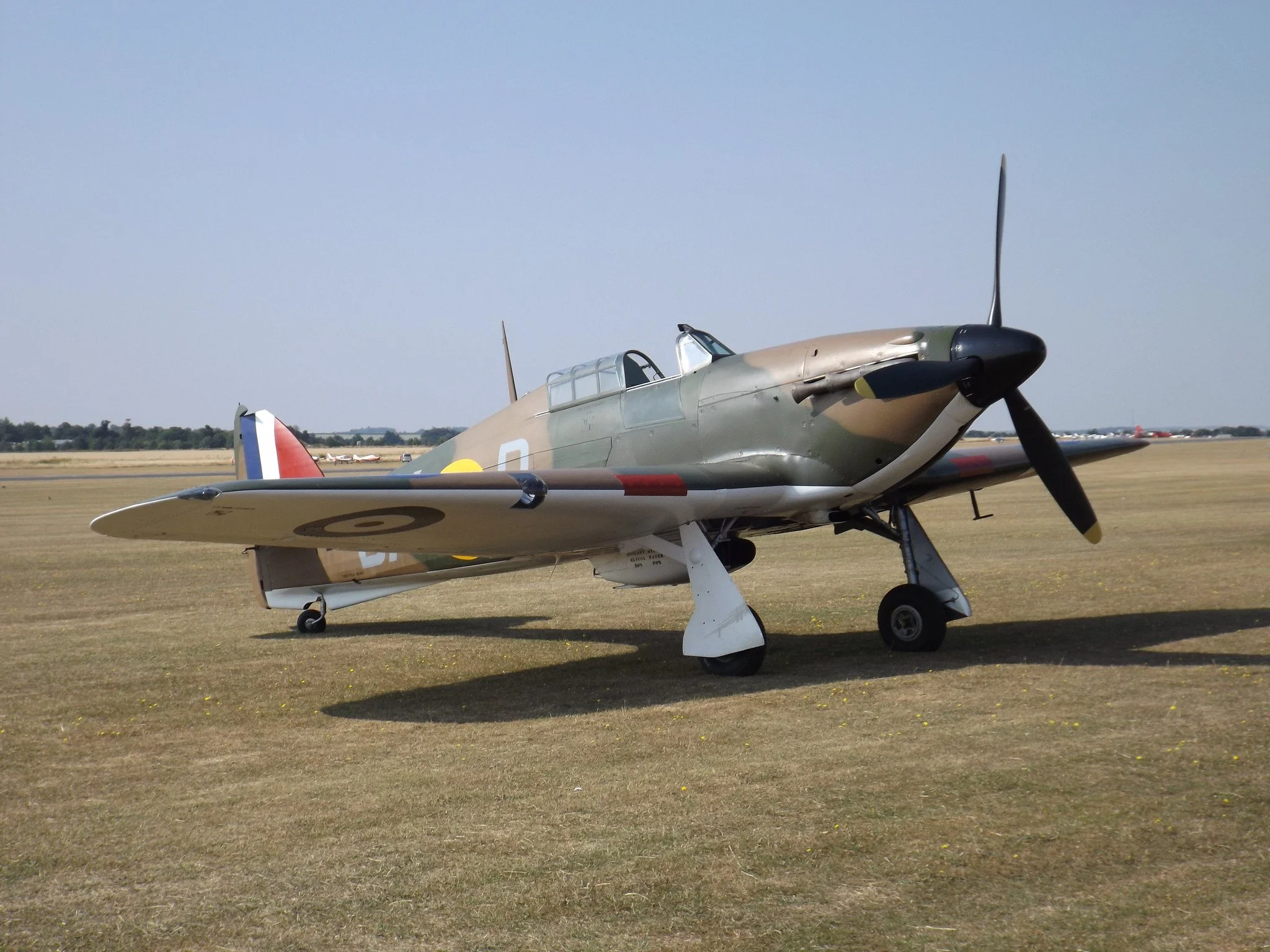
HURRICANE: The poignant biography of the plane that won the war.
HURRICANE: The Plane That Won the War by Jacky Hyams tells the story of the Hawker Hurricane and the people who designed it, built it, fought in it, and maintained and repaired it. Read the full book review now.
One British aircraft of the Second World War has come to symbolize the indomitable spirit of the nation during the dark days of 1940, the Supermarine Spitfire. However, it was the Hawker Hurricane that shot down more than half of the Luftwaffe’s raiders during the Battle of Britain. In Jacky Hyams’s new book, HURRICANE: The Plane That Won the War, published by Michael O’Mara Books Limited, the bestselling author attempts to set the record straight.
HURRICANE is an account of how the aircraft was designed, built and its service history. The book is also a testament to the pilots, the Air Transport Auxiliary, the ground crews, and the many unsung heroes of the production line. The stubby Hawker Hurricane or ‘Hurri’ as it was affectionately known was the brainchild of entrepreneurial aircraft manufacturer Sir Tommy Sopwith and Chief Designer, Sir Sydney Camm. Today, Camm is largely forgotten while the name of R.J. Mitchell, the designer of the Spitfire, is familiar to many. Yet, Camm would lead the design teams of the Hawker Typhoon, Hawker Tempest, and the post-war marvel, the Hawker Siddeley Harrier ‘jump jet’.
The Hurricane was the first monoplane fighter to enter service with the RAF, although the Bristol M1 was briefly in service at the end of the First World War. Partially constructed from wood and canvas, the Hurricane was quicker and cheaper to manufacture than its more glamorous stable mate, the Spitfire. The Hurri was also a more rugged aircraft, capable of withstanding Luftwaffe punishment that the Spitfire could not. The aircraft’s simple design meant that during the critical days of the Battle of Britain, seemingly unrepairable planes were patched up and put back into service by maintenance units. By the 15th of September 1940, the Hawker Hurricane had shot down more enemy aircraft than all other types of RAF aircraft and anti-aircraft (AA) guns put together.
Using a combination of archive materials and first-hand accounts, Jacky Hyams’s book retells more than just the history of the Hawker Hurricane. It is a book about the countless human stories of quiet courage, sacrifice, hard work, and emotional strain that the factory workers, pilots, and ground crews endured throughout the Second World War. The author keeps the technical jargon and military acronyms to a minimum, and when used she provides short, concise explanations.
Over the post-war period, the Hurri has proven fertile ground for authors, historians, and aircraft enthusiasts with over a hundred books and articles published on the subject. So, it might be fair to say there isn’t too much new to say about the fighter. Nevertheless, Jacky Hyams’s book is engaging, easy to read, poignant, and informative in turn.
By the end of its operational life, the Hawker Hurricane had served in every major theatre of the Second World War and flown with numerous air forces from Australia to Yugoslavia. Around 25 different variants of the aircraft were eventually produced, from Hawker Sea Hurricane to tank-busting ground attack aircraft. Together with the countless men and women who gave themselves so tirelessly to defeat tyranny perhaps Sir Sydney Camm’s stubby little aircraft, the Hawker Hurricane, was the plane that won the war.

Two Books on the Tank War for Northwest Europe
In this double book review, we look at two very different titles that both look at the tank war in Northwest Europe from very different perspectives. Ken Tout's book A Fine Night for Tanks takes an almost forensic look at Operation Totalize. Tank Action by David Render is a very personal portrait of the Allied advance from the Normandy beaches to Germany from the viewpoint of a junior tank commander.
The last year of the war in Northwest Europe was a bloody and protracted affair, especially if you were in an M4 Sherman tank at the cutting edge of the Allied advance. A Fine Night for Tanks, The Road to Falaise, by Ken Tout (originally published in 1998) takes an almost forensic look at Operation Totalize. In stark contrast, Tank Action by David Render with Stuart Tootal, An Armoured Troop Commander’s War 1944-45, recalls the very personal war experiences of a junior British tank officer.
A Fine Night for Tanks, The Road to Falaise
Ken Tout’s book is a detailed study of the various elements of the joint British and Canadian operation to break the German line south of Caen and ultimately help close the Falaise Gap. After a successful night attack using tanks and troops mounted in hastily converted M7 Priest self-propelled gun carriages, nicknamed Kangaroos, the operation stalled. Historically, Operational Totalize has generally been regarded as just another hammer blow against the 1st SS Panzer Corps. Preceding operations such as Epsom, Windsor and Charnwood were bloody battles of attrition costing thousands of men and hundreds of tanks on both sides. However, the difference was the Germans could ill-afford such grievous losses while the Allies had a seemingly endless supply of replacements.
The Death of Wittmann
An interesting footnote to Operation Totalize was the death of German panzer ace, Michael Wittmann. An SS-Hauptsturmführer with the 101st SS Heavy Panzer Battalion, Wittmann is credited with around 135 tank kills. Although completely unknown to Allied troops during the war, Wittmann has become legendary, especially for his encounter with the British 7th Armoured Division at the Norman town of Villers-Bocage. The circumstances of Wittmann’s death during Operation Totalize have been much debated. Ken Tout tells how Trooper Joe Ekins, 1st Northamptonshire Yeomanry, the gunner in a Sherman Firefly, caught Wittmann’s Tiger in the open and fired the fatal shot. I had the pleasure to meet Joe Ekins briefly at Tankfest a few years ago.
While being informative and easy to read, Ken Tout’s book does have a number of factual errors and typos, such as repeatedly referring to a Panther’s 88mm gun when it was armed with a 75mm.
Tank Action
Tank Action by David Render tells his very personal story of fighting across Northwest Europe from the D-Day beaches and infamous bocage countryside to Holland and finally into Germany. Render paints a vivid picture of life as a Troop Commander of an M4 Sherman tank with all its discomforts and many dangers. Render explains the many shortcomings of the standard M4 from its thin armour and high profile to its 75mm gun. The Sherman lacked the penetrating firepower of German 88mm anti-tank guns, Panzerfaust handheld anti-tank weapons and most types of panzer. However, probably the single most worrying feature of the Sherman was its terrifying propensity to burst into flames the moment it was hit. The Germans called the Sherman the “Tommy Cooker” while British tank crews renamed it the “Ronson” after a popular brand of cigarette lighter famed for its ability to light first time.
Two Weeks Life Expectancy
As well as the many deficiencies of British Army equipment, Render also describes the amazing comradeship, courage and ingenuity of officers and men fighting against a determined, well-armed enemy. As a junior officer, Render’s life expectancy was just two weeks once he went into the line. Over a year of almost constant action, Render would find that his mental and physical reserves quickly eroded. He freely admits that fear threatened to overwhelm him every time he was ordered to climb back into his Sherman and continue the advance.
War without End
The Sherwood Rangers Yeomanry had seen extensive action in North Africa (1940-1943) prior to David Render joining them. Once in Normandy, he noticed that prolonged exposure to combat had made many of the desert veterans excessively cautious and unreliable. On the job training was the order of the day. He would have to learn his craft from bitter, hard won experience as he and his crew fought across Normandy, Belgium, Holland and into Germany. By war’s end, the Sherwood Rangers would have earned 30 battle honours, 78 gallantry awards at the cost of 827 casualties killed, wounded and missing. However, for many of the veterans the war would never be over. At aged 90, and with a successful business career behind him, David Render remains haunted by the loss of many comrades, and one in particular. His great friend, Harry Heenan, killed in a freak accident just after saving David’s life during an engagement with a concealed 88mm anti-tank gun.
David Render’s book is a very personal, first-hand account of the tank war in Northwest Europe. In Render’s world, soldiers seldom knew what was happening in the next field or hedgerow. They knew nothing of the strategic decisions being made by Allied high commanders like Eisenhower, Montgomery or General Brian Horrocks. Instead, they focused on keeping their tanks ready for the next day’s action. They worried about being caught in a burning tank as it “brewed up”. They foraged for extra food to supplement their meagre rations. They struggled against fatigue, fear, and the terrible odds against any of them making it through alive. Sadly, David Render recently died aged 92.