
Blog
The Second World War resulted in the deaths of around 85 million people. Additionally, tens of millions more people were displaced. However, amid all the carnage, people demonstrated remarkable courage, fortitude, compassion, mercy and sacrifice. We want to honour and celebrate all of those people. In the War Years Blog, we examine the extraordinary experiences of individual service personnel. We also review military history books, events, and museums. We also look at the history of unique World War II artefacts, medals, and anything else of interest.
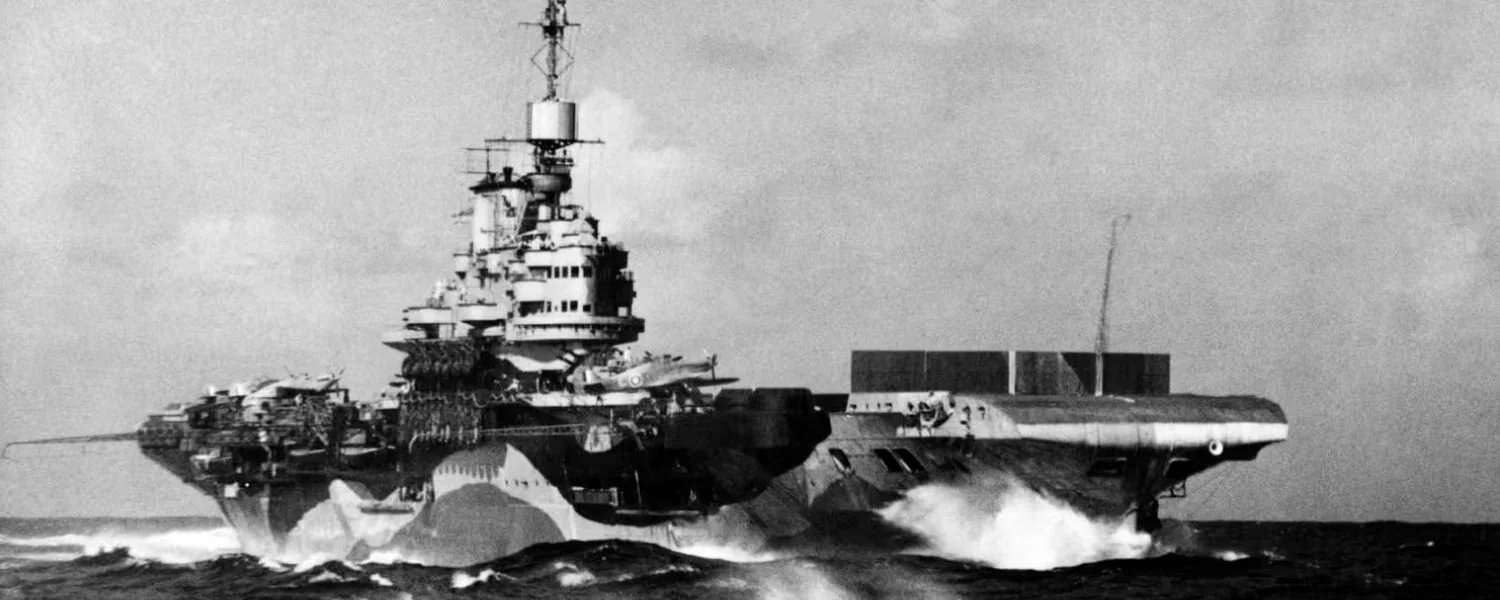
HMS Formidable: Uncle Bert, Kamikaze, and Learning Under Fire
On 4 May 1945, a Japanese kamikaze crashed into HMS Formidable's armoured flight deck off Okinawa, killing eight men and wounding forty-seven. The 3-inch steel deck was penetrated, fires raged across the flight deck, and bomb fragments severed a steam pipe in the centre boiler room. Five days later, a second kamikaze struck almost the identical spot. This time, one man died, and four were wounded, a 91 per cent reduction in casualties.
What changed in those five days? The crew learned valuable lessons under fire and made life-saving adaptations during kamikaze attacks.
This is the story of HMS Formidable during Operation Iceberg, learning under fire, the cost of armoured flight decks, and the men who kept fighting despite two kamikaze strikes that would have crippled any other carrier.
On 4 May 1945, at approximately 11:35 hours, a Japanese Zero fighter completed a climbing turn over HMS Formidable, rolled inverted, and dove towards the carrier's flight deck. The aircraft had evaded radar by approaching low over the sea, then pulled up at the last moment. Every available close-range gun was brought into action and opened fire. The pilot released a bomb moments before impact. The aircraft and bomb struck simultaneously, just level with the island (the carrier’s command and control centre), creating an enormous orange flash and blowing in the bridge windows where Captain Philip Ruck-Keene stood. Down in the centre boiler room, Stoker Stanley Harris heard the action commentator shout: “Oh my God. There's one on the flight deck!” An instant later, bomb fragments cut through the armoured hangar deck, severed a steam pipe in Harris's boiler room, and continued down into the oil fuel tanks below.
Eight men died. Forty-seven were wounded. One Avenger blew up on deck with its pilot, Sub-Lieutenant Donald Jupp, still in the cockpit. Yet by 17:00 hours the same day, aircraft were landing back aboard. The 3-inch armoured flight deck had been breached, leaving a 2-foot-square hole, which was later repaired with quick-drying cement, covered with steel plates, and tack-welded back into service.
This article examines HMS Formidable's service with the British Pacific Fleet during Operation Iceberg in May 1945, focusing on two kamikaze attacks that struck the ship on 4 and 9 May. The comparison between these attacks demonstrates institutional learning under fire: practical adaptations developed in five days that reduced casualties by 91 per cent while maintaining operational effectiveness. My analysis draws on operational reports, the ship's official log, and crew members' testimonies, supplemented by published secondary sources. But that’s not quite the whole story, as I have a personal connection to the ship.
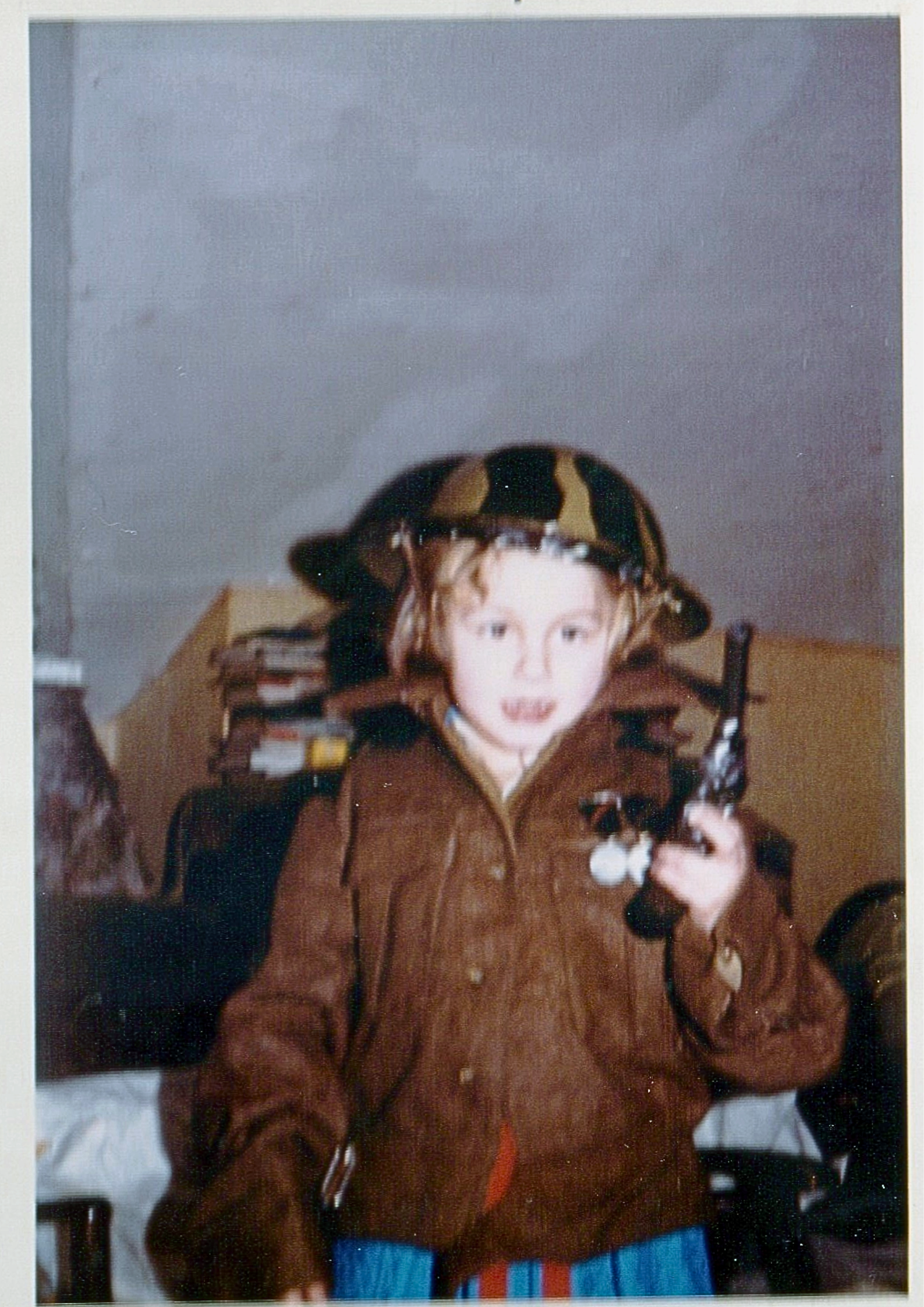
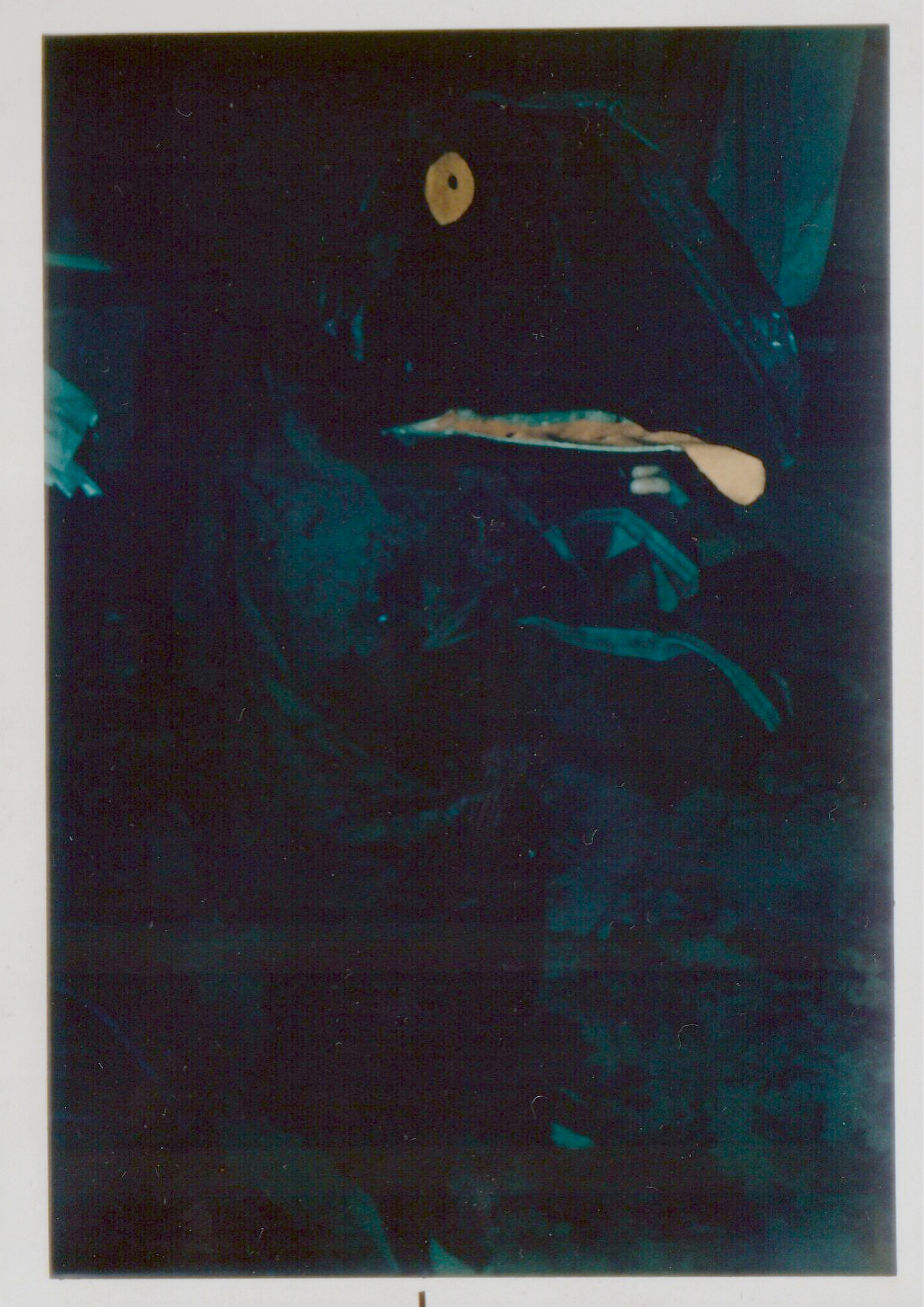
It’s Christmas morning in the 1970s. Charlie is dressed in a World War II battledress, complete with medals, a tin helmet, a webbing belt, and a holster, while holding a toy Webley revolver. On another Christmas, Charlie is dressed in a Triceratops dinosaur costume, all designed and made by Bert.
Magic Christmas Mornings in the 1970s
As a child growing up in the 1970s, Christmas mornings meant waking up to a pillowcase stuffed with presents. For most children of my era, that would have been the highlight of the day, but not in our house. Typically, on Christmas Eve, a shadowy figure would arrive in the early evening, and my siblings and I would be sent to watch television. My parents and my “Uncle Bert” would disappear into a downstairs room, emerge some hours later, and lock the door. Christmas morning would arrive, but the room would remain locked until Uncle Bert returned. Finally, all would be revealed. The room would be opened, and we would be ushered inside. Over the years, we were greeted by an array of handmade toys, ranging from a full-size racing car to miniature stables, a medieval castle, a Viking ship, a circus, and a battlefield, which included a landing craft, a pontoon bridge, tanks, and aircraft. Over the preceding months, Uncle Bert had meticulously designed, planned and built these unique and wondrous gifts. As children, whenever we asked how Uncle Bert built such things, we were simply told that he had been a shipwright in the navy, as if that were supposed to explain everything.
My Uncle Bert wasn’t a blood relative; his real name was Herbert Shortland, and he was a close friend of my father. After leaving the Royal Navy, Bert spent many years as a merchant seaman. At some point, my parents took Bert in and provided him with a room while he was away at sea. Later, he joined the prison service and lodged in a nearby house before eventually buying a home of his own and moving to Rochester, Kent, near the sea. After my father’s death, the family kept in touch with Bert, and as an adult, I would visit him. On one occasion, we discussed his time in the navy, and he showed me a photo album of his ship, HMS Formidable. The album contained a sequence of photographs of a Japanese kamikaze aircraft crashing onto the flight deck and the subsequent fire and chaos. Regrettably, I cannot recall what he said about the event, and he never spoke at length or in any detail about his time with the British Pacific Fleet. A short time later, he passed away. Since he had no living relatives that I know of, the Council cleared out his house. His photo albums, personal belongings, and all the memories of his extraordinary life at sea were put into rubbish bags and taken to the municipal recycling centre. Recently, I was reading, Crucible of Hell: Okinawa: The Last Great Battle of the Second World War by Saul David. In the book, there is the briefest mention of HMS Formidable. Well, it got me thinking.
HMS Formidable: Design and Service to 1945
HMS Formidable belonged to the Illustrious-class fleet carriers, revolutionary warships that encased the aircraft hangar in an armoured box. The flight deck itself formed the hull's strength deck and was built of 3-inch steel plate, with 4.5-inch armoured sides protecting the hangar. This armour came at a severe cost. Pre-war naval treaties limited displacement to 23,000 tons. The ship’s armoured hangar had to be lower and smaller, reducing aircraft capacity to 36 operational aircraft, compared with 80-100 on American carriers of similar size. According to the Wardroom Officer in his book, A Formidable Commission (1947), the ship’s second commission started on 16 May 1944.
On 17 August 1939, at Harland and Wolff's Belfast shipyard, Formidable launched herself when the launch cradle collapsed prematurely, killing a spectator and injuring others. The whole unfortunate episode was captured on camera by Pathé News. Commissioned on 24 November 1940, Formidable saw extensive Mediterranean service, including the Battle of Cape Matapan (27-29 March 1941) and sustained severe damage from German Stuka dive bombers on 26 May 1941. After repairs and operations covering the Salerno landings and attacks on Tirpitz, a centre shaft gear wheel failure delayed her deployment to the Pacific until January 1945.
HMS 'Formidable' launches herself in Belfast shipyard, Northern Ireland, 1939.
Captain Philip Ruck-Keene, CBE, DSO, commanded Formidable from 23 September 1943. A submariner by background, he had commanded the experimental submarine HMS X1 and the submarine depot ship HMS Medway. Ruck-Keene possessed a foghorn voice and drove his ship hard. He appears to have been a man who demanded high standards of professionalism and competence from officers and ratings alike. During a Belfast refit in 1943, he removed what he termed “bad apples” throughout the fleet. It seems that rather than make any concessions to naval conscripts, who regarded themselves as civilians in uniform, he despised “lower-deck lawyers” who he said knew all their rights but nothing of their duty. Consequently, Formidable was not a particularly “happy ship” under his command but was highly efficient. Rear Admiral Philip Vian would later praise Ruck-Keene's performance during the kamikaze attacks.
British Pacific Fleet: Command Structure and Strategic Context
HMS Formidable’s flight deck captures sister carriers Implacable and Victorious turning in formation with their destroyer escort on 10 July 1945, as the British Pacific Fleet advances toward strikes on the Japanese mainland in the final weeks of the war.
Source: Imperial War Museums (IWM A 30192).
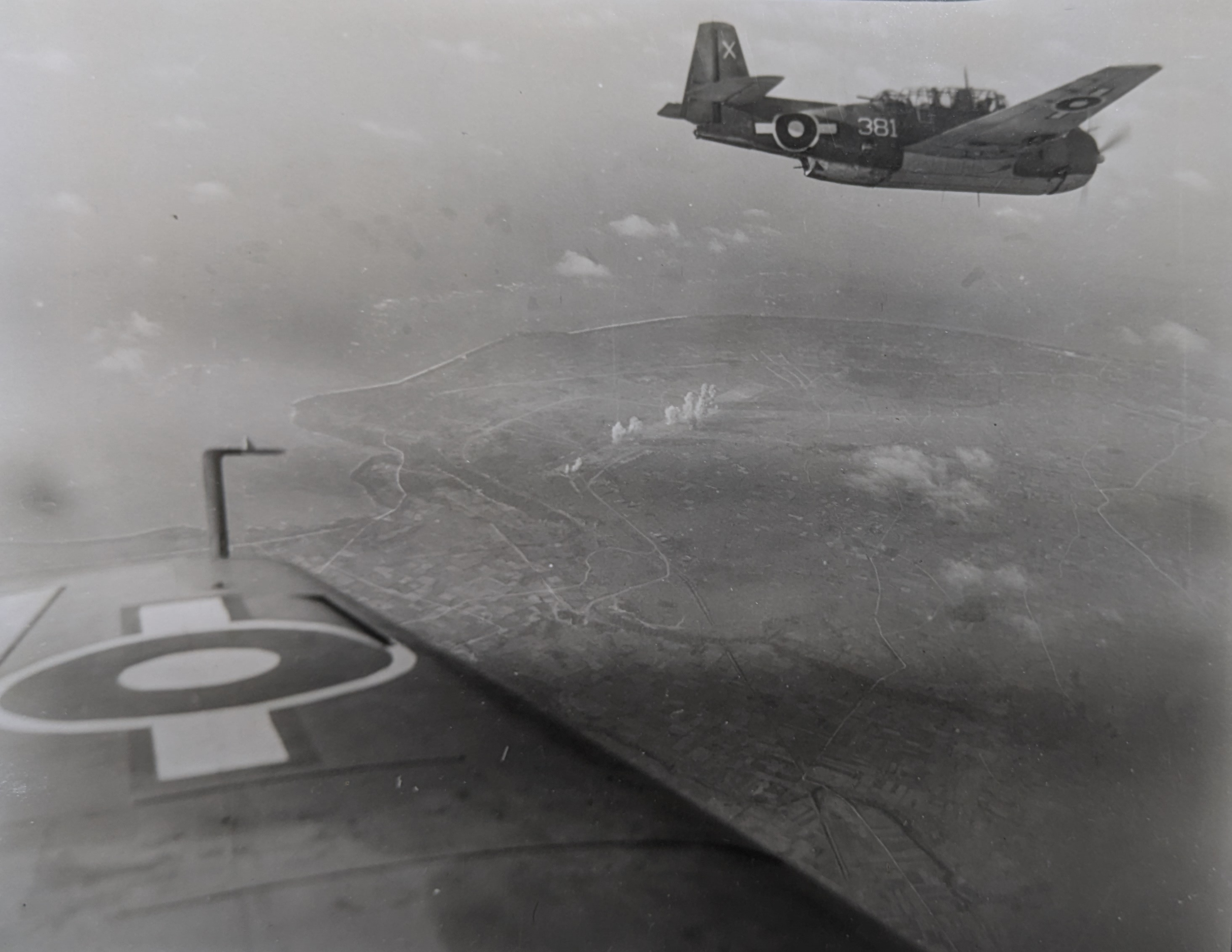


Gallery #1: Picture Captions
Aircraft from HMS Formidable attack Ishigaki Airfield on 16 April 1945 during Operation Iceberg, striking runways and dispersed aircraft positions.
Source: The National Archives, ADM 199/595, Operation Iceberg Photographs, AC1s No. 109/12/346.
A second view of HMS Formidable’s 16 April 1945 strike on Ishigaki Airfield, capturing additional bomb impacts and smoke rising from targeted areas.
Source: The National Archives, ADM 199/595, Operation Iceberg Photographs, AC1s No. 109/12/346.
HMS Formidable’s “Strike Charlie” on 17 April 1945 hits Hirara Airfield, showing explosive strikes against key facilities during continued support of Operation Iceberg.
Source: The National Archives, ADM 199/595, Operation Iceberg Photographs, AC1s No. 109/12/346.
The British Pacific Fleet assembled in Sydney in early 1945 under Admiral Sir Bruce Fraser, Commander-in-Chief. Fraser commanded from shore headquarters whilst Vice Admiral Sir Bernard Rawlings commanded the fleet at sea from the battleship HMS King George V. Rear Admiral Sir Philip Vian commanded the 1st Aircraft Carrier Squadron.
Vian required particular mention. He had led the destroyer flotilla in the Altmark incident, participated in the pursuit of Bismarck, and commanded the Eastern Task Force on D-Day. Regarded as a “fighting admiral” and compared to Nelson, he was characterised by his intense dedication to duty, tactical brilliance, and demanding, often abrasive leadership style that earned him immense respect despite limited personal popularity.
The American command structure designated the British Pacific Fleet as Task Force 57 (later TF 37) under overall US operational control. Admiral Raymond A. Spruance commanded Fifth Fleet during Operation Iceberg. The Americans assigned the British carriers a specific mission: neutralise Japanese airfields in the Sakishima Gunto islands between Formosa (modern-day Taiwan) and Okinawa to prevent enemy aircraft from staging attacks on the Okinawa invasion fleet.
Alexander Beldam, an Observer with 848 Naval Air Squadron aboard Formidable, recalled the mission clearly: “Our task was to disable the Japanese airfields in the islands between Formosa and the Philippines and the Japanese mainland, and in particular, the island of Ishigaki.” The Japanese proved ingenious at airfield repair. “They had a little railway down to the sea,” Beldam remembered, “and they would fill trucks with spoil (coral), run them back up to the airfield, and fill the bomb holes, so that by teatime sometimes the airfields were able to be used again. So we had to go back in the afternoon and bomb them again.”
On 14 April 1945, Formidable joined Task Force 57. Her air group consisted of 1841 and 1842 Naval Air Squadrons flying Corsair Mk IV fighters (18 aircraft each) and 848 Naval Air Squadron operating Grumman Avengers (12-18 aircraft), for a total complement of approximately 54 aircraft.
HMS Formidable and HMS Euryalus refuel from a British Pacific Fleet tanker, while Euryalus simultaneously transfers stores to the destroyer HMS Undaunted. Source: Imperial War Museums (IWM A 30072).
Fleet Train: Logistics and American Lessons
The British Pacific Fleet confronted a fundamental strategic problem: distance. Sydney lay 3,200 nautical miles from the operational area off Okinawa. The Royal Navy had never sustained carrier operations at such distances from established bases. The solution required wholesale adoption of American logistical methods and development of a mobile fleet train on a scale the Admiralty had never attempted.
The Americans had pioneered fleet replenishment while at sea. Their Task Force 38 could remain at sea for months, supplied by a continuous stream of oilers, ammunition ships, store ships, and repair vessels. The Royal Navy possessed minimal experience with this operational concept. British carriers had traditionally operated within the range of established shore facilities like Malta, Alexandria, and Scapa Flow. The Pacific offered no such infrastructure.
The British Pacific Fleet assembled a fleet train of unprecedented size. It included four escort carriers packed with replacement aircraft, pilots, and aircrew to replenish combat losses. Two additional carriers operated on ferry duty. There were landing ships, escort vessels, destroyers, repair ships, oilers, store ships, victualling ships, distilling ships, a net layer, armament ships, and hospital ships.
Personnel assigned to the fleet train received concentrated training in underway replenishment techniques from American instructors. Refuelling procedures, cargo transfer methods, and maintenance protocols were adapted from US Navy practice. British artificers and engineers learned American repair techniques. The learning curve proved steep but vital.
Operational tempo required extended periods at sea. Stoker Stanley Harris recalled: “I think the longest one we did there was about 80 odd days at sea, and didn't go ashore at all because we had a fleet train that used to supply us.” The fleet alternated between operational zones and replenishment areas. “We used to say that we would be going into the long grass when we were going off to conduct bombing missions on Sakishima-Gunto,” Harris explained, “and then would come back to what we called the short grass, and it was there that the fleet train would come. It was like a load of shops floating around, and we would take on oil from the tankers, and we would take flour aboard for cooking, and mail.”
Observer Alexander Beldam confirmed this operational pattern: “We used to retire to refuel and pick up more bombs before going back the following day for more bombing raids.” The fleet train enabled sustained operations impossible under traditional Royal Navy logistics doctrine.
Maintenance presented particular challenges. American carriers possessed larger maintenance crews and more extensive workshop facilities. British carriers operated with smaller engineering complements and less equipment. Repairs had to be improvised. Artificers developed field expedients. Spare parts were cannibalised from damaged aircraft. The forward aircraft lift on Formidable, disabled on 4 May, could not be repaired at sea and remained inoperative for the duration of operations.
Aircraft serviceability rates improved through practical experience. Initially, British carriers struggled to match American sortie rates. Engineering crews learned through observation and practice. Maintenance procedures were refined. By the strikes on Japan in July-August 1945, Formidable achieved fighter sortie rates of 1.54 sorties per aircraft; a 40 per cent improvement over Sakishima operations and approaching American performance levels.
The British Pacific Fleet demonstrated institutional capacity for rapid adaptation. Traditional Admiralty logistics doctrine proved inadequate for distances in the Pacific. American methods were studied, adopted, and integrated within months. Personnel at every level, from Admiral Fraser's headquarters staff to individual artificers on carrier hangar decks, developed practical solutions to unprecedented operational challenges.
This adaptability would prove equally valuable in combat damage control, as the events of 4 and 9 May would demonstrate.
A Japanese Mitsubishi Zero dives toward USS Missouri off Okinawa in April 1945, attempting a suicide crash. The impact missed the deck and struck only the battleship’s hull, causing no major damage. Source: Imperial War Museums (IWM NYF 70679).
4 May 1945: First Kamikaze Attack
Tactical Situation
At 10:02 hours on 4 May 1945, the battleships and cruisers of Task Force 57 detached from the carrier squadron for shore bombardment of targets on Miyako Island. This decision had significant tactical implications. The departing ships carried substantial anti-aircraft firepower and long-range radar coverage. The four British carriers, Formidable, Victorious, Indomitable, and Indefatigable, continued operations with eight destroyers providing close escort.
Shortly after 11:00 hours, radar detected bogeys (enemy aircraft) to the west. The weather provided perfect attack conditions: cumulus clouds at 3,000 feet with bright sun breaking through intermittently. Japanese pilots often conducted decoy attacks to distract the fleet's Combat Air Patrols (CAP), allowing individual attackers to approach low enough to avoid radar detection.
At 11:27 hours, Captain Ruck-Keene ordered Damage Control State II, then, three minutes later, moved to State I, the highest alert level. Watertight doors were secured, and damage control parties came to full readiness. Formidable turned into wind. At 11:27 hours, two Corsairs flew off on bombardment spotting missions. After launching, the ship turned to starboard, and eleven Avengers taxied forward in a single line to clear the deck aft in case the Corsairs needed to make emergency landings. This was a standard operating procedure.
HMS Formidable, after being hit abreast the island on 4 May 1945 during Operation Iceberg, was captured in official wartime photography documenting the Okinawa campaign. Source: The National Archives, ADM 199/595, Operation Iceberg, Photographs AC1s No. 109/12/346.
The Attack
At approximately 11:30 hours, without further warning, a Mitsubishi A6M Zero (referred to by the Allied codename, Zeke) passed overhead at 50 feet, firing its machine guns and strafing the deck park. The aircraft had evaded radar detection by approaching low over the sea. A few personnel glanced up in time to see the red Japanese roundels on the fuselage.
The pilot proved highly skilled. Dissatisfied with his angle of approach, he flew over the bow from port to starboard, threw the aircraft into a vertical climb, flew alongside the carrier in an arc past the island, then banked sharply to come round again towards the starboard quarter. Personnel on the flight deck ran for their lives, some throwing themselves headfirst down ladders.
'A' Group opened fire with both 4.5-inch gun turrets. All pom-poms and Oerlikon anti-aircraft guns with a clear line of sight engaged the target. The aircraft was hit repeatedly and caught fire, but the pilot continued his dive. Ruck-Keene ordered an emergency hard turn to starboard. Too late. A moment before impact, the pilot released his bomb, estimated to weigh between 500 and 1,000 pounds.
The ship's log recorded: “11:35hrs: Japanese aircraft crash dived onto flightdeck causing a hole 2-feet square. Centre boiler room evacuated due to steam leak. Fires on flightdeck and starboard boat deck.”
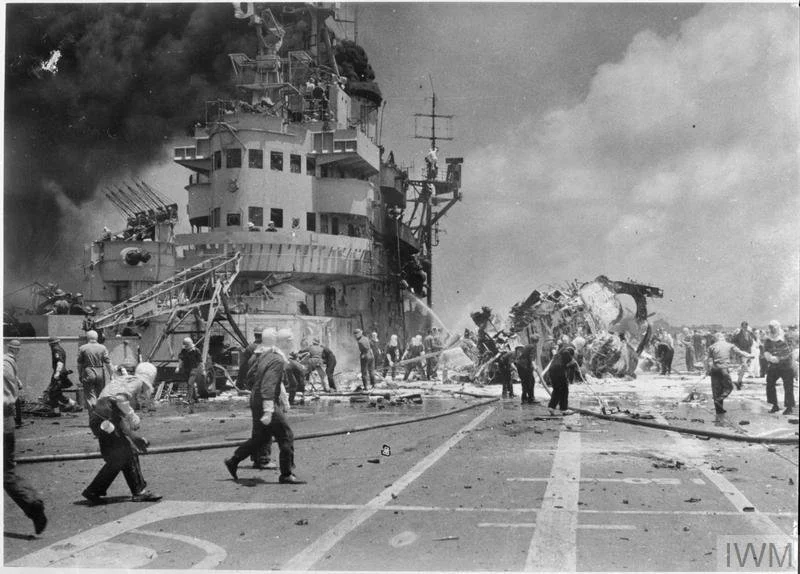
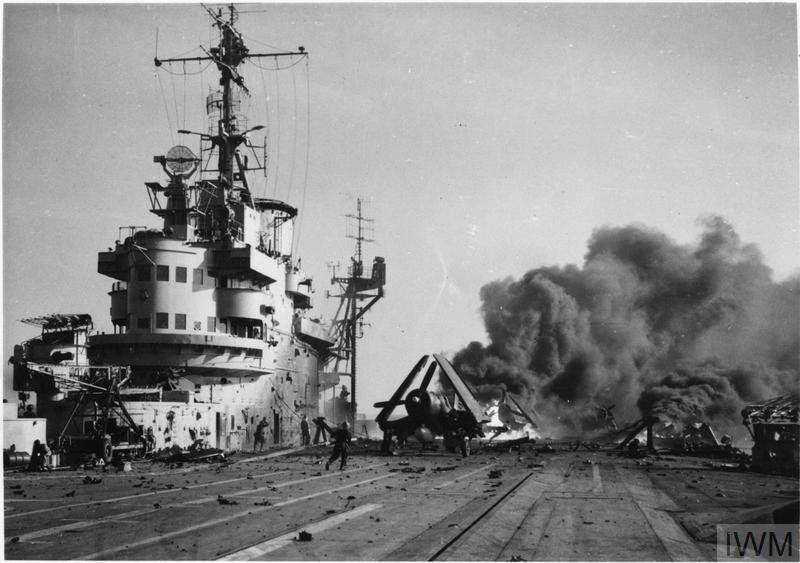
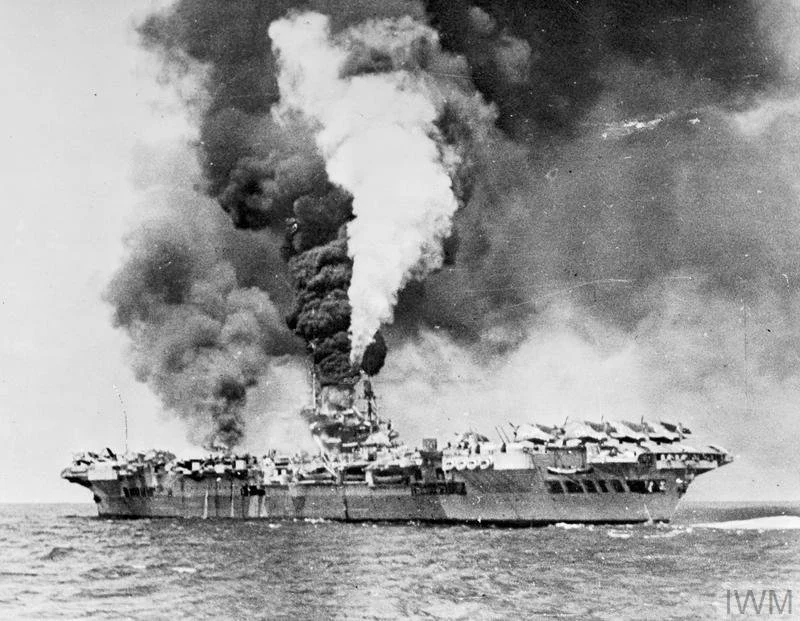
Gallery #2: Picture Captions
Firefighting crews work amid scorched metal, foam, and scattered wreckage on HMS Formidable’s flight deck after a kamikaze crash during operations supporting the Okinawa landings. Source: Imperial War Museums (IWM A 29312).
Crew members battle flames on HMS Formidable’s deck following a suicide plane crash, with a folded‑wing Corsair beside the ship’s heavily damaged island as smoke pours from wreckage aft. Source: Imperial War Museums (IWM A 29313).
HMS Formidable burns after a kamikaze strike off Sakishima Gunto during the Okinawa campaign, seen from HMS Victorious in April–June 1945. Source: Imperial War Museums (IWM A 29717).
Immediate Damage and Casualties
The bomb and aircraft struck simultaneously, just level with the ship's island control centre. The explosion blew in all the windows on the bridge where Captain Ruck-Keene was standing. The bomb struck at the intersection of four armoured deck plates, a weak point, and punched a 2-foot square hole through the 3-inch steel flight deck. The surrounding area was depressed to a depth of up to 2 feet, approximately 24 feet by 20 feet.
Bomb fragments and armour splinters tore through the hangar below, collapsing a fire curtain roller which smashed an Avenger parked beneath it. The fragments continued down through the hangar deck, through the main deck, and into the centre boiler room, severing the Auxiliary Superheated Steam Pipe. Stoker Stanley Harris and his crew had to evacuate immediately before being boiled alive. The centre boiler room remained out of action for hours.
Further fragments struck the oil fuel tanks, starting fires. A fire also broke out in the torpedo shop when flames spread down the torpedo lift shaft.
On the flight deck, one Avenger exploded. Its pilot, Sub-Lieutenant Donald George Jupp, RNVR, was taxiing the aircraft forward when the kamikaze struck. Despite being enveloped in flames, Jupp managed to climb out of his burning cockpit and somehow walk to the sick bay, terribly burned over a large part of his body and unable to see.
The former First Aid Post inside the island had been taken over by the Air Intelligence Department a few days before the attack. Senior Medical Officer, Surgeon Commander St. George Delisle Gray viewed this change “with equanimity” given that in the first kamikaze attack on HMS Indefatigable, the entire First Aid Party including the Medical Officer had been wiped out. The old F.A.P. opened directly onto the flight deck, with one door permanently left open for easy access. When the bomb exploded, the room was crowded with personnel from the Air Intelligence Department. Lieutenant (A) Burger was standing near a scuttle and pressed his face against the small window to see what was happening. The scuttle was blown inwards by the blast, mortally wounding him.
Commander (Ops) Walter Elliott and his assistant were in the operations room. Their veteran's instinct told them to run. Burger did the opposite and died as a result. The explosion lifted Elliott and his assistant off their feet and threw them into the next room.
On that day, Observer Alexander Beldam was not flying. Instead, he was assisting the Commander of Operations, based in the plot room. His pilot and close friend, Don Jupp, was helping move aircraft on the flight deck. Beldam recounted the events that followed the explosion: “The first assistant to the Commander of Ops was on the floor at that time. Unfortunately, he had been looking out of the scuttle when the kamikaze struck the Formidable, and he was killed because the explosion blasted the glass from the scuttle directly into his face.”
The official casualty list:
Killed immediately: 6 (including 2 officers: Lt Burger and Sub-Lt Bell, plus 4 ratings)
Died within 30 minutes: 2 more
Injured: 47 (6 officers, 41 ratings), of whom 48 were detained in Sick Bay.
Damage Control Response
Speed saved lives. Ruck-Keene immediately ordered the ship to turn 250 degrees downwind and reduce speed to 16 knots, blowing fires away from the island. All hands were called to the flight deck. Aircraft Handling Parties and firefighting teams went to work.
Geoffrey Brooke, who led the firefighting operation, grabbed foam generator nozzles and directed teams to attack the fires. One novice began hosing burning aviation fuel with water. The fuel simply floated on the surface and spread across the flight deck. Hand extinguishers were grabbed to douse smaller fires. Additional drums of foam compound were brought up from stores.
Senior Medical Officer Gray was making his way forward on the boat deck when the explosion occurred. “An enormous sheet of flame extended 10 feet over the side of the ship,” he recalled, “and parts of the aircraft passed overhead.” He ran to the sick bay, which quickly became overcrowded with injured men. All patients in cots were turned out to make room for the seriously wounded. Casualties lay in corners and in the gangway. The immediate task was to determine which patients had already received morphine and administer it to others who needed it. None had been labelled.
The worst casualties:
Gray’s report and clinical description of wounds suffered by members of the ship’s crew make sobering reading.
Sub-Lieutenant Donald George Jupp: For 50 hours, it was impossible to do more than administer morphine and give continuous transfusions of reconstituted plasma. On the evening of 5 May, he had recovered sufficiently to be taken to the sick bay theatre to examine and dress his injuries. His condition initially improved. His friend and crewmate, Observer Alexander Beldam, visited him every night and read to him. On one occasion, Jupp looked up at the doctor and said, “Doc, you never told me you had blue eyes.” It was the first indication he could see again. He was transferred to a hospital ship. Beldam shook his hand and said, “I'll see you in Sydney.” That was the last Beldam saw of him. Jupp died suddenly about 10 days later from the effects of his burns. He was just 20 years old.
Petty Officer Thomas Lamb, P/JX 149881, age 44: Aircraft Handling Party on the flight deck when the bomb exploded. He suffered a compound fracture of the right thigh, multiple wounds to both legs, and a wound on the dorsum of the left instep. He was tender over his abdomen and complained of chest pain. He had suffered much domestic trouble and told the medical staff that he was going to die and did not wish to live. He was too ill for surgical intervention beyond morphine and plasma transfusions for 48 hours. When his condition stabilised sufficiently, surgeons excised the wound edges and packed the sinuses with sulphanilamide cream. A hard object was located in his left foot, a piece of steel, apparently the head of a piston, was removed from in front of his os calcis (heel bone). It was decidedly larger than the entry wound; there was no wound on his sole. The next morning, he took a turn for the worse and died at approximately 11:50 on 7 May, 72 hours after being wounded.
A Chance‑Vought Corsair launches with a bomb mounted beside its auxiliary fuel tank, heading out on a dive‑bombing raid against the German battleship Tirpitz. Source: Imperial War Museums (IWM A 25440).
Repair and Return to Operations
All fires were reported under control by 11:55 hours, approximately 20 minutes after the attack. Captain Ruck-Keene gripped the American liaison officer, Lieutenant Commander Ben Hedges, by the arm and shook his other fist at him. The Americans had been unimpressed with British carrier design, particularly the steel flight decks that radiated heat through the ship. “What do you think of our bloody British flight-decks now?” Ruck-Keene demanded. Hedges looked at the skipper and replied: “Sir, they're a honey.”
With fires out, Ruck-Keene set about making good the damage. He had aircraft in the air and wanted them back aboard. Gangs of shipwrights and artificers went to work plugging the hole with quick-drying cement. Timber was placed first, then cement, before steel plates were positioned over it and tack-welded into place. Brooms cleared any small pieces of debris off the flight deck that might burst an aircraft's tyres.
By 12:54 hours, the ship could make 24 knots. The centre boiler room was not reconnected until 04:00 hours on 5 May, but steam had been diverted from the starboard boiler room to restore speed more quickly. The flight deck barriers were assessed: one was a complete write-off, but the other could be repaired. All arrestor cables and both lifts remained intact. By 13:15 hours, the damage was made good. The skipper was told the barrier should be fixed by 16:00 hours. By 17:00 hours, the aircraft were landing back aboard.
Four Avengers and one Corsair were pushed over the side as damaged beyond repair. At 15:30 hours, funerals were held for Lt Burger, Sub-Lt Bell, and six ratings.
The Admiralty signal to Rear Admiral Vian read simply: “Good show, Formidable.”
Lessons Learned: Adaptations Between 4 and 9 May
The five days between the first and second kamikaze attacks saw intensive analysis and practical adaptation. No formal Admiralty doctrine covered these improvements; they emerged from observation, thought, and a willingness to act on painful experience.
Anti-Hawk Stations Procedures Refined
The alarm system had failed on 4 May. The mechanical roar of eleven Avenger engines drowned out the klaxon warning personnel to clear the flight deck. Many crew members never heard the anti-hawk alarm and were caught on deck at the moment of the explosion. Lieutenant Burger died because he was looking out of a scuttle window. Sub-Lieutenant Jupp was taxiing his aircraft. Petty Officer Lamb was working with the Aircraft Handling Party. All were exposed because the warning system was inadequate.
The solution proved simple: a red flag system. When radar detected an incoming kamikaze, a red flag would be raised from the bridge as a visual signal. This cut through aircraft engine noise where sirens failed. It was an improvisation, not Navy doctrine, and it saved lives.
Anti-Hawk Stations procedures were refined to maximum protective posture. Both aircraft lifts were to be raised and sealed. All hangar armoured doors were to be closed. The fire main was split into six independent sections so damage to one would not disable the entire system. Specialist flight-deck fire parties were pre-positioned in nettings and lobbies below the armoured deck with equipment ready to rush topside immediately after impact. Most critically, every person on the flight deck was ordered below the armoured deck except gun crews. Twenty “Squadron Action Gangs” (one Petty Officer plus ten men each) closed up on the Upper Gallery Deck, ready to rush topside after the attack to clear wreckage and fight fires.
Firefighting Doctrine
Foam compound supply was doubled from 1,000 to 2,000 gallons. Additional foamite extinguishers were pre-positioned. The hangar spraying system drill was rehearsed. One critical lesson was learned the hard way on 4 May: burning aviation fuel must never be fought with water. Water simply spreads the burning fuel. Flight deck fires required foam only. This became an absolute doctrine.
A second counterintuitive lesson: immediately after a kamikaze strike, reduce speed to approximately 15 knots. High speed creates airflow that fans the deck fires. Slower speeds starve fires of oxygen and make firefighting more effective.
Medical Preparations
The sick bay proved inadequate. Located on the port side, not under the armoured deck, it was exposed, awkward to access, and extremely noisy when the anti-aircraft guns fired. The laundry was converted to an operating theatre. Camp beds were drawn from stores to rig emergency wards. The after half of the Wardroom and the Warrant Officers' Mess were taken over and fitted with camp beds to accommodate wounded under protective armour. However, having the laundry out of service created its own problems.
Plasma supplies were found to be critically inadequate. The ship carried 400 bottles and used 360 of them to treat casualties from the first attack. Official allocation was only 260 bottles, just one for every ten men. Senior Medical Officer Gray recommended that each fleet carrier carry 1,000 bottles of plasma to be prepared for multiple emergencies.
Anti-Flash Gear Discipline
The medical report noted an important detail: “All cases of burns [on 9 May] were wearing overalls and anti-flash gear at the time.” Despite this protection, several men received severe burns on their backs. The Senior Medical Officer theorised that men facing the explosion and bending forward had the backs of their overalls gape open, allowing flash to pass down their backs. Nevertheless, anti-flash gear discipline was rigorously enforced despite tropical heat.
One detail from the 4 May attack proved significant: “There were no cases of burns among the fire parties.” Personnel who wore proper anti-flash gear and followed procedures remained protected.
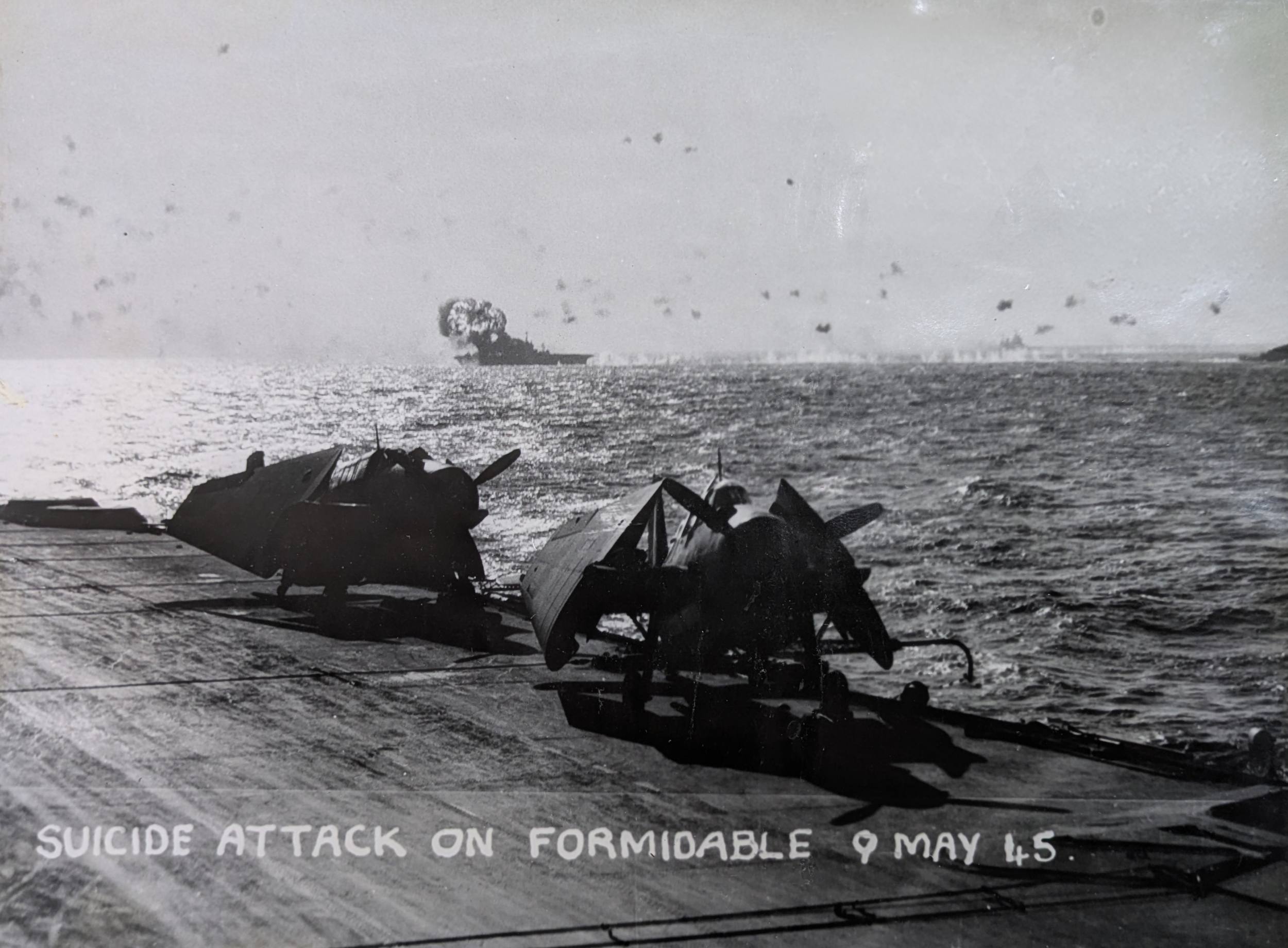


Gallery #3: Picture Captions
HMS Formidable seen from the starboard bow moments after the 9 May 1945 suicide attack, showing damage and smoke rising from the forward area. Source: The National Archives, ADM 199/595, Operation Iceberg Photographs, AC1s No. 109/12/346.
A head‑on perspective of HMS Formidable shortly after the 9 May 1945 strike, showing the extent of damage to her forward flight deck and island area. Source: The National Archives, ADM 199/595, Operation Iceberg Photographs, AC1s No. 109/12/346.
Crew members work rapidly to clear HMS Formidable’s damaged flight deck after the 9 May 1945 attack, with wreckage strewn aft as emergency teams restore the deck to operational condition. Source: The National Archives, ADM 199/595, Operation Iceberg Photographs, AC1s No. 109/12/346.
A close view of the impact point on HMS Formidable’s armoured deck, revealing the force of the explosion and the structural resilience that prevented deeper penetration. Source: The National Archives, ADM 199/595, Operation Iceberg Photographs, AC1s No. 109/12/346.
9 May 1945: Second Kamikaze Attack
Tactical Situation
Task Force 57 continued operations off Sakishima Gunto. At 16:53 hours on 9 May, radar detected bogeys. Damage Control State I was set immediately. Anti-Hawk Stations were sounded. The flight deck was cleared. Six Corsairs were on deck at the time.
At 17:02 hours, HMS Victorious was hit by a kamikaze. At 17:06 hours, Formidable's guns engaged an aircraft attacking the battleship HMS Howe. At 17:08 hours, a third aircraft, the fourth in the overall raid, was detected Red 100 (bearing 100 degrees relative), making a shallow dive.
The aircraft, either a Zero or a Nakajima B6N (Allied codename Jill), initially appeared to attack Formidable from astern, then changed course toward the fleet carrier HMS Indomitable, banked sharply back, and dove at approximately 30 feet above the sea. The Japanese aircraft was hit repeatedly, but the gunfire appeared to have no effect.
The Impact
At 17:09 hours, the aircraft crashed onto the flight deck slightly starboard of the centreline, abreast the after end of the island, only a few feet aft of the 4 May impact point. The aircraft disintegrated. The bomb the plane was carrying, estimated at 250 pounds or possibly a modified heavy shell, only partially detonated.
The ship's log recorded: “17:07hrs: Japanese aircraft crash dived onto flightdeck setting fire to three aircraft and denting armoured plates (of the flightdeck). One rating killed and five injured. 17:40hrs: Fires extinguished.”
Note: The ship's log records the date as the 8th of May, but I believe this was an error, and the date was the 9th of May 1945. All other sources confirm 9 May as the correct date.
Effectiveness of Adaptations
The red flag system worked exactly as intended. Flight Commander Keith Quilter was strapped into his Corsair with the engine running when he saw the red flag. He killed the engine, unstrapped, leapt out along with three other pilots, and jumped down two or three decks before impact. His aircraft was completely destroyed. He was unhurt.
The cleared flight deck meant only gun crews were exposed. All others were protected by the ship’s 3 inches of armour plate. This single measure dramatically reduced casualties.
Foam-only firefighting and pre-positioned fire parties proved highly effective. All fires were brought under control by 17:25 and extinguished by 17:35, a total of 10 minutes. The immediate speed reduction to 15 knots starved fires of wind.
The hangar containment procedures worked. 'C' Hangar was sprayed as a precaution (Corsairs were carrying full drop tanks). The 'B' Hangar fire was handled “in most admirable manner.”
Casualties and Damage
The sole fatality of the second attack was Petty Officer George Hinkins. He commanded the S3 pom-pom mounting. As the kamikaze approached, he ordered his crew to take cover and ensured all were sheltered before the impact. He remained at his post and was killed by a flying Corsair wheel. His funeral was held on the quarterdeck at 19:15 hours on 9 May.
Four personnel were wounded (the ship's log states five). All survived.
Six Corsairs and one Avenger were destroyed on deck. Seven Corsairs and three Avengers in the hangar became “flyable duds” from saltwater contamination when the spraying system activated. Formidable was left with 11 serviceable Corsairs and 4 serviceable Avengers from her original complement of 54 aircraft.
Structural damage was far less severe than on 4 May despite a similar point of impact. The armoured deck was depressed 4.5 inches over an area of approximately 10 feet square. Approximately 90-100 rivets were loosened or gouged. The deep beam was depressed approximately 2 inches. The armoured deck was not penetrated. One rivet was blown out, allowing burning fuel to drip into the hangar below, hence the fire in 'B' Hangar.
The ship was ready to receive aircraft at 17:55 hours, under 50 minutes after being hit.
Comparative Analysis
The comparison between 4 May and 9 May demonstrates the effectiveness of systematic institutional learning:
Casualties:
4 May: 8 killed (possibly 9), 47 wounded = 56 total
9 May: 1 killed, 4-5 wounded = 5-6 total
Reduction: 91 per cent
Fire control:
4 May: 20 minutes, approximately
9 May: 10-15 minutes, approximately
Improvement: 25 per cent
Resumption of flight operations:
4 May: 5.5 hours, approximately
9 May: 50 minutes, approximately
Improvement: 85 per cent
Flight deck penetration:
4 May: Yes (2-foot square hole)
9 May: No
It must be noted that the differences in bomb size and detonation (a 500-pound SAP bomb fully detonating on 4 May versus a 250-pound bomb partially detonating on 9 May) account for significant differences in structural damage. However, the dramatic reduction in human casualties resulted primarily from procedural changes: red flag warnings, cleared flight decks, foam-only firefighting, and speed reductions.
18 May 1945: Hangar Deck Fire
At approximately 11:00 hours on 18 May, Formidable was in a logistics support area. Armourers were loading ammunition into aircraft guns in the hangar; routine maintenance between operational periods. A Corsair's guns accidentally discharged. Rounds struck an adjacent Avenger, which erupted in flames.
The overhead sprinkler system was activated, but the fire spread rapidly. The fire curtain motors were destroyed on 4 May and were never replaced. They could only be replaced in a properly equipped dockyard. Without the fire curtain, flames spread through the hangar without containment.
The fire burned for approximately 55 minutes before being extinguished. Extensive saltwater spraying was required. Stoker Petty Officer Arthur Camfield led the firefighting effort.
Casualties: None killed.
Aircraft losses: Twenty-one Corsairs and seven Avengers destroyed or severely damaged; more than both kamikaze attacks combined.
Alexander Beldam recalled the incident vividly. He was in his cabin with friend Doug Andreas when alarms sounded. Initially, they thought it was an exercise. Beldam went to investigate and found the hangar deck covered in water approximately 18 inches deep. The ship was rolling, causing the water to slosh from side to side. A bomb on a carriage was sliding across the deck. Two Air Fitters stood on either side, feet extended, trying to stop the trolley from careening.
“An armourer who had been rearming one of the Corsair aircraft had unfortunately tested the guns before making sure there was nothing that could be fired,” Beldam explained. “Anyway, he accidentally fired a bullet or a couple of bullets into the Corsair in front of him, which then caught fire.”
According to Beldam, the armourer was sentenced to 90 days in a labour battalion in New Guinea for his incompetence.
Rear Admiral Rawlings detached Formidable from Task Force 57 on 22 May. She arrived in Sydney on 31 May for nearly a full month of repairs in the Captain Cook Dry Dock at Garden Island.
Repairs, Further Operations, and Post-War Service
Sydney Repairs
The temporary cement and steel patches applied on 4 May were removed. Two of the three damaged 14-ton armour plates were straightened or replaced. The third was replaced with a double layer of 1.5-inch-high-quality steel, as no armour plate was available in Australia. The damaged deck girder was replaced.
The forward aircraft lift, damaged on 4 May when the explosion blew fragments through its housing, was permanently disabled. The lift shaft was reportedly converted to an Admiral's bathroom, though this detail appears in memoirs rather than official records and may be apocryphal.
Barracuda and Corsair aircraft are ranged across HMS Formidable’s flight deck as the carrier prepares to launch strike operations. Source: Imperial War Museums (IWM A 25441).
Silent film footage shows Seafires, Fireflies, and Avengers operating primarily from HMS Indefatigable—sister ship to HMS Formidable—during British Pacific Fleet operations in 1945. The aircraft of Indefatigable are identifiable by the distinctive “S” marking on their tails.
Return to Operations: Strikes on Japan
By late June 1945, Formidable was operational again. She became the flagship of the 1st Aircraft Carrier Squadron when Rear Admiral Vian transferred his flag aboard from HMS Indomitable. The 6th Naval Fighter Wing was disbanded and reorganised as No. 2 Carrier Air Group under Lieutenant-Colonel P.P. Nelson-Gracie, Royal Marines.
On 27 May, Admiral Halsey relieved Admiral Spruance. The Fifth Fleet became the Third Fleet. Task Force 57 was redesignated Task Force 37. The British Pacific Fleet carriers Formidable, Victorious, Indefatigable, and Implacable deployed approximately 250 aircraft, while American Task Force 38's twelve carriers had around 1,000 aircraft.
The fleet departed Manus on 6 July and rendezvoused with Third Fleet on 16 July. On 17 July 1945, British carriers launched the first air attacks on the Japanese home islands, striking targets on the east coast of Honshu. HMS King George V bombarded Hitachi alongside American battleships.
The British Pacific Fleet was excluded from the main attacks on the Imperial Japanese Navy at Kure. The Americans wanted sole credit for sinking the remnants of the Japanese fleet. British carriers were directed against Osaka and targets in the Inland Sea instead.
British fighter sortie rates improved significantly from Sakishima operations. At Sakishima Gunto, Formidable achieved 1.08-1.09 sorties per aircraft. During the strikes on Japan, this increased to 1.54 sorties per aircraft, a 40 per cent improvement reflecting better logistics, shorter distances, and crew experience.
On 9 August 1945, the day of the Nagasaki atomic bombing, the British Pacific Fleet dropped 120 tons of ordnance, the Royal Navy's highest single-day total of the entire war. Aircraft destroyed 22 Japanese planes and 24 gliders on the ground.
Portrait of Lieutenant Robert Hampton Gray, VC, DSO, RCNVR—Canada’s only Royal Canadian Navy Victoria Cross recipient of the Second World War. Serving as a fighter pilot from HMS Formidable, Gray sank a Japanese destroyer six days before VJ Day but was shot down in flames and declared missing, presumed dead. Source: Imperial War Museums (IWM A 30950).
Lieutenant Robert Hampton Gray, VC, DSC, RCNVR
Lieutenant Robert Hampton Gray of 1841 Naval Air Squadron, a Canadian pilot, had earned a Mention in Despatches for pressing home strafing attacks on Tirpitz in August 1944 despite severe aircraft damage. On 28 July 1945, he scored a direct hit, sinking a Japanese destroyer and earned the Distinguished Service Cross.
On 9 August 1945, Gray led eight Corsairs against shipping in Onagawa Bay, northeast Honshu. The area was heavily defended. Gray dove on the escort vessel Amakusa. Intense anti-aircraft fire struck his Corsair and set it ablaze. One bomb dislodged. Despite flames engulfing his aircraft, Gray pressed the attack. His remaining bomb struck Amakusa squarely, sinking her. The burning Corsair plunged into the bay. Gray's body was never recovered.
Lieutenant Robert Hampton Gray was posthumously awarded the Victoria Cross, the last Canadian to receive the decoration and one of only two Fleet Air Arm aircrew to earn it during the entire war. In 1989, the Japanese erected a memorial at Onagawa Bay, the only such memorial in Japan dedicated to a foreign Allied serviceman.
HMS Formidable is towed into her berth in Sydney on 24 August 1945, returning with units of the British Pacific Fleet after Japan’s defeat, seen alongside a sister carrier.
Source: Imperial War Museums (IWM A 30364).
War's End
On 10 August, strikes continued as Japan considered the Potsdam terms. On 12 August, Formidable, Victorious, and Implacable departed for Australia as the supply line had failed. HMS Indefatigable and HMS King George V remained as Task Group 38.5.
On 15 August, Emperor Hirohito announced Japan's surrender. Dawn strikes from Indefatigable resulted in the last fighter combat of the war.
Admiral Sir Bruce Fraser signed the surrender document aboard USS Missouri on 2 September 1945. HMS Duke of York lay at anchor nearby.
A Royal Navy fleet carrier, HMS Formidable, lies berthed at Wharf R in Sydney Cove, with a MANXMAN‑class fast minelayer visible astern. At right, the Manly ferry South Steyne heads inbound across the harbour. Source: Graeme Andrews Working Harbour Collection, courtesy of the City of Sydney Archives.
British Movietone newsreel footage from 11 February 1946 records the aircraft carrier HMS Formidable arriving at Portsmouth, returning from wartime service in the Far East.
Source: British Movietone Newsreel.
Troopship Service and Decommissioning
With the war’s end, Formidable's aircraft were flown off one last time, and her hangars were converted to dormitories. In September 1945, she sailed from Manila to Sydney carrying over 1,000 liberated Australian prisoners of war. Over the following 18 months, she made multiple voyages throughout the Far East, Australia, India, and Singapore, carrying nearly 14,000 passengers and steaming over 100,000 miles.
Among the crew serving aboard during 1946-1947 was Able Seaman Thomas Connery, later known by his stage name, Sean Connery. He was training as an anti-aircraft gunner and was medically discharged in 1949 with a duodenal ulcer.
Her final voyage delivered 1,000 Royal Marine Commandos to Singapore. She arrived at Portsmouth on 3 February 1947.
In March 1947, Formidable went to Rosyth for a brief refit before being reduced to reserve. She paid off on 12 August 1947.
A post-war structural survey revealed that the hull had been permanently deformed by accumulated damage from the 1941 Mediterranean bombing, two kamikaze strikes, and subsequent heavy steaming. The armoured flight deck, which served as the strength deck and was integral to the hull girder, transmitted all impact stresses throughout the hull structure. As a result, the ship was deemed beyond economic repair.
She languished without preservation, moving from Rosyth to Spithead to Portsmouth. In January 1953, she was sold for scrap to the British Iron and Steel Corporation for demolition by Thomas W. Ward and Company. She arrived under tow at Inverkeithing, Scotland, on 12 May 1953. Breaking up continued into 1956. It was a sad end for such a valiant ship.
Statistical Summary and Assessment
The British Pacific Fleet report for May 1945 concluded: “Without armoured decks, TF 57 would have been out of action (with 4 carriers) for at least 2 months.”
British Pacific Fleet Operations, Operation Iceberg
Sorties: 5,335
Bombs dropped: ~958 tons
Enemy aircraft destroyed: 42 in air, 100+ on the ground
Aircraft losses: 160
Ship's company: 44 killed, 83 wounded
HMS Formidable Service, June 1944 – December 1945
Distance steamed: ~112,823.5 miles
Operational hours: ~6,118 hours 11 minutes
HMS Formidable enters Woolloomooloo Bay en route to Garden Island naval base, photographed sometime between January and December 1946. Source: Graeme Andrews Working Harbour Collection, courtesy of the City of Sydney Archives.
Conclusions
The comparison between the kamikaze attacks on May 4 and May 9, 1945, illustrates how the officers and crew of HMS Formidable adapted and learned under pressure. The measures taken, including red flag warnings, clearing the flight deck, implementing foam-only firefighting, and immediately reducing speed, were not derived from existing naval doctrine. Instead, they emerged from practical observation, thoughtful analysis, and a willingness to learn from combat experiences.
The armoured flight deck represented a fundamental design trade-off. It saved crews in 1945 but ultimately killed the ship. The accumulated structural damage proved irreparable. Every bomb or kamikaze that struck the strength deck transmitted stress through the entire hull girder. American carriers with wooden flight decks and strength decks lower in the hull could absorb localised damage without compromising the entire ship’s structure.
The British Pacific Fleet's contribution to the Pacific War is still a subject of debate among historians. Some characterise it as “more diplomatic than military.” While it may be true that the fleet's role often seemed more about maintaining British influence in the post-war Pacific than about making a significant operational impact, this view overlooks the hard work, hardships, and casualties it endured. To date, around eighty-two books have been written about the Battle of the Atlantic. Eighty-nine cover Mediterranean operations. Only fifteen examine the Royal Navy's Pacific campaign. The young sailors, Royal Marines and aircrew who served, fought and died with “the forgotten fleet” deserve better.
Petty Officer George Hinkins ordered his gun crew to take cover and remained at his post. Sub-Lieutenant Don Jupp climbed from his burning aircraft and walked to the sick bay before dying ten days later from his terrible injuries. Lieutenant Robert Hampton Grey pressed home his attack whilst his aircraft was on fire and earned the Victoria Cross for his valour. These were not diplomatic gestures.
HMS Formidable, known as “the ship that launched herself” when her slipway cradle collapsed, survived two kamikaze attacks and a severe hangar fire to continue her mission. She carried 14,000 souls home. Ultimately, however, she was defeated not by the enemy but by her own design. The accumulated damage from every impact, transmitted through an armoured deck that had saved so many lives, ultimately broke her spine. The ship that launched herself could not save herself.
As for Uncle Bert, well, his adventures were just beginning. After the Royal Navy, he joined the merchant fleet and spent years sailing the world’s oceans. On one occasion, during a terrible storm, he received an awful head wound while nearly being washed overboard. After joining the prison service, he would save his holidays and then disappear on treks across North and Central Africa, from Tunis and the Western Desert to the ancient city of Timbuktu, and to many other remote, inhospitable, and exotic places. He was truly one of a kind, part of the Greatest Generation from World War II.
If you would like to know more about one of your relatives' military service, contact me now.
Bibliography
Primary Sources
National Archives (ADM Series)
ADM 53/121382. HMS Formidable Ship's Log, May 1945.
ADM 118694. Report of Two Kamikaze Attacks on HMS Formidable. Senior Medical Officer Surgeon Commander St. George Delisle Gray, 8 June 1945.
ADM 199595. Report on Operation Iceberg Five, Commanding Officer HMS Formidable, 18 April 1945.
ADM 199595. Operation Iceberg Photo/ACI Report No. 10912346, 23 June 1945.
Oral Histories (Imperial War Museum)
Beldam, Alexander Roy Asplin. Interview, IWM Catalogue Number 34503, 18 November 2015.
Harris, Stanley. Interview, IWM Sound Archive Catalogue Number 33740, July 2012.
Secondary Sources
Books
Brown, David. Carrier Operations in World War II. Vol. 2. Annapolis: Naval Institute Press, 1974.
Wardroom Officer. A Formidable Commission. London: Seeley Services & Co. Ltd, 1947.
Please note: this blog contains Amazon affiliate links. If you purchase books through these links, I receive a small commission at no additional cost to you. This helps support the ongoing research and content on The War Years.

Learning Through Laughter: The Ingenious WWII German Tank Training Manuals
Have you ever wondered how young German panzer crews learned to handle their formidable machines during the Second World War? Here’s a surprise - the German Army created comic book-style manuals filled with cartoons, jokes, and even a board game. From these humorous wartime guides to today’s virtual reality training, discover how making learning fun revolutionised military education. In this article, we tell the fascinating story of the Panther-Fibel and Tiger-Fibel. We explore how making learning fun and memorable is an approach that works just as well today as it did back then.
In this article, we examine how the German Army tackled a unique World War Two challenge: rapidly training thousands of young recruits to operate highly complex Panther and Tiger tanks. Their solution was surprisingly modern – they created comic-style training manuals filled with humour, games, risqué artwork and memorable characters. This innovative approach to military education proved highly effective and foreshadowed today's gamification techniques in training and education.
In 2021, The Tank Museum launched a crowdfunding campaign. The campaign aimed to publish the first English-language translation of the Second World War German Army's Panther-Fibel. Curator David Willey explained, “The Panther-Fibel is a fascinating historical document. It was originally produced as an engaging and easy to understand handbook for the wartime Panther tank crews. The Panther was a highly sophisticated machine in every respect and required considerable knowledge to keep it serviceable and to get the best out of it.”
The Tank Museum needed to secure at least 200 pre-orders of the publication before 12 April 2021, to make a print run financially viable. The crowdfunding campaign succeeded in getting the first English-language edition of the Panther-Fibel printed.
Big Cats
During WWII, German panzer forces faced the daunting task of rapidly training thousands of new tank crews to operate some of the most sophisticated armoured fighting vehicles of the era. As the war progressed, the Allied nations opted for the mass production of medium tanks such as the American M4 Sherman and Soviet T-34. In contrast, the German panzer arm focused on increasing firepower and armoured protection. Between the summer of 1942 and 1943, the Germans introduced the formidable Tiger and Panther tanks. While extremely capable on the battlefield, these cutting-edge machines were also remarkably complex, requiring highly skilled crews to operate and maintain them effectively.
The Mighty Panther
First entering service in 1943, the Panther tank (Panzerkampfwagen V Panther) was a direct response to the shock of encountering advanced Soviet T-34 and KV-1 tanks on the Eastern Front. With its combination of thick, sloped armour, a powerful 75mm high-velocity gun, and wide tracks for excellent cross-country mobility, the Panther proved to be one of the most effective tanks of the war. However, it was also a complex, overly engineered machine, with numerous interleaved road wheels, an intimidating array of controls and equipment, and a temperamental transmission that demanded skilful handling. Rushed prematurely into service, the first production Panther tanks were plagued with mechanical problems. Nevertheless, overall, the Panther proved a successful medium battle tank. The British Army’s 4th Battalion, Coldstream Guards, for example, adopted a captured Panther, which they named 'Cuckoo'.[1]
The Birth of the Fibel Manuals
To help train the influx of new Panther and Tiger crews, Generaloberst Heinz Guderian, Inspector General of Panzer Troops, devised an unorthodox but highly effective approach. He tasked his subordinates with creating accessible, engaging crew manuals that would depart from the dry, highly technical publications of the past. The result was the “Tiger-Fibel” and “Panther-Fibel”. The two pocket-sized manuals featured cartoon illustrations throughout and used humour, rhymes, characters, and even risqué images to convey essential information in an engaging and memorable format.
Developed under the leadership of Lieutenant Josef von Glatter-Goetz, these “fibel” manuals covered everything from vehicle components and operating procedures to tactical advice, maintenance tips, and troubleshooting guides. The manuals use humour, storytelling and visual mnemonics to help make complex topics more understandable and easier to remember under the stress of combat. The manuals were written in rough, informal language. This reflected how soldiers spoke. It differed from the technical jargon commonly used in official publications. It is noteworthy that the manuals do not contain any Nazi iconography or propaganda commonly found during the period.[2]
One fascinating feature unique to the Panther-Fibel was the inclusion of a simple board game, resembling Snakes & Ladders, where players could review key learning points while navigating the hazards of operating their tank under combat conditions. By combining education with entertainment, the fibel manuals achieved remarkable results in preparing crews to handle their vehicles more effectively.[3]
Military and Government Informational Comics
During the war, the American military also effectively utilised comic books for training and morale purposes. The popularity of comic books among the civilian population, coupled with their ability to convey information in an engaging and entertaining manner, made them an ideal medium for military education and propaganda.
One of the most notable examples of this is the work of Will Eisner, a renowned cartoonist who was drafted into the U.S. Army. Eisner created a series of illustrations for army publications and maintenance manuals, featuring a character named “Joe Dope.” Through Joe Dope's humorous misadventures, soldiers were reminded of the importance of properly maintaining their equipment, thus promoting safety and efficiency within the ranks.[4]
The military also recognised the potential of comic books to boost morale among the troops. By reflecting the lives of American soldiers both on the battlefield and home front, these comics provided a sense of connection and familiarity amid the chaos of war. Furthermore, comic books were used to help explain U.S. foreign policy and justify specific actions and operations, helping to maintain support for the war effort among both soldiers and civilians.
The success of these military-themed comic books is evident in their sales figures. Between 1940 and 1945, comic book circulation doubled from 10 million to 20 million copies per month. In military post exchanges (PX), they outsold popular magazines like Life and Reader’s Digest. This demonstrates the effectiveness of comic books as a tool for military training, education, and boosting morale.[5]
During the Vietnam War, award-winning graphic artist Will Eisner teamed up with the U.S. Army again. This time Eisner was tasked to produce the M16A1 rifle manual in a comic book format, complete with a blonde bombshell narrator (a somewhat pejorative term for attractive blonde-haired women, usually media stars) and cheeky humour, to help GIs (infantrymen) absorb essential weapons handling information. A testament to the popularity of his work, Eisner’s M16A1 rifle manual remains in print and is available to purchase online.[6]
The Rise of Gamification in Military Training
In recent years, the concept of gamification has gained significant traction in various fields, including military training. Gamification refers to the application of game design elements, such as points, badges, leaderboards, and narrative, in non-game contexts to increase engagement, motivation, and learning outcomes. The term itself was coined in the early 2000s, but the idea of using game-like features to make serious activities more enjoyable and effective has a much longer history, as evidenced by the fibel manuals of World War II.[7]
Today, militaries around the world have embraced gamification and interactive multimedia as powerful tools for enhancing training. Virtual reality simulators, first-person shooter video games, and digital scenario trainers are used to immerse soldiers in realistic environments, helping them develop critical skills and decision-making abilities. Game-based learning has been shown to improve knowledge retention, problem solving, teamwork, and motivation.[8]
In January 2024, the British Army’s 1st (United Kingdom) Division announced that it was experimenting with augmented reality to enhance command-and-control capabilities. This initiative aims to make the division more agile, mobile, and resilient, preparing it for its new role as the land component of NATO’s Allied Reaction Force.[9]
The Royal Signals are using a virtual reality system called the Interim Combined Arms Virtual Simulation (Deployable) to enhance their battlefield skills. This system allows soldiers to practice driving, manoeuvring, and combat scenarios in a virtual environment, reducing costs and environmental impact compared to live training.[10]
Lessons for Business
The fibel story also offers valuable insights for enterprises seeking to improve their own training and employee development. By injecting humour, storytelling, and game-like elements into instructional content, companies can create more engaging and memorable learning experiences. Well-designed games can simulate real-world challenges, providing safe environments for employees to practise skills, experiment with strategies, and learn from mistakes.
SAP's Road Warrior, for example, was a gamified training tool designed to make learning and onboarding for salespeople more interactive and enjoyable. It uses videos and multiple-choice questions to simulate real-life sales meetings, rewarding users with points and badges, and fostering competition and social interaction among peers. Similarly, gamification in cybersecurity awareness training makes interactions more engaging, enjoyable, and secure. Serious games are gaining popularity because they promote natural learning.[11]
According to academic studies on the effectiveness of gamification, it does work and improves training outcomes. However, studies also highlight that the success of gamification often depends on the context and users.[12]
Key Principles
There are several key principles to keep in mind when integrating game-based learning into corporate training. The game objectives must be aligned with specific learning outcomes to ensure the activity supports the desired skills and knowledge. Leveraging the power of narrative can make the content more relatable and resonant for learners. Providing frequent feedback and rewards will help to motivate participants and reinforce their progress. Incorporating social elements fosters collaboration and friendly competition, reflecting the dynamics of real-world teamwork. Finally, the game should be accessible and easy to use for all skill levels to maximise engagement and effectiveness. It's interesting that the Panther-Fibel, with its stories, jokes, characters, and comical illustrations, fulfils all the necessary elements for successful game-based learning.
When these principles are applied, game-based learning becomes a powerful way to boost employee engagement, knowledge retention, and performance. Just like the young Panther crews found, the quickest way to learn new skills is often the most enjoyable. By embracing the power of play, modern organisations can help their teams tackle the challenges of today’s workplace with skill, confidence, and a touch of humour.
References:
David Willey, Panther-Fibel Introduction, Tank Museum, 2021.How the 'Tiger-fibel' and 'Panther-fibel' Came About, Military History Visualised, YouTube video, 2020. https://www.youtube.com/watch?v=KT8ql7TMhmoPanther-Fibel, David Wiley, Tank Museum document, 2021.Todd Crumley, Don’t Be a Dope”: Will Eisner’s World War II Posters, NATIONAL ARCHIVES, 2022.Wikipedia.org, U.S. Government Informational Comics.Blake Stilwell, The Original M16 Manual Was a Vietnam War Comic Book, Military.com, September 30, 2021.Sebastian Deterding, Dan Dixon, Rilla Khaled, and Lennart Nacke, From Game Design Elements to Gamefulness: Defining 'Gamification', Proceedings of the 15th International Academic MindTrek Conference: Envisioning Future Media Environments, 2011, pp. 9-15.Jo Brick, Gaming and Professional Military Education, The Forge, October 2020.Army.mod.uk, Land warriors in the world of augmented reality, January 2024.Army.mod.uk, Royal Signals use virtual reality system to hone battlefield skills, July 2023.Iqra Obaid, Shoaib Farooq and Adnan Abid, Gamification for Recruitment and Job Training: Model, Taxonomy, and Challenges, IEEE Access. PP. 1-1. 10.1109/ACCESS.2020.2984178, 2020.J. Hamari, J. Koivisto and H. Sarsa, Does Gamification Work? -- A Literature Review of Empirical Studies on Gamification, 47th Hawaii International Conference on System Sciences, Waikoloa, HI, USA, 2014, pp. 3025-3034, doi: 10.1109/HICSS.2014.377, 2014.

Strategic Insights from the Battle for Crete
Operation Mercury - the Battle for Crete in 1941 - was a ground-breaking airborne invasion. This historic event offers modern organisations valuable lessons in strategy, leadership, and adaptability. By examining the successes and failures of this battle, we can gain insights into effective decision-making and resilience in today’s competitive business world.
In May 1941, the idyllic Mediterranean island of Crete, a strategic location for controlling the region, became the stage for one of the Second World War’s most daring and innovative military operations. Operation Mercury, Nazi Germany's airborne invasion of Crete, marked a turning point in military tactics and offers valuable lessons for modern business leaders. This blog post explores why the German forces succeeded against British and Commonwealth defenders, and what today's organisations can learn from this historic battle.
The German Gambit for Crete: Innovation and Risk
The brainchild of Luftwaffe General Kurt Student, Operation Mercury represented a huge gamble by the German high command. Prior to this operation, no military force had ever tried to capture a whole island mainly through airborne assault. According to one of his closest aides, Student possessed the unusual ability to combine his inclination for the new, unconventional and adventurous with a working method based on meticulous staff work and precise attention to detail. As Mark Bathurst notes in his article for New Zealand Geographic, “Operation Mercury - the invasion of Crete by Nazi Germany - began on 20 May 1941, when gliders and paratroops (Fallschirmjäger) swooped through the dust and smoke thrown up by Luftwaffe bombs and cannon”. The Germans employed innovative tactics such as using silent gliders to land troops behind enemy lines, catching the defenders off guard.
This innovative approach surprised the Allied defenders, despite their superior numbers and defensive positions. The Germans’ willingness to embrace new tactics and technologies paid off, albeit at a high cost in casualties. Between 20 May and 1 June 1941, the Germans suffered 3,352 casualties. However, we must not forget the immense human cost paid by the Cretans during the Nazi occupation, resulting in the deaths of more than 3,400 individuals.
For business leaders, this underscores the potential rewards of innovation and calculated risk-taking. Companies that dare to challenge conventional wisdom and pioneer new approaches, such as adopting disruptive technologies or entering untapped markets, often gain a significant competitive advantage. However, it is crucial to balance innovation with proven methods and have contingency plans in place, as the high casualty rate among German paratroopers demonstrates.
Allied Failures: The Perils of Poor Communication and Complacency
Despite having advance knowledge of the German invasion plans through Ultra intercepts (signals intelligence), the Allies failed to mount an effective defence. This failure stemmed from several factors, including poor communication, complacency, and ineffective leadership.
As one historical account points out, “The Allied forces on Crete were a mix of British, Australian, New Zealand, and Greek troops, with unclear command structures and poor coordination”. This lack of clear leadership and communication channels severely hampered the defenders’ ability to respond effectively to the German assault.
Moreover, Allied commanders, including New Zealand’s General Bernard Freyberg, seemed overly concerned about a potential seaborne invasion, diverting crucial resources away from the defence of key airfields. This misallocation of forces proved disastrous when the Germans seized control of the Maleme airfield, allowing them to fly in reinforcements and ultimately secure victory.
For businesses, this serves as a stark reminder of the importance of clear communication, effective leadership, and the dangers of complacency. Even with superior resources or market intelligence, companies can fail if they do not have systems in place to act on information quickly and decisively. Leaders must ensure that all team members are aligned with strategic priorities and can adapt swiftly to changing circumstances.
The Power of Seizing Opportunities
Despite heavy initial losses, the German forces managed to capture the critical Maleme airfield, west of Chania. This success allowed them to fly in reinforcements and ultimately turn the tide of the battle. As Johann Stadler, a German veteran, recalled, “I was very proud. It was the first time in war history an island was conquered from the air”.
This aspect of the battle highlights the importance of rapidly capitalising on opportunities, even in the face of setbacks. In business, the ability to quickly identify and exploit key opportunities, such as emerging market gaps or shifting customer preferences, can make the difference between success and failure. Leaders must cultivate a culture of agility and empower their teams to seize chances when they arise.
Adapting to Changing Circumstances
The battle for Crete also demonstrates the critical importance of adaptability. The Germans had to adjust their plans on the fly when they encountered stronger-than-expected resistance. Conversely, the Allies’ rigid adherence to their initial defensive plans, despite changing circumstances, contributed to their defeat.
For business leaders, this underscores the need for agility and the ability to rapidly adjust strategies when market realities do not align with expectations. Successful companies are those that can pivot quickly in response to unexpected challenges or opportunities, such as technological disruptions or shifts in consumer behaviour. Building a flexible, responsive organisation is key to navigating today’s fast-paced business landscape.
The Cost of Victory: Long-term Strategic Implications
While Operation Mercury was ultimately successful, it came at a high cost. The heavy casualties suffered by the German paratroopers led Hitler to prohibit future large-scale airborne operations, effectively wasting this specialised resource.
This outcome offers a valuable lesson for businesses about the importance of considering long-term strategic implications when pursuing high-risk, high-reward strategies. Short-term successes that come at too high a cost can ultimately prove detrimental to long-term goals and capabilities. Leaders must carefully weigh the potential benefits of bold moves against their potential downsides and opportunity costs.
Learning from Failure and Setbacks
Although the Allies lost the Battle of Crete, they learned valuable lessons that they applied to later amphibious invasions, such as the landings in Sicily and Normandy. Their ability to adapt and improve their tactics based on the hard-won experience at Crete ultimately contributed to their success in the war. However, it can be argued that the Allies learned some of the wrong lessons from the German victory on Crete. As the war progressed, the Allies amassed considerable airborne forces, but their deployment was infrequent and not always successful. In 1944, Britain was chronically short of infantrymen while thousands of ‘special service’ troops like paratroopers were held in reserve for airborne operations that were frequently postponed or cancelled.
Similarly, businesses must learn to treat failures and setbacks as opportunities for growth and improvement. By conducting thorough post-mortems, identifying root causes, and implementing corrective actions, companies can emerge stronger and more resilient. Leaders who encourage a culture of continuous learning and improvement will have better preparation to face the inevitable challenges of the business world.
Applying Historical Lessons to Modern Business
The Battle for Crete offers a wealth of insights for today's business leaders:
Innovation and calculated risk-taking can provide a competitive edge but must be balanced with proven methods and contingency planning.
Clear communication, effective leadership, and avoiding complacency are crucial, even when you seem to have an advantage.
The ability to quickly seize opportunities and adapt to changing circumstances can be the difference between success and failure.
It is essential to consider the long-term strategic implications of high-risk actions, not just short-term gains.
Failures and setbacks should be treated as valuable learning opportunities for continuous improvement.
By studying historical events like Operation Mercury, business leaders can gain valuable insights on strategy, tactics, leadership, and communication. These lessons, drawn from one of military history’s most daring operations, remain remarkably relevant in today’s fast-paced, competitive business environment. As modern leaders navigate the challenges and opportunities of the 21st century, they would do well to remember the hard-fought lessons of Crete and apply them to their own strategic decisions.
References:
Bathurst, M. (2005). Operation Mercury: The Battle of Crete. New Zealand Geographic, Issue 073. https://www.nzgeo.com/stories/crete/
Bell, K. (2006). Battle of Crete: It Began with Germany’s Airborne Invasion—Operation Mercury. Historynet. https://www.historynet.com/battle-of-crete-it-began-with-germanys-airborne-invasion-operation-mercury/
MacDonald, C. (1995). The Lost Battle – Crete 1941.
Rehman, I. (2024). Britain’s Strange Defeat: The 1941 Fall of Crete and Its Lessons for Taiwan. War on the Rocks: https://warontherocks.com/2024/05/britains-strange-defeat-the-1941-fall-of-crete-and-its-lessons-for-taiwan/
The defence and loss of Crete, 1940-1941 (Part 1). (2020). The National Archives. https://blog.nationalarchives.gov.uk/the-defence-and-loss-of-crete-1940-1941-part-1/
The defence and loss of Crete, 1940-1941 (Part 2). (2020). The National Archives. https://blog.nationalarchives.gov.uk/the-defence-and-loss-of-crete-1940-1941-part-2/

From Battlefields to Boardrooms: How World War II Tactics Can Revolutionise Your Business Strategy
In our latest article, we delve into the contrasting tactics used by the British and German armies during WWII and extract practical advice for today’s business leaders. Discover how the British Army’s centralised command structure often led to slower response times and missed opportunities, and learn how you can avoid these pitfalls in your own organisation.
A Light Tank Mk.VIA of the 3rd King's Own Hussars. By British Army photographer. - This photograph ARMY TRAINING comes from the collections of the Imperial War Museums (collection no. 4700-101), Public Domain, https://commons.wikimedia.org/w/index.php?curid=2113928
In the high-stakes arena of modern business, leaders are constantly seeking innovative ways to stay ahead of the competition. Surprisingly, some of the most valuable lessons in organisational agility and decision-making can be drawn from an unexpected source: Second World War military tactics. In this article, we will briefly explore the contrasting tactics used by the British and German armies in WWII and provide some practical advice for today's business leaders.
The British Approach: Centralised Command and Its Pitfalls
During World War II, the British and German armies employed starkly different tactical approaches, which had significant impacts on their battlefield effectiveness. The British Army, particularly its infantry, often found itself at a disadvantage due to its rigid command structure. This system was characterised by centralised decision-making, strict adherence to hierarchy, and limited autonomy for lower-ranking officers and soldiers.
As a result, British units frequently had to await orders from higher up the chain of command before adapting to new situations. This led to slower response times, missed opportunities, and loss of initiative on the battlefield. The inflexibility of the British system often left them struggling to keep pace with rapidly changing circumstances.
The German Strategy: Auftragstaktik and Decentralised Decision-Making
In contrast, the German army embraced a philosophy known as “Auftragstaktik” or mission-type tactics. Decentralised decision-making and empowerment of junior officers and non-commissioned officers marked this approach. It allowed for greater flexibility to adapt to changing battlefield conditions.
The German approach fostered initiative and adaptability at all levels, enabling their forces to react quickly to evolving threats and exploit unexpected weaknesses. This agility gave them a significant advantage in maintaining a high level of operational tempo and seizing opportunities as they arose.
StuG´s of the SS-Kampfgruppe “Harzer” of the 9th SS-Panzer-Division “Hohenstaufen” during the battle of Arnhem, Operation Market Garden 1944.
In Aaron Bates’ book, The Last German Victory (2021) he highlights the stark contrast between German and British military tactics during the ill-fated Operation Market Garden of September 1944. The German army’s doctrine emphasised individual initiative and aggression, allowing their forces to quickly adapt and respond to unexpected situations. This approach, coupled with their reliance on self-contained infantry units with substantial organic firepower, provided a significant tactical advantage. In contrast, the British Army’s strategy was heavily dependent on indirect firepower (artillery) and rigid planning, which proved less effective in the fast-paced, airborne assault environment of Market Garden. Bates argues that these doctrinal differences were pivotal in shaping the battle’s outcome, displaying the Germans’ ability to leverage their strengths against the Allies’ more rigid and less adaptable tactics.
StuG´s of the SS-Kampfgruppe “Harzer” of the 9th SS-Panzer-Division “Hohenstaufen” with British prisoners during the battle of Arnhem, Operation Market Garden 1944.
Translating Military Tactics to Business Strategy
The historical example of these contrasting military tactics holds valuable lessons for today's business leaders. Companies that allow employees to make decisions within the framework of overall organisational goals are likely to be more agile and responsive to market changes. Encouraging initiative at all levels can lead to innovation and improved problem-solving.
A decentralised approach can significantly reduce the time it takes to react to new challenges or opportunities. In a fast-paced business environment, the ability to quickly adapt to changing circumstances is crucial for success. While maintaining strategic oversight is important, creating a culture of empowerment allows for better tactical execution.
Implementing Mission-Type Tactics in the Corporate World
Clear Communication of Goals
To apply these lessons in a business context, leaders should focus on clear communication of goals. It is essential that all employees understand the company’s overall mission and objectives. This shared understanding provides a framework within which individuals can make decisions confidently.
Trust and Empowerment
Trusting and empowering employees is crucial. Micromanaging employees can stifle creativity, erode trust, and lead to decreased productivity and job satisfaction, ultimately resulting in higher turnover rates and a toxic work environment. Give team members the authority to make decisions within their areas of responsibility. This trust fosters a sense of ownership and accountability, often leading to more innovative solutions and improved performance.
Encouraging Calculated Risk-Taking
Creating an environment where reasonable risks are accepted and learned from is also important. Encourage calculated risk-taking and view failures as learning opportunities rather than reasons for punishment. This approach can drive innovation and help the organisation stay ahead of competitors.
Lessons from British Army Evolution: Investing in Training and Equipment
The importance of comprehensive training and proper equipment is starkly illustrated by the British Army’s experience in World War II. In the early years of the war, British forces often found themselves at a disadvantage due to inadequate training and outdated equipment. This deficiency contributed to several setbacks and defeats, particularly in the North African campaign.
British infantry training on an assault course, 1941. Photograph from the archive of the Imperial War Museum (H 12699)
However, the British military, political and industrial leadership recognised these shortcomings and acted. From 1941 onwards, there was a concerted effort to improve both training regimens and equipment quality. This included more realistic combat training (battle school), better integration of arms, and the introduction of more effective weapons and vehicles. The results of these improvements became evident in later campaigns, with British forces showing increased effectiveness and adaptability on the battlefield.
This historical example offers valuable lessons for modern businesses. Like the British Army of the early 1940s, many organisations today may find themselves ill-equipped to face rapidly changing market conditions. The solution lies in a commitment to ongoing training and investment in the right tools.
In a business context, comprehensive training should focus on developing both hard and soft skills. This includes technical training specific to job roles, as well as leadership development, decision-making workshops, and scenario-based exercises that simulate real-world challenges. By exposing employees to a wide range of potential situations, companies can build a workforce that’s adaptable and confident in their ability to handle unexpected circumstances.
Equally important is equipping employees with the right tools for the job. Just as the British Army needed modern tanks and aircraft to compete effectively, today’s businesses need cutting-edge software applications and technology. From project management tools that facilitate collaboration to data analytics platforms that enable informed decision-making, the right software can significantly enhance an employee’s ability to work autonomously and effectively.
Moreover, investing in user-friendly and efficient systems reduces friction in daily operations, allowing employees to focus on higher-level tasks rather than getting bogged down by cumbersome processes. This not only improves productivity but also boosts morale as employees feel the company is invested in their success. Without a doubt, cutting corners on equipment can produce the opposite result, causing bottlenecks in the workflow, decreased productivity, more mistakes, and unhappy employees.
The combination of comprehensive training and the right equipment pays off in increased confidence and competence across the organisation. When team members feel well-equipped, both in terms of skills and tools, they are more likely to take initiative, make informed decisions, and contribute meaningfully to the company’s success. This empowerment aligns perfectly with the principles of mission-type tactics, fostering a workforce that can adapt quickly to changing circumstances and seize opportunities as they arise.
Furthermore, this investment sends a clear message that the organisation values its employees and is committed to their growth and success. This can lead to improved job satisfaction, higher retention rates, and a more positive company culture overall.
By learning from the British Army’s evolution during World War II, modern businesses can understand the critical importance of continually updating their training methods and tools. In doing so, they can transform their workforce from one that struggles with outdated practices to one that excels in the face of new challenges.
Promoting Open Communication
Promoting open communication is essential for a decentralised approach to work effectively. Encourage the free flow of information across all levels of the organisation. This transparency helps ensure that decisions are made with the best available information and that lessons learned are quickly disseminated.
The Power of Decentralisation in Modern Business
By adopting a more decentralised approach, like the German military’s mission-type tactics, businesses can foster innovation, improve response times, and better adapt to the fast-paced, ever-changing modern business environment. This does not mean abandoning strategic oversight, but rather creating a culture where employees at all levels feel empowered to act in the best interests of the company’s mission.
Lessons from the Past, Strategies for the Future
In the words of General George S. Patton, “Never tell people how to do things. Tell them what to do and they will surprise you with their ingenuity.” By embracing this philosophy, modern businesses can unlock their full potential and outmanoeuvre their competitors in the complex battlefield of the global marketplace.
The lessons from World War II tactics remind us that in both warfare and business, adaptability and empowerment at all levels can be the key to success. As we navigate the uncertainties of the modern business world, it is time to look to the past for inspiration on how to build more resilient, agile, and successful organisations for the future.
Contact us today to discover the ways military history can inform and benefit business strategy, tactics, leadership, communication, motivation, and training.
References:
Dupuy, T. N. (1977). A Genius for War: The German Army and General Staff, 1807-1945. Prentice Hall.
Bates, Aaron (2021). The Last German Victory, Operation Market Garden 1944. Pen & Sword Military.
Van Creveld, M. (1985). Command in War. Harvard University Press.
Note: This article is for educational purposes only. The author acknowledges that while historical examples can provide valuable insights, modern business practices should always be adapted to current ethical standards and legal requirements.

The Fleet Air Arm’s Solution to the Corsair’s Problem
The Vought F4U Corsair's journey from a flawed carrier-based fighter to a WWII ace offers powerful lessons for businesses facing seemingly insurmountable challenges. Through innovative thinking, adaptability, and focusing on process changes rather than expensive redesigns, the Corsair's transformation demonstrates how companies can turn potential failures into remarkable successes.

Vought F4U Corsair, IWM Duxford, Flying Legends 2018
The story of the Vought F4U Corsair’s development and eventual success provides valuable insights for businesses facing seemingly insurmountable challenges. Initially designed as a carrier-based fighter, the Corsair’s long nose and consequent poor forward visibility made it notoriously difficult to land on aircraft carriers, leading to several accidents.
Why did Britain use the American F4U Corsairs? The complete story
This situation mirrors a common business scenario: a product designed for a specific purpose that fails to meet critical requirements in real-world application. Many companies might have scrapped the project or invested heavily in redesigning the aircraft or modifying carriers - both expensive and time-consuming solutions.
However, the British Fleet Air Arm developed an innovative approach that transformed the Corsair’s fortunes without significant modifications to either the plane or the carriers. They introduced a new landing technique, a wide curving approach, which compensated for the limited visibility. The British also made several small technical modifications to the aircraft, such as raising the pilots' seat and a new canopy that provided better visibility.
These creative solutions offer several key lessons for businesses:
1. Innovation doesn’t always require starting from scratch. Sometimes, the most effective solutions involve changing processes or approaches rather than the product itself.
2. Cross-functional collaboration can lead to breakthrough solutions. The British solution came from operational experience rather than engineering, highlighting the value of diverse perspectives in problem-solving.
3. Customer feedback and real-world testing are crucial. The Corsair’s issues only became apparent in actual carrier operations, underscoring the importance of thorough, real-world product testing.
4. Adaptability is key to success. Rather than abandoning the Corsair as a carrier-borne aircraft, the British found ways to adapt its used to overcome its limitations.
5. Sometimes, the most cost-effective solutions are the simplest. The British approach avoided expensive redesigns or modifications, offering a cost-effective solution to a complex problem.
6. Training and skill development can overcome product limitations. By focusing on pilot training and developing new techniques, the British turned a liability into an asset.
The Corsair’s journey from problematic design to successful deployment demonstrates that, with innovative thinking, collaboration, and a willingness to adapt, businesses can overcome significant challenges and turn potential failures into successes. It's a powerful reminder that the solution to a problem may not always lie in changing the product, but in changing how we use it.
Businesses can gain valuable insights from military history that can enhance their strategic planning and operational efficiency. Lessons learned from past conflicts highlight the importance of adaptability, leadership, and the effective allocation of resources. By understanding how military strategies and tactics can be applied to the corporate world, organisations can improve decision-making, strengthen team cohesion, and navigate challenges more effectively. If your business is interested in exploring these lessons further, please reach out for a consultation.
Contact me to learn more about how military history can inform your business strategy.