
Blog
The Second World War resulted in the deaths of around 85 million people. Additionally, tens of millions more people were displaced. However, amid all the carnage, people demonstrated remarkable courage, fortitude, compassion, mercy and sacrifice. We want to honour and celebrate all of those people. In the War Years Blog, we examine the extraordinary experiences of individual service personnel. We also review military history books, events, and museums. We also look at the history of unique World War II artefacts, medals, and anything else of interest.

Legasee's Mission to Record Britain's Berlin Airlift Veterans
Dick Arscott passed away in 2020. Only after his passing, did his granddaughter Kate discover the full extent of his service as an RAF pilot during the Berlin Airlift through a 2013 interview he gave to Legasee Educational Trust. That interview has now been brought to life in a powerful new podcast series, sharing Dick's voice and those of other veterans with a new generation.
The Berlin Blockade and Airlift of 1948-49 has faded from the public consciousness, but this pivotal Cold War mission kept a city alive and a war at bay. Through their work preserving veteran testimonies, Legasee ensures these crucial voices continue to educate and inspire future generations.
In 1982, the TV series Airline appeared on our screens. The series was set in post-war Britain and followed the exploits of Jack Ruskin (played by Roy Marsden), a former RAF pilot who starts his own air transport business. In the final episode of the series, Too Many Promises, the Berlin Airlift offers Ruskin an opportunity to save his fledgling company from financial ruin. Unfortunately, the planned second series of Airline was cancelled, and the viewing public never got to find out if Jack Ruskin succeeded.
The Berlin Blockade and Airlift of 1948-49 represented the first major confrontation of the Cold War, yet this pivotal humanitarian mission has faded from the public consciousness. The only feature film on the subject, The Big Lift (1950), which starred Montgomery Clift and Paul Douglas, is a curious piece of cinema history, also forgotten. The film, shot on location in Berlin, offers a rare, authentic glimpse of the city’s devastation, resilience, and Cold War realities.
Today, the UK’s Legasee Educational Trust, a registered charity dedicated to preserving the stories of British military veterans through filmed interviews, has returned to the subject of the Berlin Airlift.


The Forgotten Crisis of 1948
The Berlin Blockade emerged from mounting tensions following the Yalta Conference of February 1945, where the USA, Great Britain and USSR discussed the reorganisation of post-war Europe. Perhaps inevitably, Berlin proved a flashpoint in the developing Cold War.
Since the end of the war in Europe in May 1945, Germany had been divided into four zones of occupation, each controlled by one of the Allies. The German capital, Berlin, lay inside the Russian zone and was also divided into four zones of occupation. Access to Berlin for the Allies was by way of road, rail and canals, and via three specific air corridors.
Soviet leader Joseph Stalin wanted to keep Germany weak and use it as a buffer zone between the USSR and the West. The Western powers saw things differently. Learning lessons from the Treaty of Versailles, they did not want to see Germany financially crippled again. This meant introducing a new, stable currency and more jobs for workers in the Western sectors.
The crisis escalated when the Western Allies began using Marshall Aid funds to rebuild the German economy, introduced stable currency, and created 'Bizonia' by joining the British and American zones in 1947. On 24 June 1948, Stalin responded by cutting all land access to Berlin, leaving the city accessible only by air and creating critical shortages - West Berlin possessed merely 36 days' worth of food supplies.
The Berlin Airlift represented the first practical test of American containment policy to prevent the spread of communism. Rather than forcing passage by land and risking another war, the Allies chose to supply their sectors through air corridors. This operation continued for eleven months until the blockade's conclusion in May 1949.
Operation Plainfare: Britain’s Contribution
Despite the scale of the operation, the British contribution has often been overlooked. At the airlift's height, aircraft landed at Berlin's Templehof Airport every minute, with the operation costing the USA $350 million and Britain £17 million. The Allies initially aimed to transport 4,500 tons of supplies daily, increasing this target to 5,000 tons by autumn 1948, with coal comprising a substantial portion of the tonnage required for the city's energy needs.
British forces mobilised the Royal Air Force and contracted twenty-five additional charter companies to transport primarily oil and gasoline into the city. Beyond their approximately 23 per cent share of total freight tonnage, the British assumed responsibility for the majority of passenger transport during the blockade.
Legasee's Archive of Service
Legasee was founded by Martin Bisiker, a videographer whose personal mission began when his grandfather passed away without sharing his experiences as a Desert Rat. The organisation has created the largest freely available film archive of British military veterans online, conducting filmed interviews that capture stories in veterans’ own words.
Between 2012 and 2013, with support from the Heritage Lottery Fund, Legasee captured fifty interviews with British veterans who participated in the airlift - pilots, ground crew, engineers, and support staff. Working alongside the British Berlin Airlift Association, the Norfolk & Suffolk Aviation Museum, and Bungay High School, the project created a permanent exhibition commemorating the 65th anniversary of the airlift.


Individual Stories of Service
The recently launched podcast series The Veterans' Voice: Berlin Airlift draws from these archived interviews. The four-episode series chronicles the progression from rising tensions through ultimate victory in the skies:
Episode 1 features Terence Crowley, Jean Eastham, Tom Holland, Tom Henshaw and Fred Danckwardt recalling the uncertain atmosphere of post-war Germany and early signs of the looming blockade. Episode 2 covers the immediate response to the June 1948 blockade, with veterans Jean Eastham, Leo Hatcher, David Edwards, Len Hurst, Tom Holland and Fred Danckwardt describing the chaos, pressure and resolve of those initial days.
The third episode documents the winter escalation, as John Eddy, Dick Arscott, Leo Hatcher, Larry Lamb, David Edwards and Fred Danckwardt recount the operation's massive scale, dangerous flying conditions, and essential camaraderie. The final episode features Tom Holland, John Curtis, Dick Arscott, Fred Danckwardt, Freddie Montgomery and William Ball reflecting on the airlift's ultimate success and their later welcome back to Berlin by the people whose lives they had helped preserve.


Dick Arscott's Legacy
Among these voices stands that of Dick Arscott, whose story exemplifies both the operation's human dimension and the challenge of preserving veteran testimony. Arscott was one of the RAF pilots flying Dakotas into Berlin's precarious corridors, enduring freezing conditions, constant Soviet harassment, and relentless pressure while maintaining professionalism and determination.
Arscott passed away in 2020 during the COVID-19 pandemic, when restrictions meant only his children and their partners could attend his funeral. His granddaughter Kate discovered the full extent of his service through his 2013 Legasee interview. She noted: “To us, he was just Grandpa... Family was at the heart of his life, and gatherings were filled with his steady presence, gentle humour, and stories that rarely touched on his wartime experiences”.
The interview revealed previously unshared details of Arscott’s character, including an incident where “he once flew a Meteor jet under the Clifton Suspension Bridge, an act for which he was 'severely reprimanded', but which brings a smile to the family.” Kate Arscott observed: “He also used to borrow an aircraft just to fly home and see my grandma for the weekend. It's typical of the devotion and quiet daring that defined him.”
Watch A Veteran Interview with Dick Arscott. Interview by Martin Bisiker. Legasee, 9 Nov. 2012.
West Germany and the Soviet Collapse
The Cold War nation of West Germany, officially known as the Federal Republic of Germany, was established on 23 May 1949, by a declaration of the German Parliamentary Council, which represented the former zones of occupation held by the United States, Great Britain, and France after World War II. West Germany was an essential part of the American and Western European economic and military shield against the Soviets and their Eastern European satellites during the decades of the Cold War.
Forty years and six months later, the fall of the Berlin Wall on 9 November 1989 marked the beginning of the end of the Cold War and the Soviet Union. Soviet-occupied East Germany, officially known as the German Democratic Republic, was reunited with West Germany on 3 October 1990. The Soviet Union collapsed a year later. Regrettably, the initial optimism that surrounded the collapse of the USSR quickly dissipated in a storm of economic instability, corruption, political, ethnic and nationalistic tensions and violence.
Preserving Historical Memory
Martin Bisiker, Legasee's founder, emphasised the broader significance: “Dick was part of one of the greatest logistical efforts in modern history, but the individual stories of those men and women who served are rarely told.” The Berlin Airlift succeeded without military force, resolving the first Cold War crisis through logistical means, though not without casualties - at least 78 people died in aircraft accidents, their names engraved on the Airlift Memorial in Berlin's Tempelhof district.
Legasee's mission remains essential: these stories represent “primary source material that offer unique insights into military service, personal resilience, and the social history of their times.” As the generation that lived through these events passes away, organisations like Legasee provide the crucial link, ensuring their experiences continue to educate and inspire future generations.
The project received support from The National Lottery Heritage Fund and the Armed Forces Covenant Fund Trust, reflecting recognition of the urgent need to “record and share the lived experiences of British veterans before they are lost to time.” Through their work, individual voices like Dick Arscott's continue speaking to new audiences, preserving both the operational history and human dimension of this defining Cold War episode.
The Veterans' Voice: Berlin Airlift podcast series is available on major platforms, accompanied by the complete digital archive of filmed interviews at www.Legasee.org.uk.
References:

The Lancaster Story: A New Book About a Legendary Bomber
From the moment it entered service in 1942, the Avro Lancaster heavy bomber quickly became an icon. In this blog post, we review The Lancaster Story: True Tales of Britain’s Legendary Bomber a new book by Dr. Sarah-Louise Miller.

Avro Lancaster Just Jane at East Kirkby, October 2015, Rob Reedman.
As we approach the 80th anniversary of the D-Day landings, it is only correct that we remember the aerial battle for Normandy. On the morning of 6 June 1944, Avro Lancaster bombers of 617 Squadron (the Dam Busters) played a central role in Operation Taxable. Their mission was to create a diversion by simulating an invasion fleet on enemy radar screens, misleading the Germans about the actual location of the D-Day invasion. The role of the Lancaster bomber in the success of Operation Fortitude, the deception plan designed to convince the Germans the Allied invasion would land at the Pas-de-Calais, not Normandy, is just one of the missions depicted in a new book called The Lancaster Story by Sarah-Louise Miller.
On 17 April 1944 the Allied Supreme Headquarters issued a directive which stated the primary mission of Bomber Command prior to Operation Overlord, namely the destruction of the Luftwaffe’s air combat strength and the disruption of rail communications to isolate the designated invasion area in Normandy. RAF Bomber Command played a major role in the Transportation Plan, helping to significantly delay German panzer divisions from reaching the landing beaches and subsequent Allied build-up. Having established air superiority over the skies of Normandy, Bomber Command would be repeatedly called upon to support ground forces. Perhaps one of the most heartening sights for Allied troops on the ground was to see waves of British and American bombers streaming relentlessly toward their targets.

The Avro Lancaster
flew more than 150,000 operational sorties, dropped more than 600,000 tons of explosives, and took the Allied fight to Nazi Germany, cementing its place in history as an aviation icon.
From the moment it entered service in 1942, the Avro Lancaster heavy bomber quickly became an icon, and The Lancaster Story vividly recounts its extraordinary tale. The book describes the aircraft’s chronological history from its shaky start as the twin-engine Avro Manchester to the famous Operation Chastise or Dambusters Raid of May 1943. The book also focuses on the immense efforts made by thousands of men and women who joined RAF Bomber Command from across Britain and the Commonwealth during the Second World War. Lastly, the book sheds light on the enduring legacy of this beloved aircraft while briefly discussing the later controversy over the morality of the Allied bombing campaign.
Historian, author and broadcaster, Sarah-Louise Miller brings the story of the Lancaster to life through a combination of archival documents, letters and first-hand accounts from factory workers and aircrew to the civilians who lived near RAF Bomber Command airfields. Miller writes in a straightforward, conversational style and tone, neatly interweaving historical facts and statistics with very human tales of fear, courage, love, and loss that combine to make The Lancaster Story a compelling read. She examines the evolving strategy, tactics, and technical innovations of the air war. She also systematically explains the various jobs undertaken by each of the seven crew members and how quickly they formed tightknit, almost inseparable groups.
Ground crew refuelling and bombing up an Avro Lancaster of No. 75 (New Zealand) Squadron. The bomb load consists of a 4,000lb HC ‘Cookie’ and a mix of 500lb and 1,000lb bombs.
By 1945, a quarter of a million women of 48 different nationalities had served in the Women’s Auxiliary Air Force (WAAF). In 1943, WAAFs constituted nearly 16 percent of the RAF’s total strength. Although WAAFs did not serve as aircrew, they were exposed to many dangers working on the home front. They performed around 110 different trades including parachute packing, catering, meteorology, aircraft maintenance, transport, policing, code breaking, reconnaissance photograph analysis, intelligence operations, and air traffic control. One of the roles undertaken by WAAFs was to debrief aircrews immediately after they had returned from a mission. Initially, the RAF believed women would be unsuitable for the job of interrogating exhausted, often traumatized aircrew about their experiences. However, as Miller explains, WAAFs were found to be very effective in conducting debriefs. The women were able to use empathy, patience, and kindness to coax the airmen into talking about what they had seen and experienced. Miller’s book highlights the significant contribution that women made to the war effort, demonstrating courage and dedication in numerous essential roles within the Royal Air Force.
No book, film or documentary can adequately convey what it was like to climb into a Lancaster bomber, night after night, certain in the knowledge that you might never return. Lancaster pilot Stevie Stevens wrote, ‘It was pretty obvious that we couldn’t all survive.’ Bomber Command lost 55,573 aircrews killed. Another 8,400 were wounded and nearly 10,000 taken prisoner. Miller’s book leaves the reader in no doubt that a Lancaster bomber was an extremely hostile work environment. The interior of the aircraft was functional with few concessions to the crew’s comfort. Without heated flying suits and oxygen masks, the crews would freeze or pass out from hypoxia. At any moment, an aircraft might get jumped by enemy night fighters or peppered by chunks of white-hot shrapnel from anti-aircraft gunfire known as Flak. If your aircraft was hit and you had to bail out over hostile territory, then you might be summarily executed by an angry mob of local inhabitants before the German military arrived to take you prisoner. Rightly, Miller examines the incredible mental and physical stresses endured by Lancaster aircrews. Remarkably, only 5,000-6000 airmen were hospitalised or relieved of flying duties due to combat stress and exhaustion. Nevertheless, a rather unsympathetic RAF stigmatised these men with the label ‘LMF’ which stood for Lack of Moral Fibre.

25 June 1944, RAF Lancasters of No. 50 Squadron fitted with exhaust shrouds intended to conceal exhaust flames from night fighters. Source: Wikipedia.org.
Overall, The Lancaster Story is an accessible, well researched and well written book that I would have no hesitation in recommending. However, I have been left wondering, did we really need another book on the subject? A quick search of a certain popular online retailer returned more than thirty titles on the Lancaster bomber including Lancaster: The Forging of a Very British Legend by John Nichol, The Avro Lancaster: WWII's Most Successful Heavy Bomber by Mike Lepine, and Luck of a Lancaster by Gordon Thorburn. There are two books already in print with the same title, The Lancaster Story, one by Peter March and the other by Peter Jacobs. It has been a while since I read John Nichol’s book on the Lancaster, but I seem to recall that his book does cover a lot of the same ground. I’m sure the author and publisher discussed the pros and cons of producing another title for an already crowded segment of the aviation history market, but perhaps the Lancaster’s enduring appeal along with Sarah-Louise Miller’s celebrity will make certain of book sales. I hope so.
Today, the Lancaster has something of a mixed legacy both at home and abroad. In Britain, the aircraft has become a symbol of patriotism and national sacrifice. However, the bombing campaign against Nazi Germany has also been criticised and condemned by some for the killing of around 600,000 Germans, mostly civilians.
During the 1970s, the Headmaster of my Primary School was both feared and revered by small boys like me. He was a strict disciplinarian with a booming voice and a quick temper, who wasted no time in punishing any misbehaviour. However, he had also been a navigator in a Lancaster bomber and that made him something special to us. As children of the 70s, we had all grown up on a diet of epic British war films like The Dam Busters and spent hours in our bedrooms constructing Airfix model kits of Spitfires, Hurricanes, and Avro Lancaster. We read comic books like Warlord and Battle Picture Weekly. Most stories were set during World War Two and featured characters such as D-Day Dawson, Union Jack Jackson, and Lord Peter Flint, codenamed Warlord. Perhaps unsurprisingly, ‘The War’ has held an enduring fascination for us ever since. As adults, we flock to airshows, museums, military history events and commemorations. We go on battlefield tours and buy books by military historians such as James Holland, Max Hastings, Antony Beevor, and Sarah-Louise Miller. And, occasionally, we rush outside and turn our heads skyward at the distinctive sound of approaching Merlin engines. Then we stand in our carpet slippers and gape at the sight of an Avro Lancaster as it passes overhead.
The Lancaster Story: True Tales of Britain’s Legendary Bomber by Sarah-Louise Miller is published by Michael O’Mara Books Ltd will be available in hardback from 23 May 2024.
Spitfire September
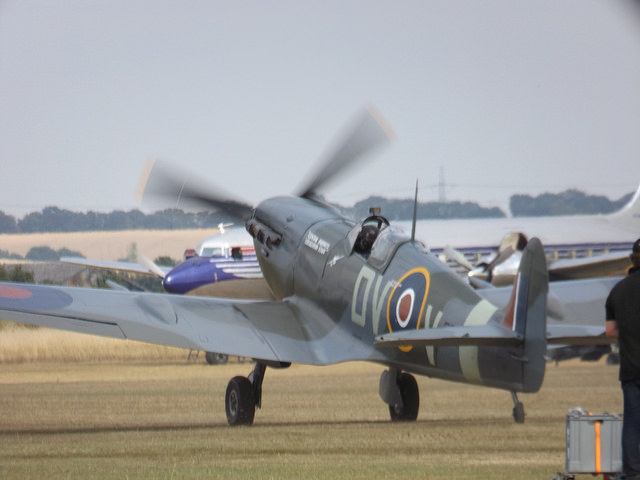
In this post, we review a Spitfire September. First, we take a look at the new Spitfire documentary film. Next, the Battle of Britain Air Show at IWM Duxford, and finally, John Nichol’s book, Spitfire: a Very British Love Story. Tally-Ho!
The 15th of September is Battle of Britain day. It commemorates a turning point in the struggle for aerial supremacy in the skies over Britain fought by the RAF and German Luftwaffe during the summer and autumn of 1940. German daylight raids would eventually cease by the end of October, and Operation Sealion, the German codename for the amphibious invasion of southern England, would be cancelled. It was Nazi Germany’s first significant defeat. A victory won by a handful of daring pilots from across the globe and two iconic aircraft: the Hawker Hurricane and Supermarine Spitfire. However, one aircraft would go on to capture the hearts and imagination of the nation. Since 1940, the Spitfire has become an enduring symbol of courage, fortitude, ingenuity and Britishness.
Spitfire – Inspiration of a Nation
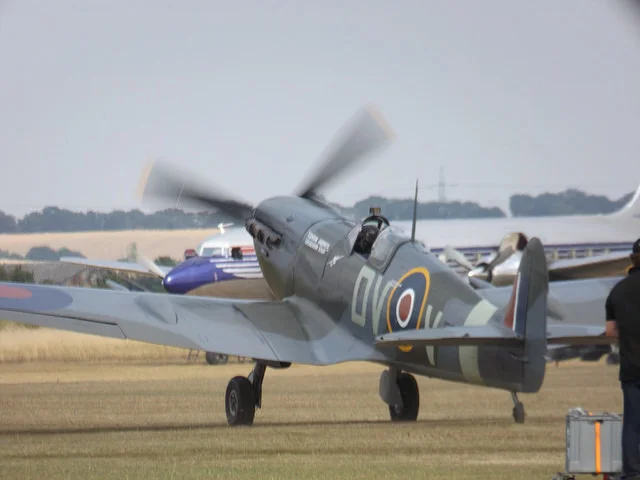
My own little September love affair with the Spitfire started with the release of the documentary film Spitfire – Inspiration of a Nation, directed by David Fairhead and Ant Palmer. Narrated by Charles Dance, the film is a biography of both the aircraft and the men and women who flew it. The original music score by composer Chris Roe and mesmerising aerial photography by director John Dibbs work beautifully together. The film was the last onscreen interview given by Battle of Britain fighter pilot and author Geoffrey Wellum, DFC. The film is also the last testament of Mary Ellis, who flew 76 different types of aircraft during the war as part of the Air Transport Auxiliary (ATA). Ferrying aircraft between factories and operational squadrons, the ATA played a vital support role. During her career, Mary delivered over 400 Spitfires safely to their destinations. The film also features a sound recording of aero engineer and chief designer of the Spitfire, R.J. Mitchell, who died of cancer before his creation went into service. Spitfire is a great piece of documentary film-making, and definitely worth the purchase price.
Battle of Britain Air Show
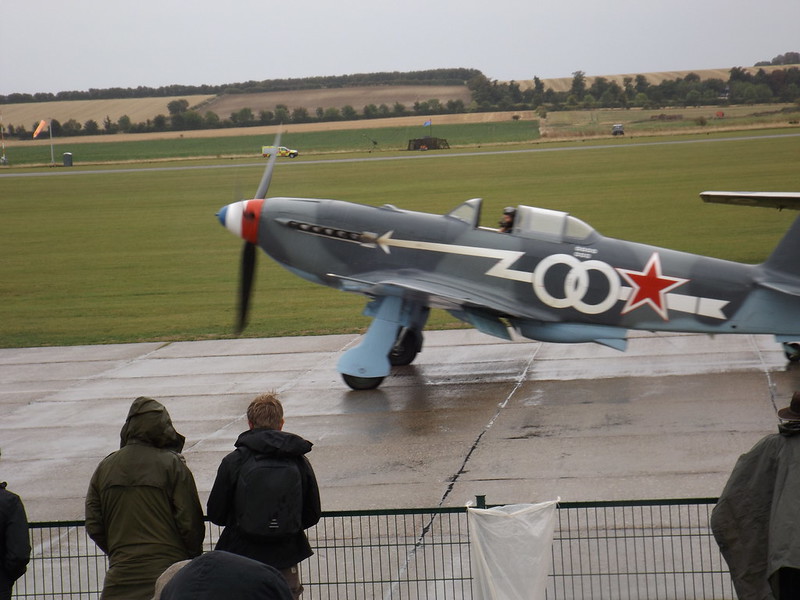
The last event to mark the centenary of the RAF’s first 100 years, the Battle of Britain Air Show was held at the IWM Duxford on the 22nd and 23rd of September, 2018. Unfortunately, the weather on Saturday was extremely challenging with heavy, persistent rain all afternoon. Nevertheless, the event organisers, aircraft owners and pilots did an excellent job. The show told the history of the RAF from its founding at the end of World War One to the modern day. Highlights of the display included two de Havilland Vampire jets, Battle of Britain Memorial Flight (Spitfire, Hurricane and Lancaster), a 617 Squadron flypast (Tornado GR4, new F-35 Lightning II and Avro Lancaster) and the Red Arrows. The show closed with a formation of 18 Spitfires. We also got to see iconic warbirds such as the P-51D Mustang, Boeing B-17 Flying Fortress, Catalina seaplane, Westland Lysander and Soviet Yak 3. Sadly, the MiG-15 was not able to fly due to adverse weather conditions. The Battle of Britain Air Show was a very impressive event, and one I would highly recommend. There’s nothing like seeing 18 Spitfires take to the sky, and listening to the combined roar of all those Merlin and Griffon engines.
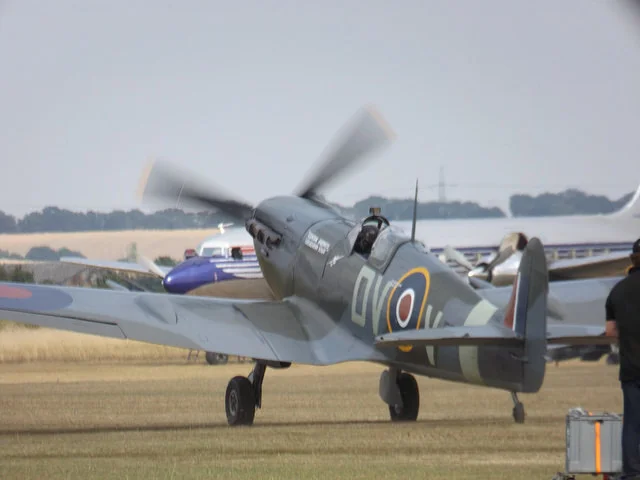
Spitfire: a Very British Love Story
Finally, I finished my Spitfire September by reading John Nichol’s book Spitfire: a Very British Love Story. A former RAF pilot, John Nichol knows a thing or two about aerial combat. During the 1991 Gulf War, he was shot down, captured and tortured by Iraqi forces. His book examines the Spitfire’s origins and continued development during the war years when the threat from new enemy aircraft demanded constant innovation. When the Spitfire was finally retired from RAF service in 1957 there had been 47 variants including the Fleet Air Arm’s Seafires. However, the book is really a collection of stories about the different roles the Spitfire played in the lives of frontline pilots such as Allan Scott and Hugh ‘Cocky’ Dundas, and ATA pilots like Diana Barnato Walker. Sadly, unlike the beloved Spitfire, the veterans of the conflict do not endure. John Nichol interviewed around 40 veterans over a three-year period of research and writing his book. By the time it was published only three were still with us. Soon the “greatest generation” will be gone forever, but while Spitfires continue to fly, let us hope they will never be forgotten.

Fragments of Triumph and Tragedy
In this blog, we look at two fragments of World War Two aviation history, one a German Luftwaffe Bf-109E-3 and the other a Royal Air Force Spitfire Mk.Vb. We learn how one pilot was to survive a short, brutal dogfight and how the other was to die and only receive a proper burial 70 years later.
Britain stands alone
After the invasion and occupation of France by Nazi Germany between May and June 1940, Britain stands alone. In July 1940, the struggle for air supremacy over the British Isles begins. The Battle of Britain will last three and a half months. Initially, the German Luftwaffe (air force) attacks dockyards and British shipping in the English Channel. The Royal Air Force (RAF), equipped with fewer fighters, seems hopelessly outmatched. However, the RAF does have some advantages. Thanks to Hugh Dowding, head of Fighter Command, Britain possesses the world’s first truly integrated air defence system including radar technology. As well as knowing when and where the enemy will strike, Dowding ensures Fighter Command is equipped with Hurricanes and Spitfires to intercept them. The RAF also enjoys home advantage while German aircraft operate at the extreme of their range.
The last flight of Lt. Albert Striberny
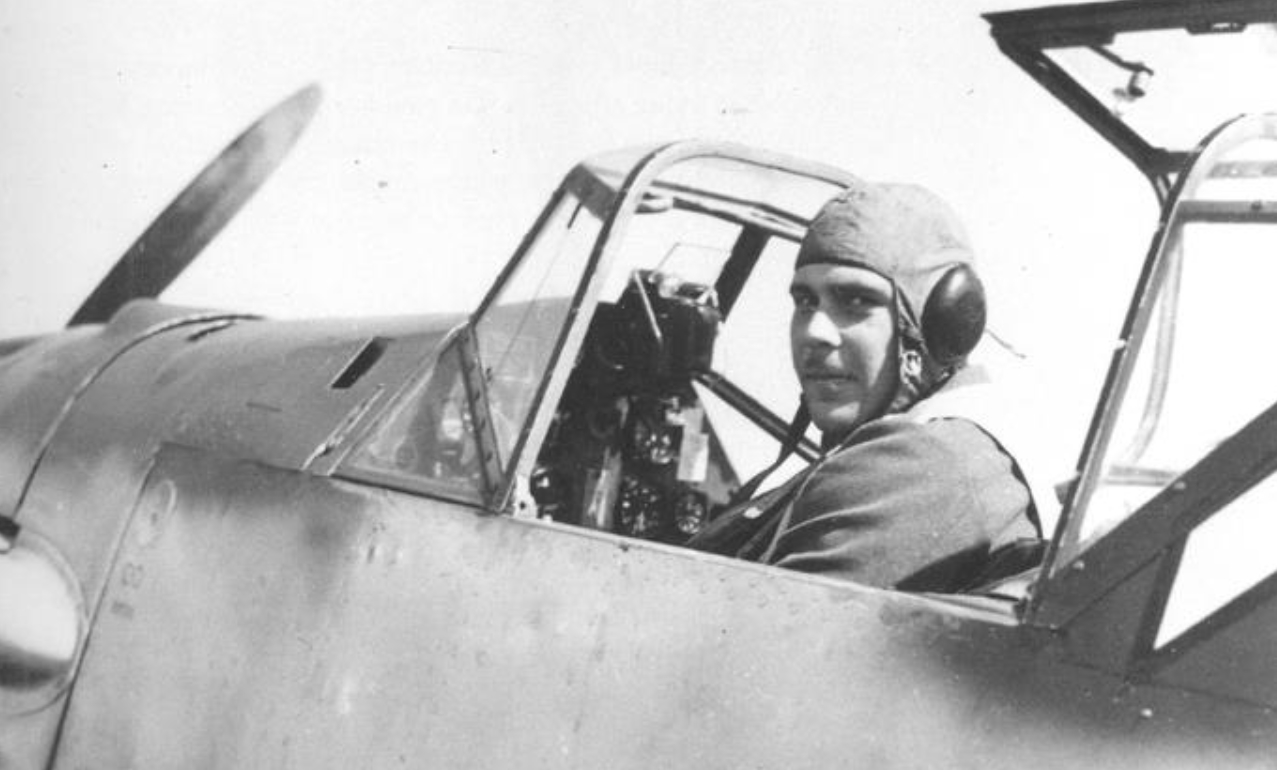
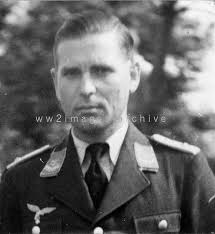
On 8 July 1940, just as the Battle of Britain is about to begin, Leutnant Albert Striberny, 3/LG2 (3 Staffel/Lehrgeschwader2), is sitting in his Messerschmitt Bf 109E-3 (work no. 2964). It’s early evening, and Lt. Striberny thinks he’s done for the day. Instead, his Staffel is ordered to escort a Dornier 17 (Do 17) on a reconnaissance mission over Dover. Once over the target, the Spitfires of 54 Squadron jump the Staffel.
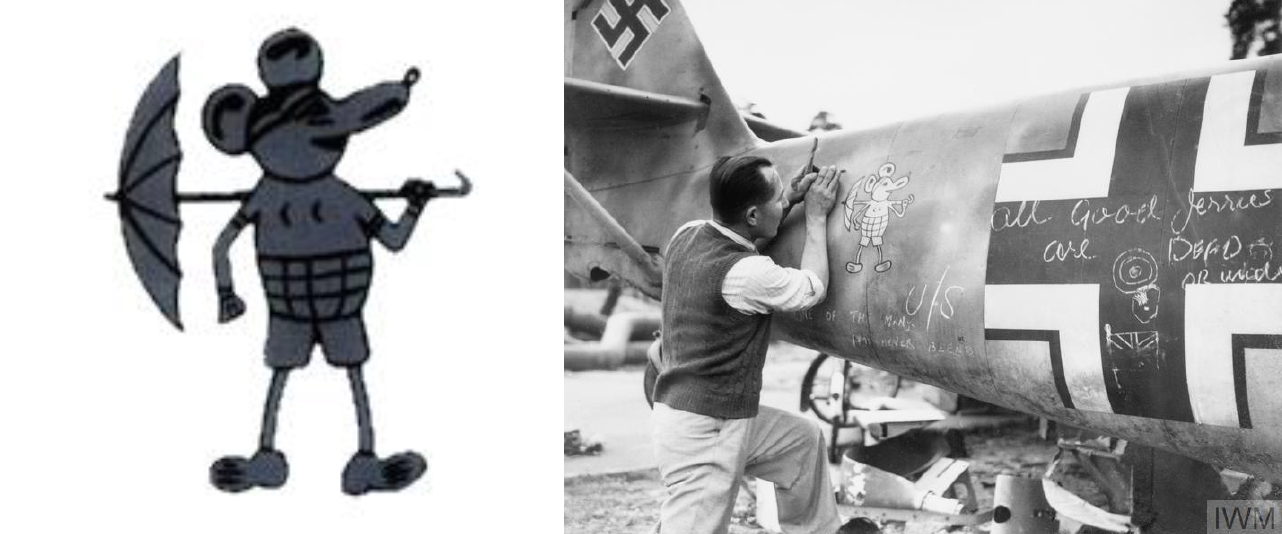
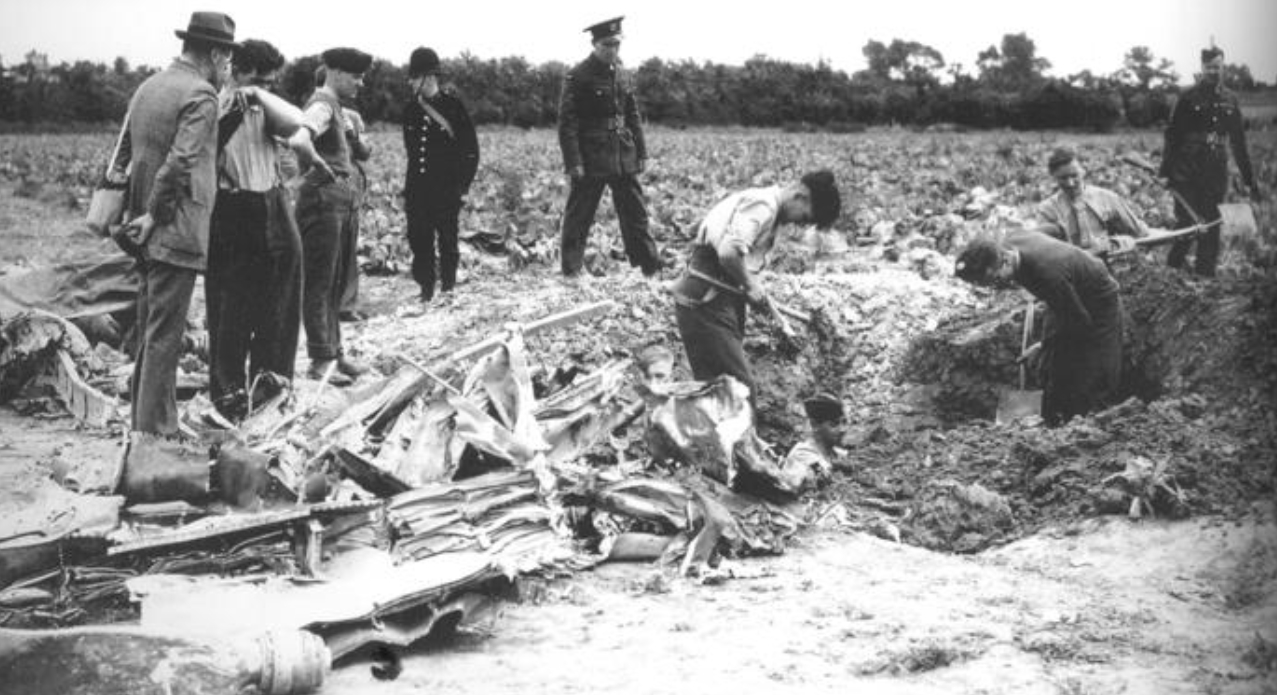
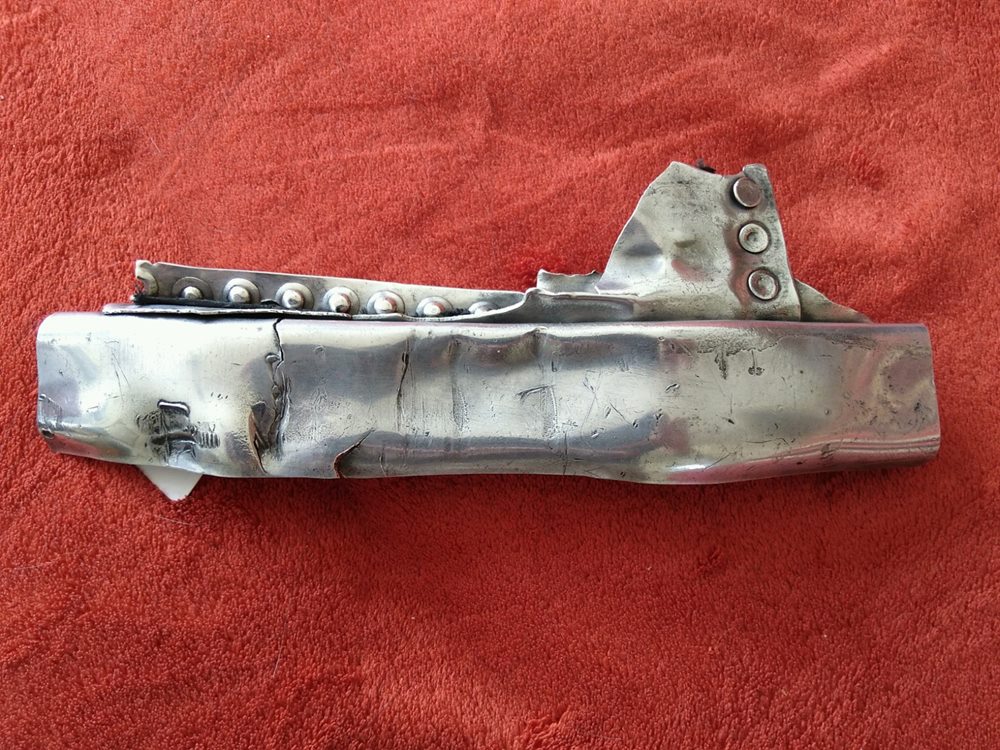
Striberny manoeuvres his Bf 109 behind a Spitfire only to discover another one is on his tail. It isn’t much of a fight. He hears a sound like someone throwing peas against a metal sheet and the cockpit fills with black smoke. Covered in aviation fuel, Striberny prepares to bail out, but he’s worried about hitting the tailplane when he makes his escape. Finally, he slides open the cockpit canopy, flips the plane over, releases his straps and drops out. The parachute opens; he floats gently to earth and is immediately taken, prisoner. His Bf 109 doesn’t do so well. It crashes, disintegrating on impact, at Buckland Farm, Sandwich, Kent. One of the few recognisable pieces is the tail section with the unit’s Micky Mouse insignia. 78 years later, almost to the day, I picked up a piece of that Bf 109E-3 at Flying Legends.
Click to move to next image
Tragic accident
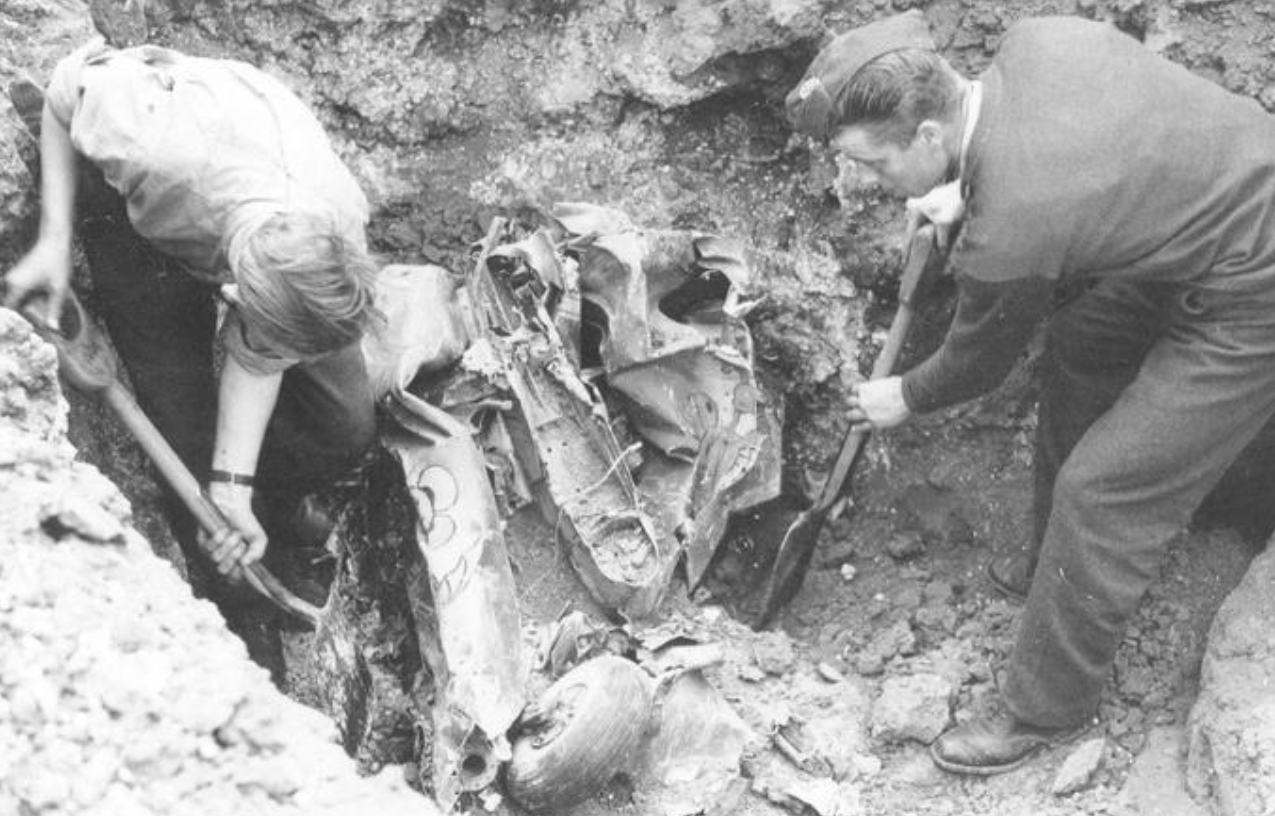
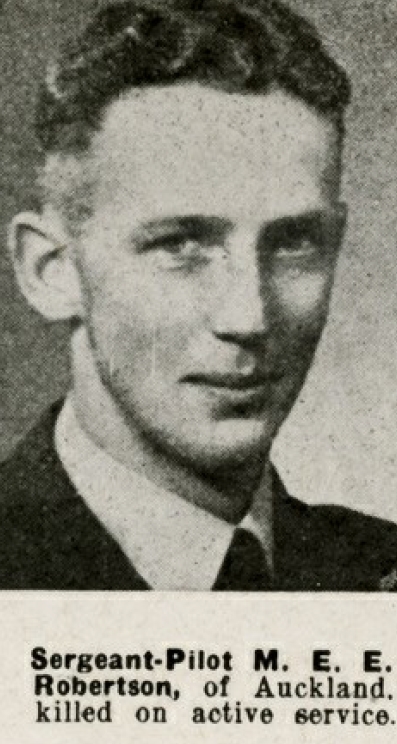
Spitfire AR403 was an Mk Vb built by Westland Aircraft under licence. The aircraft was fitted with the signature Merlin 45 engine and armed with two 20mm cannons and four .303 machine guns. On 11 April 1942, she was delivered to the 38 maintenance unit and then joined the 131 Squadron. She then went to 165 Squadron based at Llanbede. In August, the squadron moved south to Gravesend and started operational sweeps against the Luftwaffe over Northern France. Next, she was transferred to the 65 Squadron. On 16 January 1943 AR403 piloted by New Zealander Sgt. Malcolm Robertson was on a training flight over southern Scotland. The exercise was to practice climbing and aerobatic manoeuvres. However, during one of these manoeuvres, the Spitfire was reported to have dived vertically out of the cloud. It crashed into the grounds of Wedderlie House, catching fire on impact.
Click to move to the next image

A final resting place for Sgt. Robertson
Sadly, Sgt. Malcolm Robertson was killed in the crash. He was laid to rest at Craigton Cemetery, Glasgow. However, in 2012, following an expert anthropological examination, further human remains were found at the crash site. These remains were positively identified as belonging to Sgt. Robertson. These remains were reinterred during a ceremony with “the honour and dignity” befitting a pilot at Sgt. Robertson's grave in 2013. An initial crash inspection in 1943 recovered parts of a uniform, dog tags and a single flight boot, which were interred at Craigton Cemetery in Glasgow, following a wartime board of inquiry. Sgt. Robertson was just 21 years old. An exhibition of artefacts from Spitfire AR403 was held near Edinburgh to help raise funds for a memorial to Sgt. Robertson.
Sources: www.deadlinenews.co.uk, www.iwm.org.uk/collections/photographs

The Ghosts of Tangmere
In this blog post, we visit Tangmere Military Aviation Museum, once a frontline RAF fighter base during the Battle of Britain and home to the UK's airspeed records.
What to do on a cold, wet, windy November day? Well, you could take a trip back in time to the Battle of Britain or the post-war golden age of aviation. Once a frontline RAF base and home of the world airspeed record, the Tangmere Military Aviation Museum is situated just outside Chichester off the A27. Admission is currently £9.00 for adults, £3.00 for children, £7.00 for seniors and a family ticket (two adults, two children) £21.00. There are also discounted rates for service personnel and groups – see the website for more information.
Planning Your Visit
On arrival, one of the museum’s friendly volunteers furnished me with a map and briefly explained the layout. The museum is organised into a number of halls plus the NAAFI cafeteria, memorial garden and outside exhibits. Ask reception to book your ride in the English Electric flight simulator. I started my tour in the Battle of Britain Hall, which contains a large collection of artefacts, documents, photographs and paintings. The hall is somewhat dominated by the excavated remains of Sergeant Dennis Noble’s Hawker Hurricane fighter. You can listen to a recording of James Nicolson, the only RAF fighter pilot to win the Victoria Cross during World War Two, telling his story. Moving onto Middle Hall, you will find a varied collection of items including a chunk of the Mohne Dam, famously breached by the Lancaster bombers of 617 Squadron (Dambusters) back in 1943.
Airspeed Records
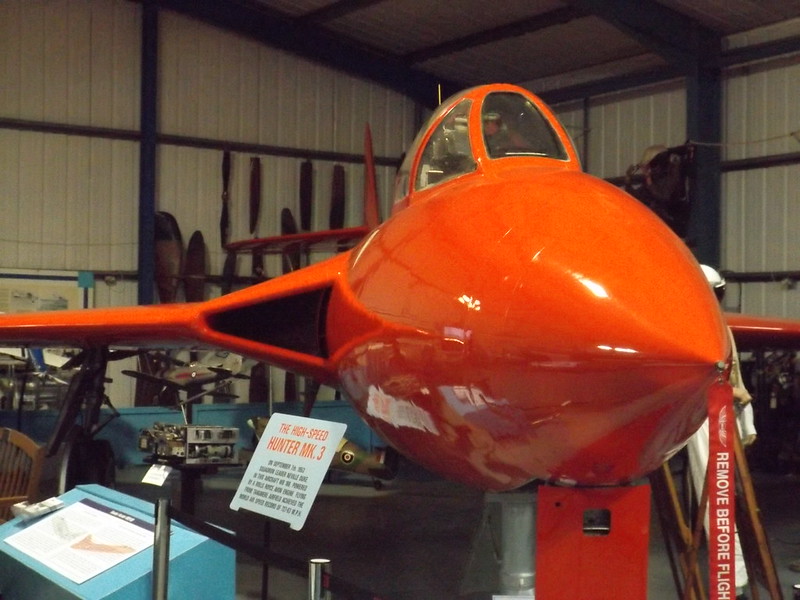
Making your way back towards the main reception area, you enter Merston Hall, which houses two world airspeed record-holding aircraft. In 1946, Edward Donaldson clocked up 615.78mph in the Gloster Meteor. In 1953, Neville Duke achieved 727.6mph in the bright red Hawker Hunter. The Merston Hall also contains a Supermarine Swift, Canberra cockpit, replica Spitfire prototype and Hawker Hurricane. Next door, in the Meryl Hansed Memorial Hall you will find an English Electric Lightning and Mk 5 Hawker Hunter.
The Tangmere Hall, as the name suggests, tells the story of the airfield from 1917 to 1970. There are exhibits on the SOE (Special Operations Executive) and Lysanders that delivered agents into occupied Europe, the Royal Flying Corps (forerunner of the RAF), Bomber Command, Women’s Auxiliary Air Force (WAAF) and Air Transport Auxiliary (ATA). The abysmal November weather meant that I didn’t get a chance to tour the memorial garden or air raid shelter.
Blue Phantom
Outside, you will find a McDonnell Douglas Phantom, a couple of Harriers, a de Havilland Sea Vixen, Lockheed T-33A, Gloster Meteor and a Westland Wessex helicopter. In the covered shed, currently being restored, is a de Havilland Vampire. Additional facilities include a small military aviation library and Neville Duke Hall, available for group lunches. The museum is a charitable trust, staffed by a dedicated group of volunteers.
Ghosts
During my visit, I noticed one of the volunteers taking a group of Scouts around the museum. Each time the volunteer asked the group a question, a sullen chorus of “Don’t know” was the response. The Scouts reminded me of Harry Enfield’s sulky comedy creations, Kevin and Perry. These gloomy, apathetic children made me bristle. However, I guess all they saw were the dusty ghosts of a lost generation, and ruins of a once mighty aircraft industry. To be honest, I don’t envy them. After all, they have inherited a country that has been in terminal decline since the war. Let us hope, the lessons of our history can still inspire them to build something better.
Many thanks for visiting The War Years blog. Please leave your comments and don’t forget to share this post on social media.

Visit the Home of Fighter Command
In this post, we visit the former Headquarters of RAF Fighter Command during the Battle of Britain, The Bentley Priory Museum in Stanmore, a suburb of Northwest London. It was here that Sir Hugh Dowding oversaw the air defence of the UK during the dark days of 1940.
They say that good things come in small packages, well, that’s certainly true of the Bentley Priory Museum. Nestled in the leafy, North London suburb of Stanmore, the Bentley Priory Museum is housed in a Grade II listed building that was once the Headquarters of RAF Fighter Command. It was from here that Air Chief Marshal, Sir Hugh Dowding directed the Battle of Britain in the dark days of 1940.
The RAF officially left Bentley Priory in 2008. Renovation work on the beautiful Mansion House was completed in 2012. The museum finally opened its doors to visitors in 2013. You can buy admission tickets from reception, which also doubles as a small gift shop. Adult single admission costs £8.80 at the time of writing with family tickets, and senior and armed services discounts available. After purchasing your ticket you will be furnished with a simple map of the museum layout. Before starting your tour proper, it’s advisable to watch an excellent ten-minute film that briefly explains the leadership role of Air Chief Marshal, Sir Hugh Dowding, Commander-in-Chief of RAF Fighter Command, during the Battle of Britain. The film is screened in the anteroom of Hugh Dowding’s office. Sadly, due to a number of thefts, visitors can no longer enter Dowding’s office, but you do get a tantalising glimpse into the room during the film.
Dowding oversaw the development of the world’s first integrated air defence system. The complex system relied on early Radar technology for detection, Filter and Operations Rooms to process incoming data, and RAF Group Headquarters to direct intercept fighter aircraft. This brilliant combination of organisational ability and technological innovation made the Dowding System so decisive during the Battle of Britain. After watching the film, make a point of taking a look at the two-page letter from Dowding to Prime Minister Winston Churchill that hangs on the wall by the film room door. The letter rationally argues the case for holding back a significant proportion of the RAF’s fighter squadrons from the battle for France. Had Dowding not written the letter, and Churchill agreed with its conclusions, then the defeat of Allied forces in France might have meant Britain’s capitulation to Nazi Germany. After all, there would have been no Fighter Command left to fend off the Luftwaffe.
Moving down the hallway into the Rotunda, visitors are greeted by an amazing collection of portraits, medals, pilots log books, original World War Two artefacts and Battle of Britain memorabilia. As well as providing wonderful vignettes of “The Few” (a collective noun for Battle of Britain pilots), the Rotunda uses wall panels and touchscreen terminals to tell the bigger picture of the conflict, the people and technologies deployed. A small collection of items that once belonged to Neville Duke immediately caught my eye. Squadron Leader Neville Duke, DSO, OBE, DFC and two bars, AFC and FRAeS was a celebrated fighter ace and later became a famous test pilot. On 7 September 1953, Duke set a new world air speed record of 727.63mph flying a Hawker Hunter.
Next, you move into the ballroom that overlooks the manicured Italian Gardens. The ballroom served as an Operations Room from 1937 to March 1940. The Operations Room was then moved to an underground bunker just before the Battle of Britain started. A mock-up Spitfire cockpit proved very popular with the younger visitors. The ballroom can accommodate around 120 people, so ideal for corporate events and private functions.
A critical part of the Dowding System of air defence was the Filter Room. The Filter Room at Bentley Priory has been lovingly recreated as part of the Museum’s exhibition galleries. Mainly staffed by members of the Women's Auxiliary Air Force (WAAF), the Filter Room collated information coming from the radar stations dotted along the coast. Only once enough data had been collected to reliably plot the track of enemy aircraft would the information be passed along to the appropriate Operations Room to organise a welcoming party of Spitfires or Hurricanes. Filter Room information was also used for air raid warnings and anti-aircraft batteries.
Finally, take a look at the Queen Adelaide Room and grand staircase before heading for the museum’s café for tea and cake. The museum volunteers are immensely helpful, knowledgeable and friendly. The museum provides a range of primary and secondary school learning experiences such as Plot the Battle of Britain. A tour of the museum takes about an hour and a half, so why not double up with a visit to the Battle of Britain Bunker at RAF Uxbridge or the RAF Museum, Hendon, just 11 miles away. The museum has ample parking for cars and coaches but isn’t so easily reached by public transport. The nearest Tube station is Stanmore, but you’ll need to get a bus from there or be prepared for a 40-minute walk.
Sir Hugh Dowding is one of the lesser-known Allied commanders of World War Two. Sadly, Dowding was the victim of political manoeuvring within the RAF and at Westminster, not helped by his own brusque personality. He was replaced as head of Fighter Command in November 1940. He retired from the RAF in 1942. Certainly, it’s a great shame that Hugh Dowding is not better known for his extraordinary contribution to the technical advancement of the RAF and the defence of Britain.
Visit my Flickr account to see our photo gallery of the Bentley Priory Museum