
Blog
The Second World War resulted in the deaths of around 85 million people. Additionally, tens of millions more people were displaced. However, amid all the carnage, people demonstrated remarkable courage, fortitude, compassion, mercy and sacrifice. We want to honour and celebrate all of those people. In the War Years Blog, we examine the extraordinary experiences of individual service personnel. We also review military history books, events, and museums. We also look at the history of unique World War II artefacts, medals, and anything else of interest.

D-Day 75th Anniversary Commemoration
As part of the D-Day 75th-anniversary commemorations, The War Years will be adding a range of content over the coming week.
As part of the D-Day 75th-anniversary commemorations, The War Years will be adding a range of content over the coming week.
The Story of D-Day, Part One
The Plan
The largest amphibious operation in military history, code-named Overlord, D-Day started in the early hours of 6 June 1944. The objective was an 80 km stretch of the Normandy coastline. An armada of 7000 ships planned to land 175,000 men, 50,000 vehicles and all their equipment by day’s end. 11,000 aircraft, oil pipelines under the English Channel and even giant Mulberry Harbours would be towed across the sea.
Neptune
Operation Neptune was the naval element of the Overlord plan. 7,000 vessels from battleships to landing craft, Neptune was truly an allied effort. British, American, Canadian, French, Norwegian, Dutch, Polish and Greek vessels all played a part in enabling the landing’s success.
The Landings
The Allies planned to land on 5 beaches code-named Utah, Omaha, Gold, Juno and Sword. The flanks or sides of the planned beachhead would be secured by airborne forces dropped during the night and early morning on 5/6 June.
Pegasus Bridge
Strategically important, the bridges over the Caen Canal and Orne River had to be captured to enable Allied tanks to operate east of the river, and prevent German counter-attacks against the landings.
Seized by a daring glider assault the bridges were successfully captured by Major John Howard’s D Company, 2nd Battalion, Ox and Bucks Light Infantry at just after midnight, 6 June 1944. Once captured it was vital Major Howard’s men held the bridges against counter-attacks until relieved by Lord Lovat’s 1st Special Service Brigade at 1 pm.
Merville
In the area immediately east of Sword Beach, some 4,800 elite airborne troops landed by parachute and glider. Men of the 9th Parachute Battalion took the German coastal battery at Merville that threatened the British landing beaches.
US Paratroops
The American 82nd and 101st Airborne Divisions secured the flanks of the US beaches. However, the 6,600 men dropped were badly scattered that reducing their initial effectiveness, although this did confuse the German defenders. The paratroopers successfully secured the exits from Utah Beach and captured bridges en route to Carentan.
The Story of D-Day, part Two
The American Beaches
Utah Beach
The D-Day landings started at the low water mark on a rising tide at 06.30hrs in the US sector and 07.30hrs for the British.
Strong coastal currents and obscuration of landmarks due to smoke from naval bombardment meant American invasion forces landed 2,000 yards south of their planned objective on Utah Beach. Luckily the area where troops from the 4th Infantry Division actually landed was less heavily defended, and casualties were mercifully light.
Pointe du Hoc
Just as Pegasus Bridge was vital to the success of the British landings so Pointe du Hoc was important to the Americans. Intelligence reports prior to the landings indicated that six 155mm guns in concrete emplacements sat atop a 177ft cliff. The guns threatened the landings on Utah and Omaha Beaches and had to be destroyed.
The elite 2nd Ranger Battalion was tasked with destroying the guns at Pointe du Hoc by direct assault from the sea, which meant scaling the cliffs while under fire. However, when the Rangers fought their way up to the gun emplacements they found them empty. The guns had been moved inland. Later, the guns were found and destroyed.
Omaha Beach
The most difficult terrain and heavily defended sector, Omaha Beach was the objective of the US 1st and 29th Infantry Divisions. At 5.40 am amphibious DD tanks launched 6,000 yards offshore, nearly all sinking in the heavy seas.
Only 5 tanks made it ashore to support the infantry landings. All but one of the 105mm field artillery guns also vital to the landings were lost. To make matters even worse, the naval and air bombardment had done little to reduce the German defensive positions commanding the exposed beach.
Seasick, heavily laden, troops of the nine companies in the first assault wave were decimated by German machine-gun, mortar and artillery fire. Those troops lucky enough to make it across the open beach took cover behind the sea wall.
The assault on Omaha initially stalled. However, gradually men formed small groups and started fighting their way up the bluffs that overlooked the beach. Later, navy destroyers came dangerously close to shore to give much-needed fire support. By day’s end, Omaha Beach was in American hands.
Brigadier General Norman “Dutch” Cota, several NCOs and Privates received decorations for gallantry during the action at "Bloody Omaha".
Today, 3 June 2019, we post a short video taken back in June 2010 on a visit to Omaha Beach and the American Cemetery and Memorial.
The Story of D-Day, part Three
The British, French and Canadian Beaches
Gold Beach
Westernmost of the British/Canadian beaches, code-named Gold, were assaulted by the 50th Division of the British XXX Corps. Specially developed armoured vehicles were landed ahead of the infantry to deal with beach obstacles, mines and the sea wall. Some 2,500 obstacles and mines needed to be cleared from Gold Beach alone. Allied forces quickly overcame German defences and moved inland.
During the advance of the 69th Brigade, Company Sergeant Major, Stan Hollis of the Green Howards won the Victoria Cross, for repeated acts of valour, Britain’s highest military honour. This was the only VC won on D-Day.
Juno Beach
Canada made a terrific contribution to the Allied war effort. Juno Beach was assigned to the Canadian 3rd Division. Like the British, the Canadians used special armoured vehicles to help overcome beach obstacles, mines and strong points. These vehicles were nick-named Hobart’s “funnies” after their creator Major General Sir Percy Hobart.
The town of Courseulles was strongly defended by the Germans but duly taken. The Queens Own Rifles suffered severe casualties crossing the beach at Bernieres. The Canadians made contact with 50th Division on their right by day’s end.
Sword Beach
The easternmost landing zone, Sword Beach, was assaulted by the British 3rd Division. The 3rd Division’s objectives were perhaps the most ambitious of the D-Day operation: capture or mask the Norman city of Caen by nightfall. The 3rd Division also knew it was likely to be counter-attacked by tanks of the German 21st Panzer (Armour) Division.
British intentions to quickly move off Sword Beach and drive inland were held up by resistance from German strong points. British troops reached Lebisey Wood, just three miles short of Caen, but could advance no further.
Special Forces - The Commandos
French Commandos led by Philippe Kieffer took Ouistreham casino and secured the canal gateway. However, the French suffered heavy casualties and Kieffer was wounded twice during the fighting.
Commandos of the 1st Special Service Brigade landed on the 'Queen Red' sector of Sword Beach at approximately 8.40 am, 6 June 1944. Commanded by Brigadier Simon Fraser, Lord Lovat, the 1st Special Service Brigade’s mission was to push inland and link up with the lightly armed British 6th Airborne Division holding Pegasus Bridge and bridge over the Orne River.
Today, we have added 241 photos to our Flickr site taken during visits to the D-Day beaches, Pegasus Bridge Memorial and Museum, Normandy American Cemetery and Memorial, Omaha Beach Memorial Museum, Airborne Museum, Sainte-Marie-du-Mont and Sainte-Mère-Église in 2010 and 2014.


Book Review: Courage After The Battle by Peter Jackson-Lee
Courage After The Battle written by ex-Royal Marine and Falklands veteran Peter Jackson-Lee is a book that takes the reader on a journey that most people will never experience. The book is a travelogue that explains how service men and women navigate their way from battlefield injury back to civilian life. Read the full book review now
Courage After The Battle written by ex-Royal Marine and Falklands veteran Peter Jackson-Lee is a book that takes the reader on a journey that most people will never experience. The book is a travelogue that explains how service men and women navigate their way from battlefield injury back to civilian life. The book also examines the history of battlefield medicine, mental healthcare, prosthetics, reconstructive surgery, politics and changes in social welfare. At turns, the book is inspiring, fascinating and deeply troubling.
The book takes a systematic look at what happens to service personnel from the moment they suffer a life-changing wound on the battlefield. It explains the process of evacuation, emergency trauma care and transition to the hospital. Next, the book explains the many different types of battlefield trauma: loss of limbs, facial disfigurement, deafness and blindness. The book also looks at various treatments available such as prosthetics and plastic surgery. However, it is the long shadow cast by mental health and social care issues such as post-traumatic stress disorder (PTSD), depression, drug addiction, alcohol abuse and homelessness that I found the most disturbing. The destructiveness of these hidden wounds, if not treated quickly, spreads out like a pressure wave damaging family, friends and wider society.
The final third of Peter Jackson-Lee’s book explains the covenant between the Armed Services, the Nation and UK Government. The book also lists around 150 national charities and other organisations that provide help and support to current service personnel, veterans and their families. The fact that over 70 pages of the book simply list charitable organisations that offer support is alarming. It demonstrates the betrayal of the Armed Forces Covenant, and the abject failure of government policies stretching back decades. In many ways, this book is the story of a shocking, perennial national disgrace.
The book is written in a balanced, no-nonsense, straightforward style and tone. Peter Jackson-Lee lets the veterans, families, healthcare professionals, charity workers and facts speak for themselves. He explains the history of every technical, medical and procedural advance that makes suffering a battlefield injury move survivable. However, while the overall survivability of battlefield injuries has steadily increased, the opposite is true of long-term care. Consecutive governments have overseen punitive cuts in the provision of everything from mental healthcare to housing, and much more besides.
From Trafalgar, Waterloo and the Battle of Britain to the Falklands, Iraq and Afghanistan, the Armed Services have always been there to protect this country’s national interests with their lives. Nevertheless, the compact between the State and its servicemen and women has always been an unequal one. Service personnel are expected to make the ultimate sacrifice without complaint when called upon to do so. In contrast, our politicians, the Ministry of Defence (MOD) and civil servants can renege on every promise and betray every commitment. While our service men and women are driven by loyalty, courage and comradeship, the politicians and bureaucrats are driven by arrogance, ignorance and greed.
Reading Courage After The Battle makes you ask the question, why would anyone join the Armed Services? In 2018, a National Audit Office (NAO) report found the Armed Services had a shortfall of 8,200 regulars (full-time service personnel). In December 2018, it was widely reported that a £495m contract with the outsourcing giant Capita had clearly failed to achieve the Army’s recruitment targets. What’s more, half of the Army’s applicants subsequently dropped out of the process. Another monumental waste of public money that could have been better spent elsewhere.
Interestingly, a Harvard Institute of Politics (IOP) survey found that while many millennials (18 to 29 years old) generally supported the US military’s war against Islamic State (ISIS), they themselves did not want to take part. One reason many millennials gave for not wanting to join the US military was a “deep distrust about all things relating to the government.” Clearly, books like Courage After The Battle can help today’s young people make better-informed decisions about joining the military, and the potential long-term consequences of doing so. The book also shines a light on the many shameful actions perpetrated by British politicians, civil servants and bureaucrats against our veterans and their families. Something to think about the next time you go to the polls.
Courage After The Battle is published by Brown Dog Books.
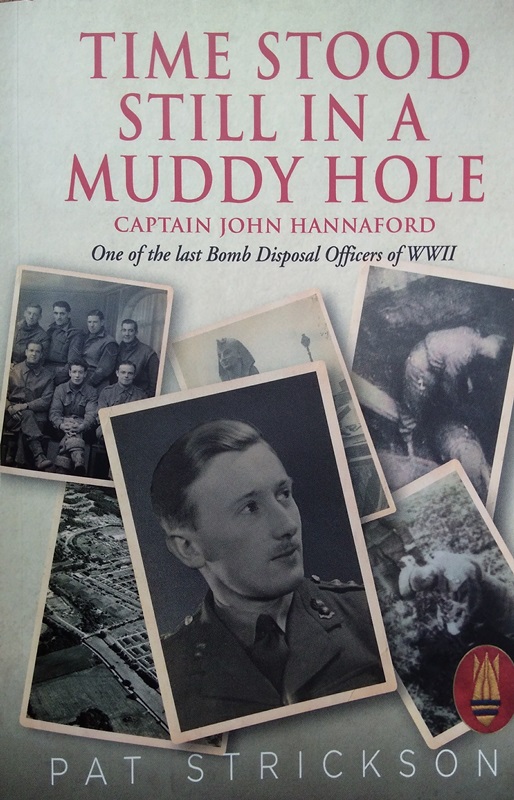
Living on Borrowed Time, the Story of Captain John Hannaford
In her book Time Stood Still in a Muddy Hole, first-time author Pat Strickson tells the fascinating true story of Captain John Hannaford, one of the UK’s last Bomb Disposal officers of World War Two. Read the full book review now on The War Years.
As a boy, I loved to watch actor Anthony Andrews play Lieutenant Brian Ash in the TV series Danger UXB. The show revolved around the daring exploits of a young Royal Engineers officer posted to a Bomb Disposal unit during the London Blitz. In reality, over 50,000 bombs were successfully defused during World War Two for the loss of 580 men and one woman killed while serving with the Royal Engineers Bomb Disposal. A dirty, nerve-racking and incredibly dangerous job that required a special type of courage. However, a job that was never officially recognised after the war.
In her book Time Stood Still in a Muddy Hole, first-time author Pat Strickson tells the fascinating true story of Captain John Hannaford, one of the UK’s last Bomb Disposal officers of World War Two. In fact, Pat’s book is really two stories. One is about the life and career of one Avro Frederick John Hannaford. Personally, I think it’s a great name, but John never appreciated it. His father was a World War One pilot and named him after the Avro aircraft company. The second, parallel story is Pat’s own journey to becoming a historical researcher, author and custodian of John’s legacy.
It was only towards the end of his life that John started to talk about his wartime experiences. Luckily, once he started he couldn’t stop. He was interviewed for a Channel 4 documentary series by the Imperial War Museum as well as local press. Sadly, he died on Armistice Day 2015, aged 98, without ever meeting his biographer. A year later, Pat came across a watercolour of a Bexhill landmark in a local charity shop. Her desire to learn more about the artist would lead to years of painstaking research and countless hours in front of the computer. I think the end result was worth the effort.
John’s early career as an apprentice architect working at the Royal Ordnance Factory Chorley made him an ideal candidate for officer training in Bomb Disposal. Once qualified, John’s life expectancy was just ten weeks. The physical rigours of the job and the constant threat of being vaporised created a unique camaraderie between John and his men. Nevertheless, after two years the stress of the job gave him a duodenal ulcer, which probably saved his life. The men of John’s section were not so fortunate. When tragedy struck, it wasn’t due to enemy action. However misplaced the sense of guilt, John never quite forgave himself for not being there. After the war, he would marry; raise a family and go on to have a successful career as an architect. But the war cast a long shadow.
John was a much-loved and respected member of his community. That knowledge must have placed the weight of expectation squarely on Pat Strickson’s shoulders. So telling his story faithfully required tact, sensitivity and honesty from the author. Pat’s use of the literary technique known as a frame story works well, essentially telling John’s story by telling her own. Overall, the book is well-researched, engaging and informative. I also found it shocking and laugh-out-loud funny at turns. I always think it’s hard to criticise the quality of a biography, after all, who really knows anyone? But the book feels authentic. However, I did find one factual inaccuracy. John’s wife Joyce had been married and widowed. Her first husband was killed during the fighting at Arnhem in 1944. Arnhem is in Holland, not Belgium.
Like so many wartime veterans, John remained haunted by his experiences and yearned to see his comrades properly recognised for their courage, devotion to duty and sacrifice. Pat Strickson’s book certainly goes some way to balancing the scales.

The Ghosts of Tangmere
In this blog post, we visit Tangmere Military Aviation Museum, once a frontline RAF fighter base during the Battle of Britain and home to the UK's airspeed records.
What to do on a cold, wet, windy November day? Well, you could take a trip back in time to the Battle of Britain or the post-war golden age of aviation. Once a frontline RAF base and home of the world airspeed record, the Tangmere Military Aviation Museum is situated just outside Chichester off the A27. Admission is currently £9.00 for adults, £3.00 for children, £7.00 for seniors and a family ticket (two adults, two children) £21.00. There are also discounted rates for service personnel and groups – see the website for more information.
Planning Your Visit
On arrival, one of the museum’s friendly volunteers furnished me with a map and briefly explained the layout. The museum is organised into a number of halls plus the NAAFI cafeteria, memorial garden and outside exhibits. Ask reception to book your ride in the English Electric flight simulator. I started my tour in the Battle of Britain Hall, which contains a large collection of artefacts, documents, photographs and paintings. The hall is somewhat dominated by the excavated remains of Sergeant Dennis Noble’s Hawker Hurricane fighter. You can listen to a recording of James Nicolson, the only RAF fighter pilot to win the Victoria Cross during World War Two, telling his story. Moving onto Middle Hall, you will find a varied collection of items including a chunk of the Mohne Dam, famously breached by the Lancaster bombers of 617 Squadron (Dambusters) back in 1943.
Airspeed Records
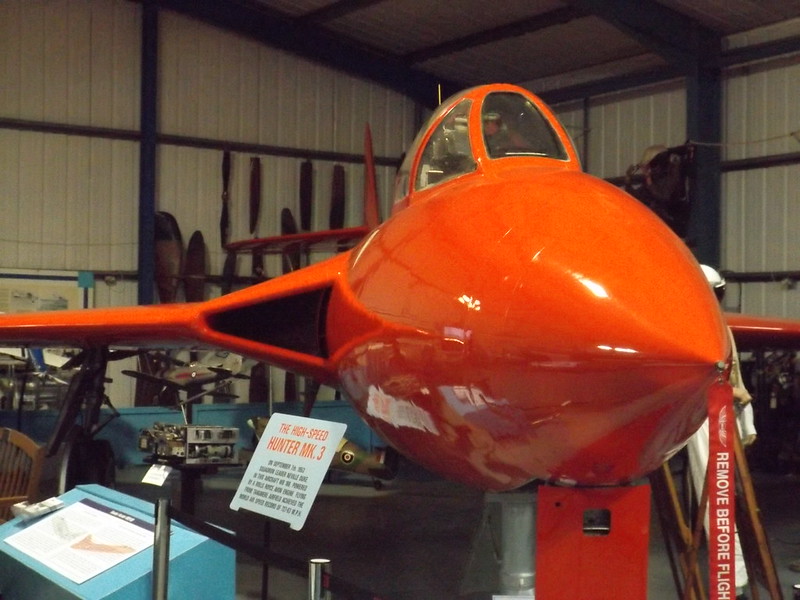
Making your way back towards the main reception area, you enter Merston Hall, which houses two world airspeed record-holding aircraft. In 1946, Edward Donaldson clocked up 615.78mph in the Gloster Meteor. In 1953, Neville Duke achieved 727.6mph in the bright red Hawker Hunter. The Merston Hall also contains a Supermarine Swift, Canberra cockpit, replica Spitfire prototype and Hawker Hurricane. Next door, in the Meryl Hansed Memorial Hall you will find an English Electric Lightning and Mk 5 Hawker Hunter.
The Tangmere Hall, as the name suggests, tells the story of the airfield from 1917 to 1970. There are exhibits on the SOE (Special Operations Executive) and Lysanders that delivered agents into occupied Europe, the Royal Flying Corps (forerunner of the RAF), Bomber Command, Women’s Auxiliary Air Force (WAAF) and Air Transport Auxiliary (ATA). The abysmal November weather meant that I didn’t get a chance to tour the memorial garden or air raid shelter.
Blue Phantom
Outside, you will find a McDonnell Douglas Phantom, a couple of Harriers, a de Havilland Sea Vixen, Lockheed T-33A, Gloster Meteor and a Westland Wessex helicopter. In the covered shed, currently being restored, is a de Havilland Vampire. Additional facilities include a small military aviation library and Neville Duke Hall, available for group lunches. The museum is a charitable trust, staffed by a dedicated group of volunteers.
Ghosts
During my visit, I noticed one of the volunteers taking a group of Scouts around the museum. Each time the volunteer asked the group a question, a sullen chorus of “Don’t know” was the response. The Scouts reminded me of Harry Enfield’s sulky comedy creations, Kevin and Perry. These gloomy, apathetic children made me bristle. However, I guess all they saw were the dusty ghosts of a lost generation, and ruins of a once mighty aircraft industry. To be honest, I don’t envy them. After all, they have inherited a country that has been in terminal decline since the war. Let us hope, the lessons of our history can still inspire them to build something better.
Many thanks for visiting The War Years blog. Please leave your comments and don’t forget to share this post on social media.

Visit the Home of Fighter Command
In this post, we visit the former Headquarters of RAF Fighter Command during the Battle of Britain, The Bentley Priory Museum in Stanmore, a suburb of Northwest London. It was here that Sir Hugh Dowding oversaw the air defence of the UK during the dark days of 1940.
They say that good things come in small packages, well, that’s certainly true of the Bentley Priory Museum. Nestled in the leafy, North London suburb of Stanmore, the Bentley Priory Museum is housed in a Grade II listed building that was once the Headquarters of RAF Fighter Command. It was from here that Air Chief Marshal, Sir Hugh Dowding directed the Battle of Britain in the dark days of 1940.
The RAF officially left Bentley Priory in 2008. Renovation work on the beautiful Mansion House was completed in 2012. The museum finally opened its doors to visitors in 2013. You can buy admission tickets from reception, which also doubles as a small gift shop. Adult single admission costs £8.80 at the time of writing with family tickets, and senior and armed services discounts available. After purchasing your ticket you will be furnished with a simple map of the museum layout. Before starting your tour proper, it’s advisable to watch an excellent ten-minute film that briefly explains the leadership role of Air Chief Marshal, Sir Hugh Dowding, Commander-in-Chief of RAF Fighter Command, during the Battle of Britain. The film is screened in the anteroom of Hugh Dowding’s office. Sadly, due to a number of thefts, visitors can no longer enter Dowding’s office, but you do get a tantalising glimpse into the room during the film.
Dowding oversaw the development of the world’s first integrated air defence system. The complex system relied on early Radar technology for detection, Filter and Operations Rooms to process incoming data, and RAF Group Headquarters to direct intercept fighter aircraft. This brilliant combination of organisational ability and technological innovation made the Dowding System so decisive during the Battle of Britain. After watching the film, make a point of taking a look at the two-page letter from Dowding to Prime Minister Winston Churchill that hangs on the wall by the film room door. The letter rationally argues the case for holding back a significant proportion of the RAF’s fighter squadrons from the battle for France. Had Dowding not written the letter, and Churchill agreed with its conclusions, then the defeat of Allied forces in France might have meant Britain’s capitulation to Nazi Germany. After all, there would have been no Fighter Command left to fend off the Luftwaffe.
Moving down the hallway into the Rotunda, visitors are greeted by an amazing collection of portraits, medals, pilots log books, original World War Two artefacts and Battle of Britain memorabilia. As well as providing wonderful vignettes of “The Few” (a collective noun for Battle of Britain pilots), the Rotunda uses wall panels and touchscreen terminals to tell the bigger picture of the conflict, the people and technologies deployed. A small collection of items that once belonged to Neville Duke immediately caught my eye. Squadron Leader Neville Duke, DSO, OBE, DFC and two bars, AFC and FRAeS was a celebrated fighter ace and later became a famous test pilot. On 7 September 1953, Duke set a new world air speed record of 727.63mph flying a Hawker Hunter.
Next, you move into the ballroom that overlooks the manicured Italian Gardens. The ballroom served as an Operations Room from 1937 to March 1940. The Operations Room was then moved to an underground bunker just before the Battle of Britain started. A mock-up Spitfire cockpit proved very popular with the younger visitors. The ballroom can accommodate around 120 people, so ideal for corporate events and private functions.
A critical part of the Dowding System of air defence was the Filter Room. The Filter Room at Bentley Priory has been lovingly recreated as part of the Museum’s exhibition galleries. Mainly staffed by members of the Women's Auxiliary Air Force (WAAF), the Filter Room collated information coming from the radar stations dotted along the coast. Only once enough data had been collected to reliably plot the track of enemy aircraft would the information be passed along to the appropriate Operations Room to organise a welcoming party of Spitfires or Hurricanes. Filter Room information was also used for air raid warnings and anti-aircraft batteries.
Finally, take a look at the Queen Adelaide Room and grand staircase before heading for the museum’s café for tea and cake. The museum volunteers are immensely helpful, knowledgeable and friendly. The museum provides a range of primary and secondary school learning experiences such as Plot the Battle of Britain. A tour of the museum takes about an hour and a half, so why not double up with a visit to the Battle of Britain Bunker at RAF Uxbridge or the RAF Museum, Hendon, just 11 miles away. The museum has ample parking for cars and coaches but isn’t so easily reached by public transport. The nearest Tube station is Stanmore, but you’ll need to get a bus from there or be prepared for a 40-minute walk.
Sir Hugh Dowding is one of the lesser-known Allied commanders of World War Two. Sadly, Dowding was the victim of political manoeuvring within the RAF and at Westminster, not helped by his own brusque personality. He was replaced as head of Fighter Command in November 1940. He retired from the RAF in 1942. Certainly, it’s a great shame that Hugh Dowding is not better known for his extraordinary contribution to the technical advancement of the RAF and the defence of Britain.
Visit my Flickr account to see our photo gallery of the Bentley Priory Museum

The Museums of RAF Davidstow Moor
In this post, we visit a former Coastal Command airfield, RAF Davidstow Moor, Cornwall, and its two fascinating military history museums that stand in the shadow of a cheese factory.
Cornwall is full of surprises. Hidden a couple of miles from Camelford is a disused World War Two airfield that is now home to a monstrous cheese-making factory and two tiny military museums. RAF Davidstow Moor was once a three-runway airfield (between 1942 and 1954) and then a Formula One racing circuit before being completely abandoned. Today, at 294 metres above sea level, it’s a windswept home for grazing sheep and the dairy industry.
Coastal Command
Between 1942 and 1945, RAF Davidstow Moor was home to B-24 Liberators, B-17 Flying Fortresses, Bristol Beaufighters and Vickers Wellingtons. These aircraft attacked U-boat pens, covered the western flank of the Normandy landings and hunted German submarines and E-boats. As part of Coastal Command, RAF Davidstow Moor also played an important air-sea rescue role flying Lockheed Hudson, Supermarine Walrus and Vickers Warwick twin-engine multi-purpose aircraft.
Davidstow Moor RAF Memorial Museum
In a rather curious arrangement, the Davidstow Moor RAF Memorial Museum and Davidstow Airfield and Cornwall at War Museum are right on top of one another, although completely separate enterprises. Located in the former sergeants' shower block, later used for pig farming, the Davidstow Moor RAF Memorial Museum is dedicated to the airfield’s history. Although tiny, the museum contains a wide selection of authentic artefacts, photographs and documents related to the airfield’s wartime activities and personnel. It also houses an impressive collection of crash site-recovered aircraft fragments (over three thousand) and the history of each event. Visit the museum’s website for more information: http://davidstowmemorialmuseum.co.uk/
Davidstow Airfield and Cornwall at War Museum
Adjacent to the Davidstow Moor RAF Memorial Museum is the Davidstow Airfield and Cornwall at War Museum. The larger of the two museums, the Cornwall at War Museum is spread across something like 17 buildings of various sizes. Each building is numbered, and tours start at the Roxy Cinema, where a rather long (25 minutes) but amusing homemade film explains the museum’s evolution. As you progress around the site, you’ll learn more about Cornwall’s military history, RAF Davidstow Moor and each building’s original use and restoration. There are buildings dedicated to the Royal Navy, RAF Operations, the Royal Marines, World War One, Battle of the Somme, the Homefront, Air-Sea Rescue and Animals at War.
The airfield’s original blast and air raid shelters have also been recovered. The former guardroom is now the gift shop, and you’ll even find some information on the museum’s cheese making neighbours. Completed in 2016, the museum’s hangar houses a growing collection of larger exhibits including a Fairey Gannet, Hawker Hunter F.6 jet aircraft and the cockpit section of a DH Vampire T.11. The hanger is also home to a number of rare airfield and military vehicles. The museum staff are extremely welcoming, there’s a kids play area, and the self-service NAAFI provides refreshments and snacks. For more information on the Cornwall at War Museum visit their website now: http://cornwallatwarmuseum.co.uk/
Having done the picture postcard fishing villages, Poldark, Arthurian legends, tin mines, surfing, cream teas and pasties, Cornwall still has more to offer. It might not be for everyone, but a visit to the former RAF Davidstow Moor airfield and its two fascinating little museums was certainly worth the effort. Finally, you can take a look at The War Years photo album of RAF Davidstow Moor on Flickr now.