
Blog
The Second World War resulted in the deaths of around 85 million people. Additionally, tens of millions more people were displaced. However, amid all the carnage, people demonstrated remarkable courage, fortitude, compassion, mercy and sacrifice. We want to honour and celebrate all of those people. In the War Years Blog, we examine the extraordinary experiences of individual service personnel. We also review military history books, events, and museums. We also look at the history of unique World War II artefacts, medals, and anything else of interest.

War Stories and Myths: Revisiting the Falklands, the Denison Smock, and Arnhem’s Legacy
In this blog article, I bring together reviews of books and documentaries that revisit the Falklands War, unravel the myths of the Denison smock, and challenge long-held beliefs about Arnhem and Operation Market Garden. Join me as I explore how personal accounts and new evidence reshape our understanding of these pivotal moments in military history.
In recent months, I’ve been reading a range of books and viewing a series of documentaries exploring the realities of twentieth-century conflicts. From the windswept battlefields of the Falklands to the airborne drops of Operation Market Garden, these works both in print and on YouTube challenge accepted narratives, expose enduring myths, and offer fresh perspectives on events that continue to shape our understanding of war. In this article, I combine reflections on various military history books and videos to create a narrative about how easily historical facts can become obscured over time.
The Falklands War: Personal Accounts and Broader Perspectives
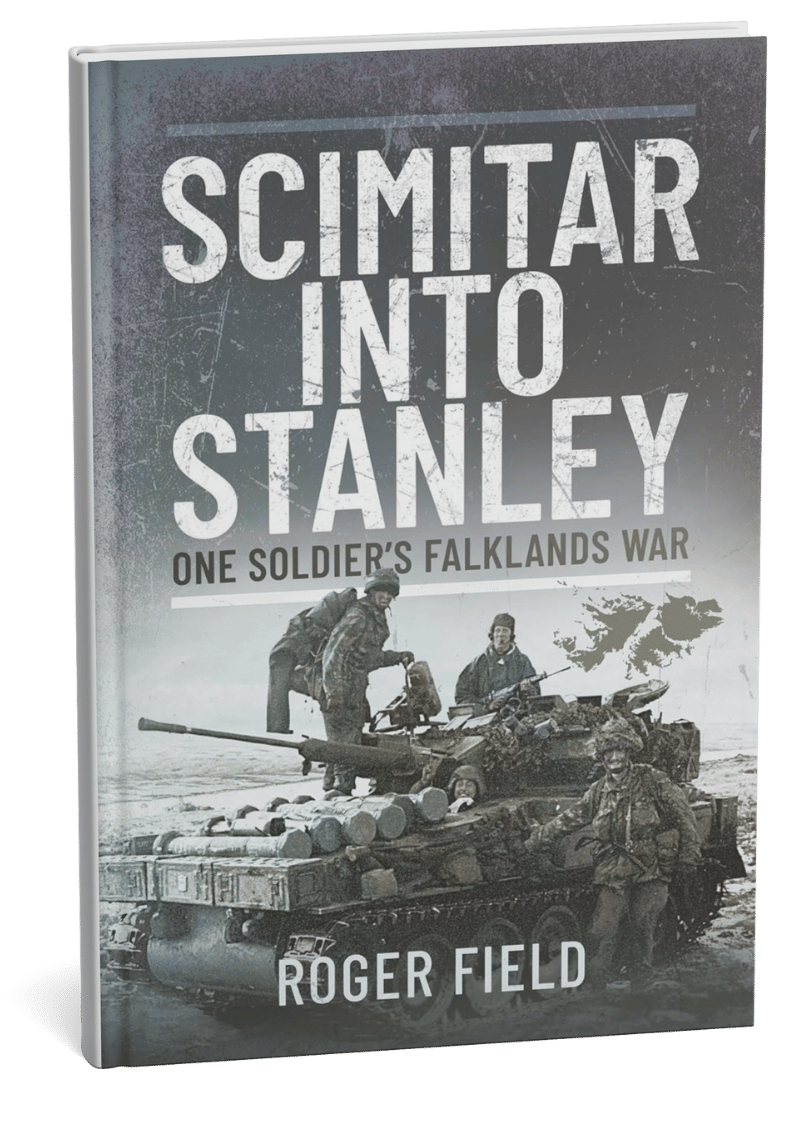
Roger Field’s Scimitar into Stanley (2022) offers a first-hand account of his experiences with the Blues and Royals during the 1982 Falklands War. Initially a staff officer, Field found himself commanding a Scimitar armoured car in battle, famously leading the charge into Port Stanley with journalist Max Hastings clinging to the back of his vehicle. The book is laced with humour, sometimes laugh-out-loud funny, though in today’s climate of political correctness, some may find parts of the text a little too candid. Field doesn’t shy away from naming names or calling out poor leadership, particularly criticising Brigadier Sir Tony Wilson. Yet, he’s equally honest about his own post-war struggles. The result is an open and honest personal account of modern conflict.
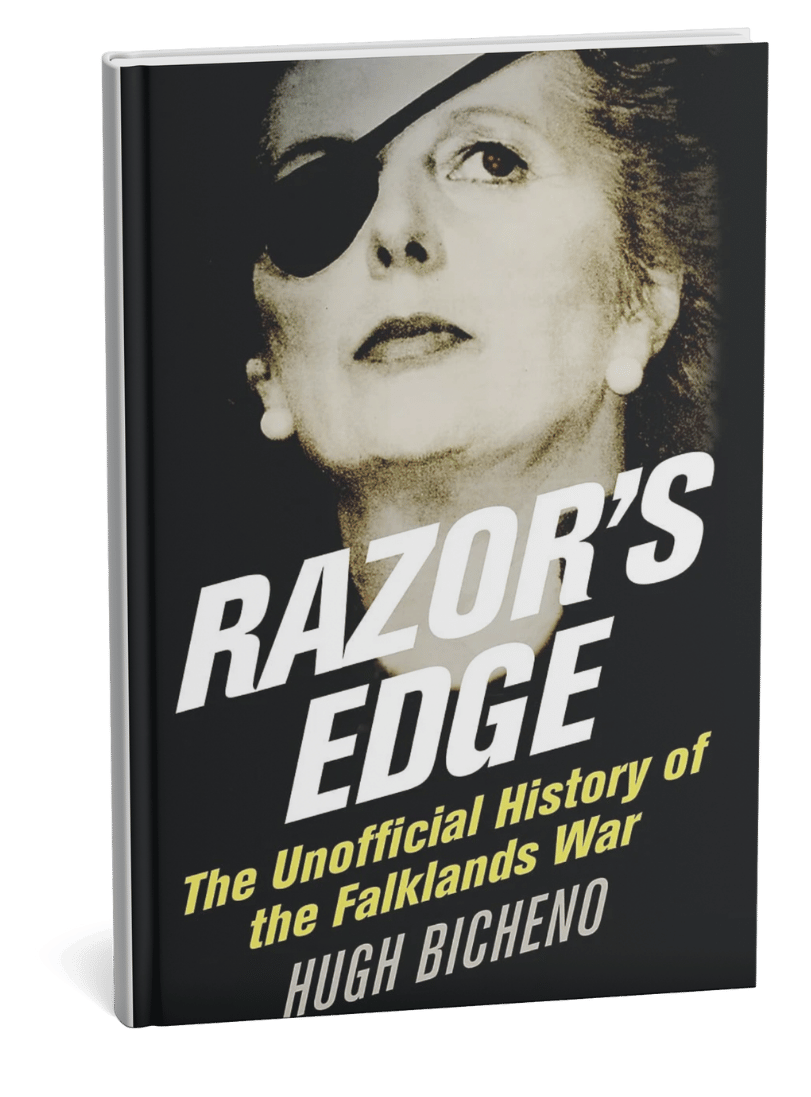
For those seeking a broader view, Hugh Bicheno’s Razor’s Edge (2007) steps back to examine the origins of the conflict. Bicheno, a former British spy in Argentina, foresaw the coming war, but his warnings fell on deaf ears in Whitehall. He spares no one in his critique, lambasting the Foreign Office, Civil Service, and politicians. The book is notable for its inclusion of the Argentine perspective, often overlooked elsewhere, and for its detailed descriptions of the campaign’s battles from both Argentine and Allied viewpoints. Bicheno highlights the role of chance in victory and defeat, and his unsparing criticism is directed at all parties in what he sees as an avoidable conflict. Interestingly, his book is used as a text at Argentina’s war college, a testament, perhaps, to its thoroughness.
If you want the soldier’s view, read Field. For the bigger picture, turn to Bicheno. Both are well worth your time.
Justice Denied: The Welsh Guards and the Sir Galahad Cover-Up
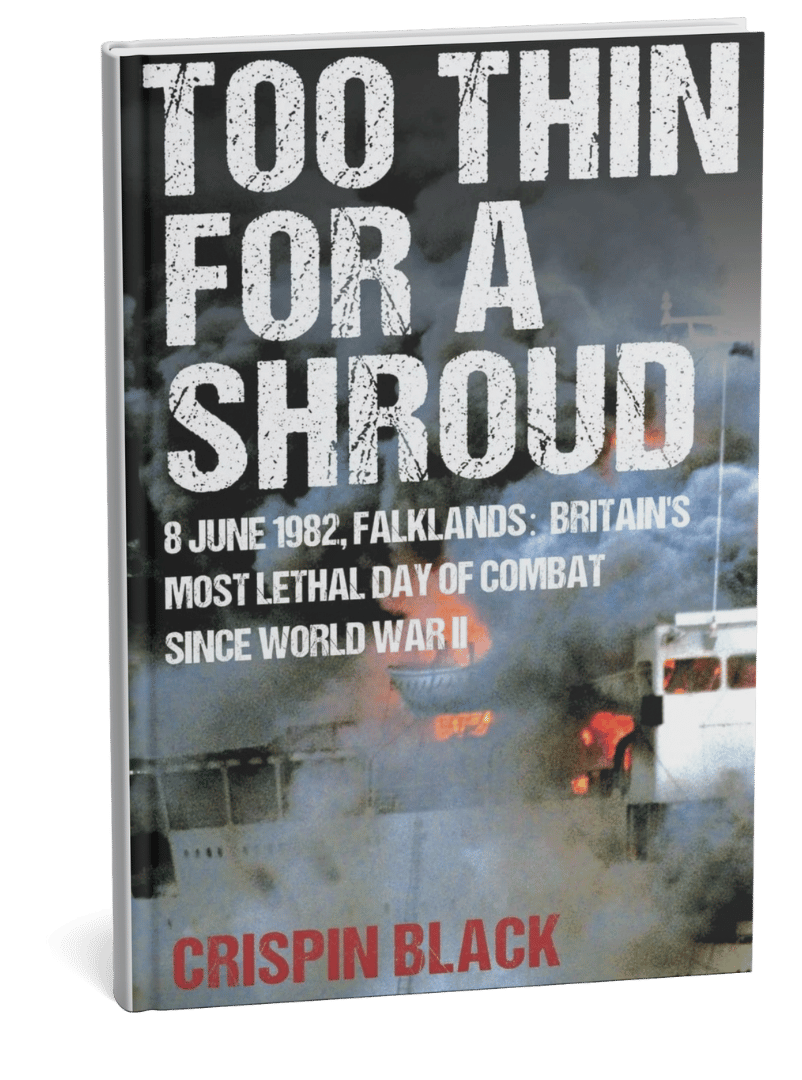
Another recent read, Too Thin for a Shroud by Lieutenant-Colonel Crispin Black (2023), delves into the bombing of the Royal Fleet Auxiliary’s Sir Galahad by the Argentine Air Force on 8 June 1982, the British Army’s deadliest day since 1945.
The Book's Claims
Black documents how 48 men died when Argentine A4 Skyhawks bombed Sir Galahad at Port Pleasant, Fitzroy. The ship was in the wrong location and lacked proper air defence. Packed with Welsh Guardsmen, Sir Galahad sat exposed in broad daylight for over six hours.
Using newly declassified Board of Inquiry documents from The National Archives, Black demonstrates that no direct orders to disembark were given to Major (later Colonel) Guy Sayle and the Welsh Guards. For 40 years, he was wrongly blamed for failing to disembark the troops. The inquiry proves this false. Black argues that senior Royal Navy and Royal Marines commanders made cascading failures: wrong location, defective landing craft, no air defence, and poor communications. The inquiry’s findings were classified until 2065, 83 years after the event.
The declassified files state, “At no time was a direct order to disembark given to Major Sayle by a superior officer.” Colonel Guy Sayle’s daughter has spoken to the media about how her father was made a “scapegoat” for the disaster, and now the Ministry of Defence (MoD) has said it “in no way blames” the Welsh Guards for the losses that day. Colonel Sayle died in 2022. According to Emma Sayle, her father died “haunted and penniless”.
Critical Reception
Unsurprisingly, reviews of Black’s book split sharply along service lines. Welsh Guards veterans and families praised the book as vindication. Royal Navy and Royal Marines personnel frequently criticise it as biased. The conservative Daily Telegraph called it “a repository of damning facts.” The Spectator acknowledged it “shows the Welsh Guards in a new light”, but questioned broader claims. In the court of public opinion, Amazon reviews range from five-star praise for the book's formidable detective work to one-star criticism for an inaccurate rewriting of history.
Senior commanders mounted coordinated rebuttals. RUSI Journal published responses from Major General Julian Thompson, Rear Admiral Jeremy Larken, and other Falklands officers. They challenged Black's interpretations whilst acknowledging errors in the original inquiry. Rear Admiral Larken contacted Black's publisher before reading the book, claiming the Welsh Guards were “unprofessional.” The Mirror reported that Larken claimed the Welsh Guards were an unprofessional and poorly led unit responsible for “pilfering” on his ship. Personally, if true, I think this statement says all we need to know about Larken.
On the flipside, General Sir Michael Rose supported Black's findings, suggesting a “cover-up” on national television.
Political Fallout
The book triggered parliamentary debates. On 25 March 2024, MPs pressed for the release of the documents. Sir Iain Duncan Smith stated: “There is now no question but that some kind of cover-up took place.” Defence Minister Andrew Murrison formally exonerated the Welsh Guards: “The board of inquiry is quite clear...the Welsh Guards were absolutely exonerated.” You can read the full transcript of the House of Commons debate on the Hansard website.
In May 2024, the MoD released 62 pages of previously classified documents. These largely confirmed Black's central claims: no orders were given to the Welsh Guards to disembark, the ship was sent to the wrong location, inadequate landing craft were available to offload the vessel, and no air defence was established.
Luckily for the families of those lost, the wounded and veterans, Black's credentials proved difficult to ignore by the Government, MoD and Navy. After all, he was on board Sir Galahad that fateful day, worked for the Cabinet Office as an intelligence adviser, and received an MBE for his work with the Defence Intelligence Staff during the crisis in the Former Yugoslavia. He is also a frequent contributor to the BBC and major British newspapers on terrorism and intelligence matters.
Crispin Black's book focuses on the bombing of RFA Sir Galahad, the subsequent cover-up, and the release of documents that prove the Welsh Guards were not to blame. He successfully campaigned for the declassification of these documents, which led to the official exoneration of the Welsh Guards after 42 years. While some critics question his interpretation of the events during the Falklands War, they present little counter-evidence. Many fundamental questions remain, and numerous documents will stay classified until 2065. Furthermore, no public inquiry has been announced. Black's work has challenged the previously accepted “official” narrative that unfairly scapegoated the Welsh Guards, turning it into an ongoing controversy.
Unravelling the Myths: The Denison Smock
On a lighter note, my recent purchase of a reproduction 1972-pattern Denison smock led me to a fascinating YouTube video by David Willey, formerly of The Tank Museum: “So you thought you knew about Denison Smocks…” The Denison smock, with its distinctive “brushstroke” camouflage, became iconic among British airborne forces, the SAS, and commandos. Yet, as Willey and Jon Baker (Curator at the Airborne Assault Museum) reveal, much of what we think we know is myth. There’s no evidence the smock was named after Major Denison—indeed, there’s no proof such a person existed. The famous “beaver tail” wasn’t designed to stop the garment riding up during jumps, as is often claimed. Willey’s video is a reminder of how easily repeated stories can become accepted fact.
Market Garden Revisited: Myths and Realities at Arnhem
Turning to Operation Market Garden, I recently watched two videos that challenge established narratives about the battle for Arnhem. The first was Niall Cherry’s Some Arnhem Myths... and a dose of reality! Part 2 on WW2TV, hosted by Paul Woodadge. Cherry, a former Royal Army Medical Corps senior NCO, has written eleven military history books. He is secretary of the Arnhem 1944 Veterans Club, a member of the 23 Parachute Field Ambulance OCA and Secretary of the Arnhem 1944 Fellowship. In the video, Cherry addresses specific myths and misconceptions with documentary evidence. Perhaps one of the most commonly held misconceptions about Market Garden is that because the radio equipment failed, the operation failed. On radios, Cherry explains that the 68 sets had known range limitations in wooded terrain. Tests in North Africa, Sicily, Italy and Normandy confirmed this. Commanders knew the Arnhem operational area exceeded set capabilities. In John Frost’s book, A Drop Too Many, he states that the failure of radio equipment was a perennial problem for Britain’s airborne forces.
Regarding the arming of British medics during the operation, establishment tables indicate that each parachute field ambulance was equipped with 123 pistols, 12 rifles, and 31 Sten guns. Of the 630 medics, only six were conscientious objectors. Photographic evidence confirms that most medics carried sidearms. As for the 21st Independent Parachute Company, the nominal rolls reveal that there were eleven foreign personnel among a total of 886 men, disproving the claim that there was a significant number of German Jews, which has become something of a myth.
In terms of planning failures, Cherry argues the 1st Air Landing Brigade should have seized the bridges at Arnhem. Air landing battalions had 750 men versus 550 in parachute battalions, formed up in seconds rather than forty minutes, and possessed superior firepower with four rifle companies, additional mortars, machine guns and anti-tank weapons. He examines General Browning’s influence on Jim Gavin at Nijmegen, where securing the Groesbeek Heights took priority over the Waal road bridge. Browning subsequently blamed Polish General Stanisław Sosabowski in a damning letter before departing for the Far East. Sosabowski's military career never really recovered from Browning’s unfounded criticisms.
During the WW2TV video, Cherry mentioned a short documentary film produced by Anglia Television on the 25th anniversary of Operation Market Garden in 1969. A quick search of YouTube, I found the programme in question, The Battle of Arnhem, directed by Harry Aldous. The programme is largely a collection of documentary interviews with many of the key protagonists and some local witnesses to events during the fighting for Arnhem and Oosterbeek.
In the documentary, Major General Roy Urquhart explained his 36-hour absence from divisional headquarters. He claimed wireless failures prompted his forward movement on the first afternoon. German opposition then trapped him with Brigadier Lathbury near St Elisabeth's Hospital. Lieutenant Colonel John Frost described reaching the Arnhem bridge intact on Sunday evening with over 500 men. Fewer than 200 remained alive and unwounded when resistance ended on Thursday morning. Brigadier John Hackett recounted arriving on Monday afternoon into active combat. His disagreement with Brigadier Pip Hicks over troop deployment at the Hartenstein reflected command confusion during Urquhart's absence.
Major General Allan Adair, Guards Armoured Division, blamed the terrain for his formation’s slow progress up the central axis of advance. The single-road approach prevented flanking movements, and the marshy Dutch polder land between Nijmegen and Arnhem, an area known as the Island, prohibited armoured manoeuvre.
SS General Wilhelm Bittrich assessed British troops as an “absolute elite” and commented on his troops' respect for their enemies. Housewife and mother, Kate ter Horst, described caring for the many wounded who packed her Oosterbeek home. Casualties filled every room. In the final segment of the programme, General Urquhart read from his 1945 report stating all ranks would willingly undertake similar operations again. Frost believed that most men who served at Arnhem, if asked, would accept another “invitation to the party”.
The Anglia Television documentary is an interesting, if uncritical, oral history filmed before later narratives worked their magic on the public imagination. The inclusion of a German perspective remains unusual for a 1969 British production. Both videos offer valuable source material. Cherry challenges operational assumptions with documented evidence. The Anglia TV program features first-hand accounts from key figures who planned, executed, and fought in the Battle of Arnhem. However, time and concerns about preserving their own reputations likely influenced the accuracy of their memories.
From the windswept South Atlantic to the battlefields of Holland, these books and documentaries reveal the enduring power of personal testimony and the importance of challenging received wisdom. Whether exposing cover-ups, debunking myths, or simply telling it as it was, each work adds a vital thread to the tapestry of military history. In revisiting these stories, we honour the lived experience and also ensure that the lessons, whether bitter or inspiring, are not forgotten.
Amazon Affiliate
This blog contains Amazon affiliate links. If you purchase books through these links, I receive a small commission at no additional cost to you. This helps support the ongoing research and content on The War Years.
References, Justice Denied:
https://www.spectator.co.uk/article/could-the-bombing-of-sir-galahad-have-been-prevented/
https://www.tandfonline.com/doi/full/10.1080/03071847.2024.2444114

Clipped Wings: Red Tape and Command Failures during the Falklands Air War
Commander “Sharkey” Ward commanded 801 Naval Air Squadron aboard HMS Invincible during the Falklands. He served as senior Sea Harrier adviser to the command on tactics and air war direction, flew over 60 CAP (combat air patrol) missions, achieved three air-to-air kills, and participated in or witnessed ten kills. He was decorated with the Distinguished Service Cross for gallantry. In 1992, Pen & Sword published his book, Sea Harrier Over the Falklands.
The book is Ward's dramatic first-hand story of the air war in the South Atlantic. It is also an extraordinarily outspoken account of inter-service rivalries, bureaucratic interference, and dangerous ignorance of the realities of air combat among many senior commanders.


In the spring of 1982, most British people knew Argentina primarily from the hit musical Evita by Andrew Lloyd Webber and Tim Rice. And if British people didn’t know much about Argentina, they knew even less about an obscure group of islands in the South Atlantic Ocean known as the Falklands.
I was sixteen years old in 1982, and just like everyone else, I was surprised to wake up one morning in early April to discover that the British inhabitants of the Falkland Islands had been invaded and occupied by Argentine armed forces. Initially, no one seemed too concerned, and a diplomatic resolution looked the most likely outcome of the crisis. However, things took a dramatic turn when Margaret Thatcher’s government, which had badly misjudged the intentions of Argentina’s military junta and its leader, General Leopoldo Galtieri, announced Britain would immediately dispatch a naval task force to recover the islands.
On 5 April 1982, a hastily organised armada set sail from British waters to steam around 8,000 miles to the South Atlantic. The timing of the crisis proved advantageous for the unpopular Thatcher government, which was busy pulling the fangs of Britain’s armed forces with sweeping defence cuts, which included selling off or decommissioning numerous Royal Navy warships and support vessels. If Galtieri had waited to launch his invasion until the following year, then Prime Minister Thatcher would have been forced into a humiliating surrender of the territory. But Galtieri and the junta had domestic woes of their own and hoped capturing the “Islas Malvinas” would be a suitable distraction for their unhappy compatriots. Argentina’s military planners saw Britain’s defence cuts as a green light for invasion, assuming Thatcher’s government would acquiesce once the Falklands were under Argentine control.
As the task force steamed toward its date with destiny, Britain’s tabloid press had a field day whipping the country into a patriotic frenzy. At the same time, the US Secretary of State, Alexander Haig, flew backwards and forwards between London, Washington and Buenos Aires, attempting to find a peaceful resolution to the crisis. On 21 May 1982, the task force arrived off the Falklands. Haig’s “shuttle diplomacy” had failed, and the shooting started. Every lunchtime, a couple of school friends and I would walk to my sister’s flat to watch the one o’clock news. We would sit and listen in silence to the slow, deliberate, monotone voice of Ian McDonald, the official Ministry of Defence spokesman, who would deliver good and bad news in the same deadpan tone. Once the fighting started, the tabloid press printed dramatic, sometimes shocking photographs, such as HMS Antelope exploding in San Carlos Bay.

HMS Antelope explodes after being the subject of repeated air attacks in ‘bomb alley’ in San Carlos Water, the Falkland Islands. Photograph courtesy of Royal Navy News www.royalnavy.mod.uk/news/
At the time, my sister was married to a member of the 1st Battalion, Scots Guards. The 1st Battalion was not part of the task force, but the 2nd Battalion was sent south. On the night of 13–14 June, the Guards launched an offensive against the strategically important Mount Tumbledown and the surrounding high ground. The Guards forced the Argentine troops off the mountain and back into the Falkland’s Capital of Port Stanley. The 2nd Battalion, Scots Guards, suffered eight dead and 43 wounded. The Guards took 30 prisoners while the bodies of 30 Argentine soldiers and marines were later recovered from the battlefield. For us, every television, radio and newspaper report carried weight and meaning.
As events unfolded, we initially focused on the naval actions and then the land battles to recapture the islands. My memories of the air war over the Falklands are vague. I do not recall being aware that our carrier-based Sea Harriers were outnumbered around ten to one. Only now, 43 years after the Argentine surrender, have I learned a little about what the courageous pilots of the Fleet Air Arm contributed to the safety of the task force and ultimate victory in the Falklands War.
Commander “Sharkey” Ward commanded 801 Naval Air Squadron aboard HMS Invincible during the Falklands. He served as senior Sea Harrier adviser to the command on tactics and air war direction, flew over 60 CAP (combat air patrol) missions, achieved three air-to-air kills, and participated in or witnessed ten kills. He was decorated with the Distinguished Service Cross for gallantry. In 1992, Pen & Sword published his book, Sea Harrier Over the Falklands.
The book is Ward's dramatic first-hand story of the air war in the South Atlantic. It is also an extraordinarily outspoken account of inter-service rivalries, bureaucratic interference, and dangerous ignorance of the realities of air combat among many senior commanders. Ward reveals how the pilots of the 801 Squadron found themselves fighting more than the enemy, experiencing exhaustion, atrocious weather, and prejudice and ignorance on their own side.
Prewar development of the Harrier as a carrier-borne fighter receives detailed examination under Ward's supervision and guidance. The Sea Harrier (SHAR) was a single-seat, subsonic VSTOL (vertical and/or short take-off and landing) fighter, reconnaissance, and strike aircraft. It was armed with Sidewinder air-to-air missiles and 30mm Aden cannon and could also be fitted with bombs, rockets, and Lepus flares.
Particularly noteworthy are the extensive details about the Sea Harriers' capabilities, especially the advanced Ferranti Blue Fox radar system, which Ward insisted his pilots master, while other squadrons underutilised and mistrusted it.
During Operation Corporate, the codename for the British military operation to reclaim the Falkland Islands, the Harriers undertook multiple critical tasks. The SHAR provided continuous CAP protection for the task force. Ward also offers detailed accounts of the numerous challenges in flying and fighting the Harrier from an aircraft carrier.
Central to Ward's argument is the contention that had he followed all his instructions to the letter, Britain might well have lost the Falklands War. The book is highly critical of various aspects of the British command structure, especially the Flag Officer, the admiral in operational control of the fleet aboard HMS Hermes, Rear Admiral (later Admiral) Sir John "Sandy" Woodward.
Especially scathing criticism targets the RAF, senior naval commanders, and even pilots from the other Sea Harrier squadron (800 Squadron on HMS Hermes). He is particularly scornful of the RAF's Operation Black Buck. These missions saw the RAF deploy ageing Vulcan bombers, which involved in-flight refuelling by Victor tankers, aimed at disrupting Argentine air operations by targeting the runway at Port Stanley. According to Ward's calculations, the Vulcan attacks on Port Stanley airfield consumed hundreds of thousands of gallons of expensive aviation fuel at the taxpayers' expense so that the RAF could drop a handful of bombs, which caused minimal damage.
Most damning of all, Ward contends that the RAF launched three V-bomber missions, which achieved next to nothing and consumed 400,000 gallons of fuel. That fuel could have supported 785 bombing sorties from the Carrier Group and would have delivered 2,357 bombs. Apparently, during one of the RAF's missions, 20 of the bombs dropped on Port Stanley air strip failed to explode because someone forgot to arm them. A Vulcan mission was scrubbed on another occasion due to a cabin depressurisation problem. When the aircraft in question returned to Ascension Island, it was found that the cause of the 'pressurisation failure' had been that one of the cockpit windows had been left open.
The military effectiveness of Black Buck remains a matter of controversy. The Vulcan raids caused minimal damage to the runway, and the damage to the radars was quickly repaired. Nevertheless, many historians contend that the raids demonstrated Britain’s ability to attack the Argentine mainland. For this reason, squadrons of Mirage fighters were redeployed from the south to defend airfields and headquarters in northern Argentina.
Ward’s book addresses the question of what 20 Sea Harriers, operating from a flight deck in the South Atlantic, could do against more than 200 Argentine military aircraft flown by skilled and courageous pilots. Ward’s account provides insights into how this seemingly impossible victory was achieved.
The book is somewhat of a technical manual on Sea Harrier operations, which may not appeal to all readers. It is also a controversial insider’s critique of British military command during one of modern naval warfare's most significant air campaigns. Regrettably, Ward’s descriptions of inter-service rivalries, leadership failures, MoD interference, penny-pinching on defence and the shameful waste of taxpayers’ money have become the all-too-familiar hallmarks of successive British governments.
The Falklands War lasted 74 days. On 14 June 1982, Argentine forces surrendered. Argentina’s military gamble cost the lives of 649 military personnel. The recovery of the Falklands led to the deaths of 255 British military personnel and three islanders.
General Galtieri, who led Argentina into the Falklands War, was removed from power after the defeat. Margaret Thatcher’s popularity surged after the conflict, leading to her victory in the 1983 general election. Before the Falklands, Thatcher’s leadership of the Tory party was tenuous at best, and the Conservatives looked sure to lose the election. According to the Declassified UK website: “Just four days before Argentina’s invasion of the Falklands in April 1982, the British government was trying to sell the regime bomber airplanes.”